.jpeg)
Choosing between CMT and full package production is one of the first decisions any fashion brand faces when looking for a manufacturer. In the CMT (Cut, Make, Trim) model, the brand supplies fabrics and trims, and the factory only cuts, sews, and finishes. In full package production, the factory handles everything, from sourcing the fabric to delivering the finished garment. According to AESTEXPORT (2023), more than 60% of Portuguese textile exports follow the CMT or equivalent regime.
The difference affects cost per unit, quality control, and operational complexity. Whether you're launching a clothing brand or scaling production, this guide helps you decide with concrete data.
Key Takeaways - CMT requires the brand to supply fabric and trims; full package delegates everything to the factory. - CMT MOQs in Portugal start at 100-500 pieces; full package can require 200-1,000 pieces. - Over 70% of independent brands choose full package for their first collection (ATP, 2024). - A hybrid model (brand sources fabric, factory handles trims) is growing among Portuguese manufacturers.
Textile factory in northern Portugal set up for both CMT and full package production.
What Is CMT (Cut, Make, Trim)?
More than 60% of Portuguese textile exports are processed under the CMT or equivalent regime, according to the Selective Garment Association (AESTEXPORT, 2023). In the CMT model, the brand takes responsibility for sourcing fabrics and trims. The factory receives the materials and performs three operations: cutting, sewing, and finishing.
It's a proven model. It's been working for decades in Portugal's textile industry.
Citation Capsule: According to AESTEXPORT (2023), more than 60% of Portuguese textile exports are processed under the CMT or equivalent regime, making this the dominant model among northern Portuguese manufacturers working with European brands.
How Does It Work in Practice?
The brand selects the fabric from its own supplier, orders the required yardage, and has it delivered directly to the factory. Buttons, zippers, labels, and ribbons are also the brand's responsibility. The factory receives everything, cuts according to the approved patterns, and sews the garments.
Sounds simple? In theory, it is. In practice, it requires coordination.
In conversations with manufacturers in the Ave Valley, we've found that many prefer CMT for smaller orders because it eliminates the risk of fabric stock on the factory's side. This translates into less resistance to starting production for brands with established fabric supplier relationships.
Who Typically Uses the CMT Model?
CMT is chosen by brands that already have trusted fabric suppliers. Also by those who want to control the origin and certification of materials, such as GOTS or OEKO-TEX fabrics. And by brands in a scaling phase that want to reduce cost per unit by eliminating the factory's margin on materials.
Typical MOQs in Portugal for CMT range between 100 and 500 pieces per style, depending on technical complexity.
Advantages of CMT
- Full control over fabric origin and quality.
- More transparent manufacturing cost, with no factory margin on materials.
- Ability to use certified fabrics to meet sustainability requirements.
- Flexibility to change fabrics between seasons without renegotiating with the factory.
Disadvantages of CMT
- Requires sourcing infrastructure: time, knowledge, and logistics capability.
- The brand assumes the risk of yardage errors or fabric delivery delays.
- More touchpoints to manage, which increases operational complexity.
 Fabric warehouse: in the CMT model, the brand is responsible for selecting and delivering fabric to the factory.
What Is Full Package Production?
The full package model has been growing among Portuguese manufacturers working with smaller international brands. The Portuguese Textile and Clothing Association (ATP, 2024) estimates that around 35% of national manufacturers now offer full package services, compared with 20% a decade ago. In full package production, the factory takes on the entire chain.
But does simplifying always pay off?
Citation Capsule: Around 35% of Portuguese textile manufacturers currently offer full package production services, a significant increase from 20% ten years ago, according to the ATP (2024), reflecting growing demand from international brands.
How Does It Work in Practice?
The brand sends the tech pack, approves samples, and the factory handles everything else. This includes selecting and negotiating with fabric suppliers, purchasing trims, and coordinating the production calendar. The result delivered to the brand is the finished garment, ready to sell.
In the enquiries we've analysed, we've observed that most first-collection brands arrive without a defined fabric supplier. For these brands, full package production is almost always the most realistic path. It avoids the logistical bottleneck of having to source fabric before even confirming the factory.
Who Typically Uses Full Package Production?
Fashion startups, first-collection brands, and brands without an internal sourcing team. It's also common for established brands launching new categories outside their area of expertise. MOQs tend to be higher, frequently between 200 and 1,000 pieces per style, because the factory needs to cover the risk of fabric stock.
See our guide on clothing production costs in Portugal to understand how the model affects your budget.
Advantages of Full Package Production
- A single point of contact for the entire production.
- Ideal for brands without sourcing infrastructure or experience.
- Reduces time and management effort for the brand.
- The factory negotiates fabrics with accumulated volume, which can generate good prices.
Disadvantages of Full Package Production
- The brand has less control over fabric quality and origin.
- Cost per unit includes the factory's margin on materials.
- It can be harder to guarantee specific fabric certifications.
- MOQs are generally higher, representing a greater initial investment.
How Do CMT and Full Package Compare in Practice?
According to data compiled by ANIVEC (2024), average MOQs in CMT are 40-60% lower than in full package production for the same garment type, making CMT more accessible in volume but more demanding in management. The table below summarises the key differences between the two models.
Citation Capsule: Average MOQs in CMT are 40-60% lower than in full package production for the same garment type in Portugal, according to ANIVEC (2024), although CMT transfers all fabric sourcing responsibility to the brand.
| Criterion | CMT | Full Package |
|---|---|---|
| Who sources the fabric | The brand | The factory |
| Fabric quality control | Full (by the brand) | Partial (dependent on factory) |
| Manufacturing cost per unit | Generally lower | Generally higher (includes margin on materials) |
| Typical MOQ in Portugal | 100-500 pieces per style | 200-1,000 pieces per style |
| Operational complexity | High (more touchpoints) | Low (single point of contact) |
| Ideal for | Brands with established sourcing | Startups, first collections |
| Main risk | Yardage errors or fabric delays | Less control over materials |
| Production lead times | Depend on fabric delivery by the brand | Factory manages internally |
| Suitable for certified fabrics | Yes, easily | Depends on the factory's suppliers |
Learn more about textile production lead times and how they vary between the two models.
What Does This Table Mean in Practice?
There is no universally better model. The right choice depends on where the brand stands right now: sourcing maturity, available budget, and the level of control desired over materials.
Many brands start with full package and migrate to CMT as they grow. It's a natural progression, not a planning failure.
When Should You Choose CMT in Portugal?
Data from ANIVEC (2024) indicates that brands with efficient sourcing save between 10% and 20% on total cost per unit using CMT, compared with full package production. The model makes more sense when the brand already has the capacity to manage fabric procurement independently.
Citation Capsule: Brands with efficient sourcing save between 10% and 20% on total cost per unit using CMT instead of full package production, according to ANIVEC (2024), by eliminating the manufacturer's margin on materials.
The Brand Already Has Established Fabric Suppliers
If the brand already works with a fabric agent or has direct access to suppliers in Portugal, Italy, or other markets, CMT is the natural choice. The factory receives the fabric and focuses on what it does best: cutting, sewing, and finishing.
Already have sourcing relationships? Then why would you pay the factory to do what you already do well?
The Brand Wants to Control Material Origin and Certification
Sustainability is now a growing requirement, from both consumers and European regulators. The ESPR regulation will reinforce this trend. If the brand wants to guarantee GOTS-certified organic cotton, GRS recycled fibres, or fabrics with proven traceability, CMT offers full control over that chain.
We've observed that sustainable fashion brands, especially those selling in northern European markets, arrive at factory sourcing with their fabrics already defined and certified. For these brands, full package production would be problematic. Manufacturers rarely have access to the same certified material suppliers.
The Brand Is Scaling and Wants to Reduce Cost per Unit
As volumes grow, negotiating directly with fabric suppliers becomes a real competitive advantage. For orders above 500-1,000 metres per fabric, the brand can frequently obtain better prices than the factory could.
The result? Lower total cost, even factoring in management costs. See our production cost comparison for detailed data.
When Should You Choose Full Package Production?
More than 70% of independent fashion brands opted for full package production on their first collection, according to the ATP (ATP, 2024). Full package production is the most pragmatic choice for brands that are just starting out or that lack sourcing infrastructure.
Citation Capsule: More than 70% of independent fashion brands opted for full package production on their first collection, according to the ATP (2024), simplifying market entry by delegating sourcing and logistics to the factory.
First Collection or Startup
When a brand produces for the first time, there are many unknowns. Managing fabric sourcing simultaneously with product development, factory search, financing, and launch is too much for a small team. Full package concentrates responsibility with the factory.
Need additional guidance? Our guide on how to launch a clothing brand covers this topic in detail.
The Brand Lacks Time or Expertise to Source Fabric
Sourcing fabric well requires knowledge of markets, the ability to evaluate quality, and time to visit suppliers or order samples. If the brand doesn't have those capabilities, delegating to the factory is a rational decision.
Yes, cost per unit will be slightly higher. But the time saved has value.
You Need a Single Point of Contact
For brands managing production remotely, or whose founders have other responsibilities, the operational simplicity of full package has real value. One contact person means fewer communication breakdowns and less time spent coordinating.
Want to know how to negotiate with manufacturers in Portugal? Start by defining the production model before the first conversation.
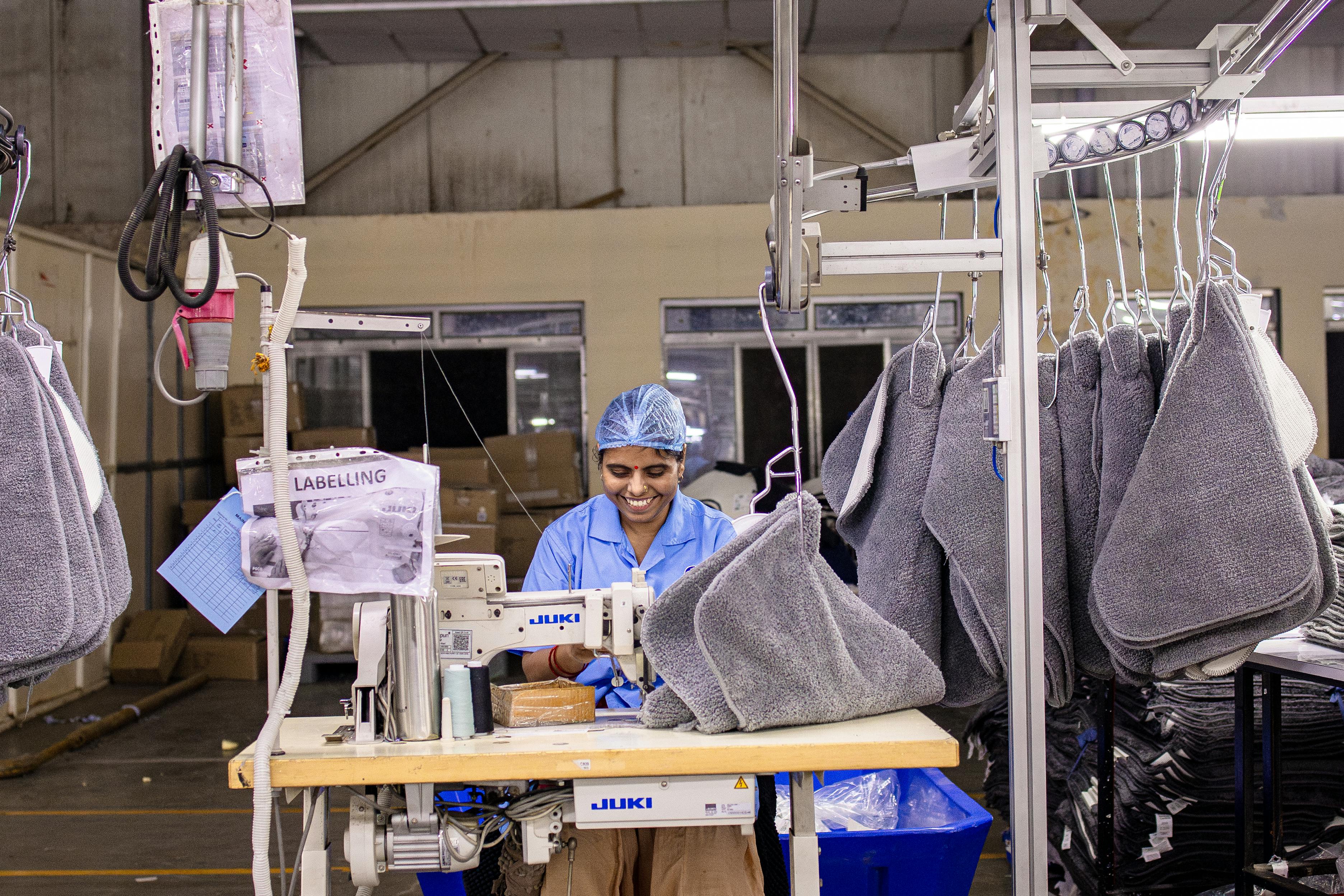 In full package production, the factory manages the entire process, from fabric procurement to the finished garment.
Is There a Hybrid Model?
Yes, and it's becoming more common. According to manufacturers contacted in Minho and the Ave Valley, around 25% now formally offer a semi-package model where the brand sources the main fabric and the factory handles the trims (ANIVEC, 2024). This approach offers a balance between control and convenience.
Citation Capsule: Around 25% of manufacturers in northern Portugal now formally offer a semi-package model, where the brand supplies the main fabric and the factory handles the trims, according to ANIVEC data (2024).
How Does the Semi-Package Model Work?
The brand maintains control over the most critical element: the fabric. The factory, in turn, uses its regular trim suppliers, with whom it already has relationships and negotiated volumes. The result is a more balanced partnership.
Some manufacturers describe this model as their preferred way of working with growing brands. The brand learns to manage fabric sourcing gradually, without having to master the entire trims universe immediately.
It's Worth Asking the Manufacturer
Not all manufacturers openly advertise the hybrid model. But many are open to the conversation. When contacting Portuguese manufacturers, ask directly: "Do you work with a model where I supply the fabric and you handle the trims?"
The answer may surprise you. And if you're evaluating manufacturers, see our guide on red flags to watch for and on small quantity production.
Frequently Asked Questions (FAQ)
Is CMT Always Cheaper Than Full Package?
Not necessarily. CMT has a lower manufacturing cost per unit, but the brand assumes sourcing, logistics, and supplier management costs. According to ANIVEC (2024), total cost in CMT can be 10-20% lower for brands with efficient sourcing. Without that efficiency, the saving disappears.
Read more: detailed production costs
Can I Switch from CMT to Full Package with the Same Manufacturer?
Yes. Many brands take the reverse journey: they start with full package and migrate to CMT as they build sourcing capability. Most Portuguese manufacturers accept both models. We recommend discussing this possibility during the initial negotiation phase.
Do Portuguese Manufacturers Prefer CMT or Full Package?
It depends on the factory's profile. Smaller factories, with less capital for fabric stock, tend to prefer CMT. Larger factories frequently prefer full package. According to AESTEXPORT (2023), most work with both models, adapting to the client's profile.
What Does FOB Mean in Clothing Production?
FOB (Free On Board) is an Incoterm that defines the point at which the factory's responsibility for the goods ends. In an FOB contract, the factory delivers at the port of origin and responsibility passes to the brand. In full package production, the FOB price includes materials and manufacturing. In CMT, it reflects manufacturing only.
How Does the Digital Product Passport Affect the Choice Between CMT and Full Package?
European regulation will require full material traceability. In CMT, the brand directly controls the supply chain and can document every step. In full package, it depends on the manufacturer's transparency. According to the European Commission, the DPP will be mandatory for textiles from 2027.
Conclusion: Which Model Should You Choose?
The decision between CMT and full package production isn't final or irreversible. It's a strategic decision that should reflect where the brand is now, not where it wants to be in five years.
The rule of thumb is simple. If you don't yet have a fabric supplier you work with regularly, start with full package. If you already have that relationship and want more control and margin, explore CMT. And if you're somewhere in between, ask the manufacturer whether they offer a hybrid model.
Portugal has a mature textile industry, with factories experienced in both models. The question isn't which model the country supports, but which model your brand can support operationally right now.
Learn more about sustainable textile sourcing and see how Portugal compares with Bangladesh and Vietnam in terms of cost and quality.
Want to request a production quote (CMT or full package) in Portugal? Describe your project and receive contacts from qualified manufacturers at portugalclothingfactory.com/contact.
Sources
- AESTEXPORT, Selective Garment Association (2023). Data on Portuguese textile exports. https://www.aestexport.pt
- ANIVEC, National Association of Clothing and Garment Industries (2024). Clothing sector report. https://www.anivec.com
- ATP, Portuguese Textile and Clothing Association (2024). Data on manufacturers and production models. https://atp.pt
- European Commission (2024). Digital Product Passport for textiles. https://commission.europa.eu
