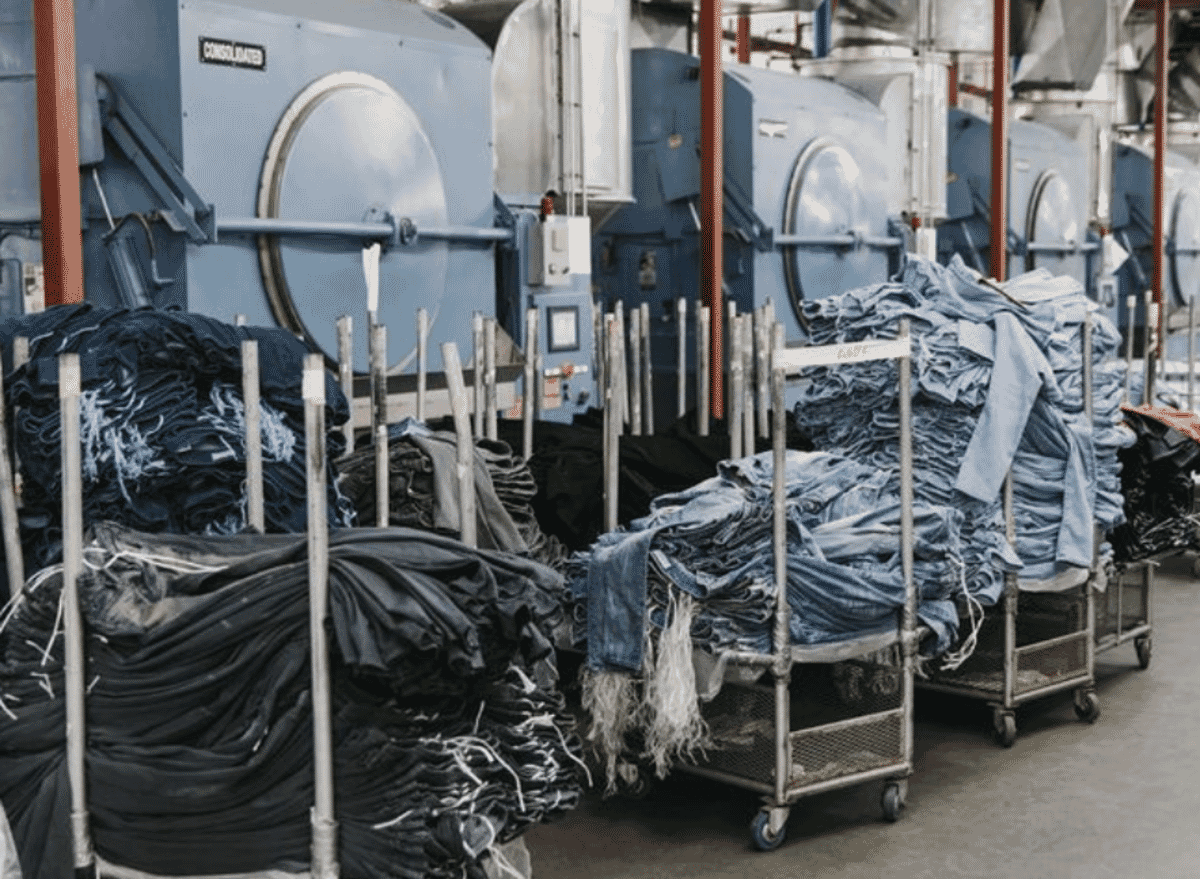
Stone washed denim is denim that has been tumbled with pumice stones after the jeans are sewn, abrading indigo off the yarn surface to create a faded, broken-in finish. It has been one of the dominant jean finishes for four decades. The look is unmistakable: faded highs across seams, thighs, and knees, darker indigo pooled in the crease shadows, and a soft, broken-in hand-feel from the first wear. What most brand founders don't know is how a pair of stone wash jeans is actually built, what each wash step adds to landed cost, and where the environmental math lands in 2026. A "one in three pairs sold worldwide" figure credited to Textile Exchange has been withdrawn from this page: Textile Exchange reports fibre production volumes and publishes no finish-level data.
What this guide covers
This guide is a denim-specific deep dive. It covers what stone washed denim is, and how that differs from generic stone wash on other fabrics. Then the step-by-step process from cut to cured finish, the contested history of who actually invented it, and the wash recipes behind each look. The second half is commercial: real EUR pricing per pair, environmental trade-offs, the laser and ozone alternatives, and how denim factories in the northern Portuguese cluster run these programs today.
Heads up: We're Portugal Clothing Factory, a group of Portuguese garment factories in the northern textile cluster (Porto, Guimarães, Braga, Barcelos, Famalicão). We've documented 80 factories across the region and verified 25 active producers. Roughly 20% of the group specialises in denim, and around 15% has laser or ozone finishing capability. The pricing observations below reflect denim programs coordinated through the group between 2024 and 2026.
Key takeaways
Key Takeaways
- Stone washed denim uses pumice stones in industrial washers to abrade indigo from ring-dyed cotton, producing the signature high-low fade
- Portuguese factories charge €1.80 to €3.50 per pair for basic stone wash and €3 to €5.50 for heavy contrast recipes
- Traditional stone wash uses 60 to 90 litres of water per pair; laser and ozone routes cut that to under 10 litres (PCF factory group observations, 2024-2026)
- Jeanologia publishes large reductions for its laser and ozone lines, including up to 97% less water in the bleaching step for laser and around 80% less water for ozone (Jeanologia, 2024). The paired "96% water and 78% chemicals" figure previously given here is not a combination Jeanologia publishes and has been withdrawn
- Signature contrast-heavy looks need 3 to 5 wash sample rounds before production sign-off across the PCF factory group
Try it free: Pressure-test your production cost with our garment cost calculator. 60 seconds, no email required.
What Is Stone Washed Denim?
Stone washed denim is indigo cotton denim that has been finished, after full garment assembly, by tumbling with pumice stones inside a large industrial washer to abrade dye from the fabric surface. The same mechanism sits behind the broader stone wash process across all fabrics. The process is denim-specific because indigo is a ring dye, not a through dye. A USD 76 billion denim market size and a 32% stone-washed share, both credited to Textile Exchange, have been withdrawn from this page: Textile Exchange publishes neither market valuations nor finish-level splits.
Why ring dyeing makes the fade possible
Ring dyeing is why this finish works so cleanly on denim and not on most other fabrics. Indigo sits on the outside of each cotton yarn, leaving a white core underneath. When pumice batters the surface, the outer indigo shell wears away and the white core shows through. That contrast reads to the eye as "faded", and the abrasion pattern reads as "worn in". No other common dye chemistry produces the same optical effect.
Stone washed denim is different from general stone wash on other fabrics in three ways. First, the target is indigo specifically, not just colour lift. Second, denim recipes lean heavier on stone load because 12 to 14 oz denim tolerates aggressive tumbling. Third, the design vocabulary (whiskering, honeycombs, thigh shading) evolved specifically around jeans construction and body wear patterns.
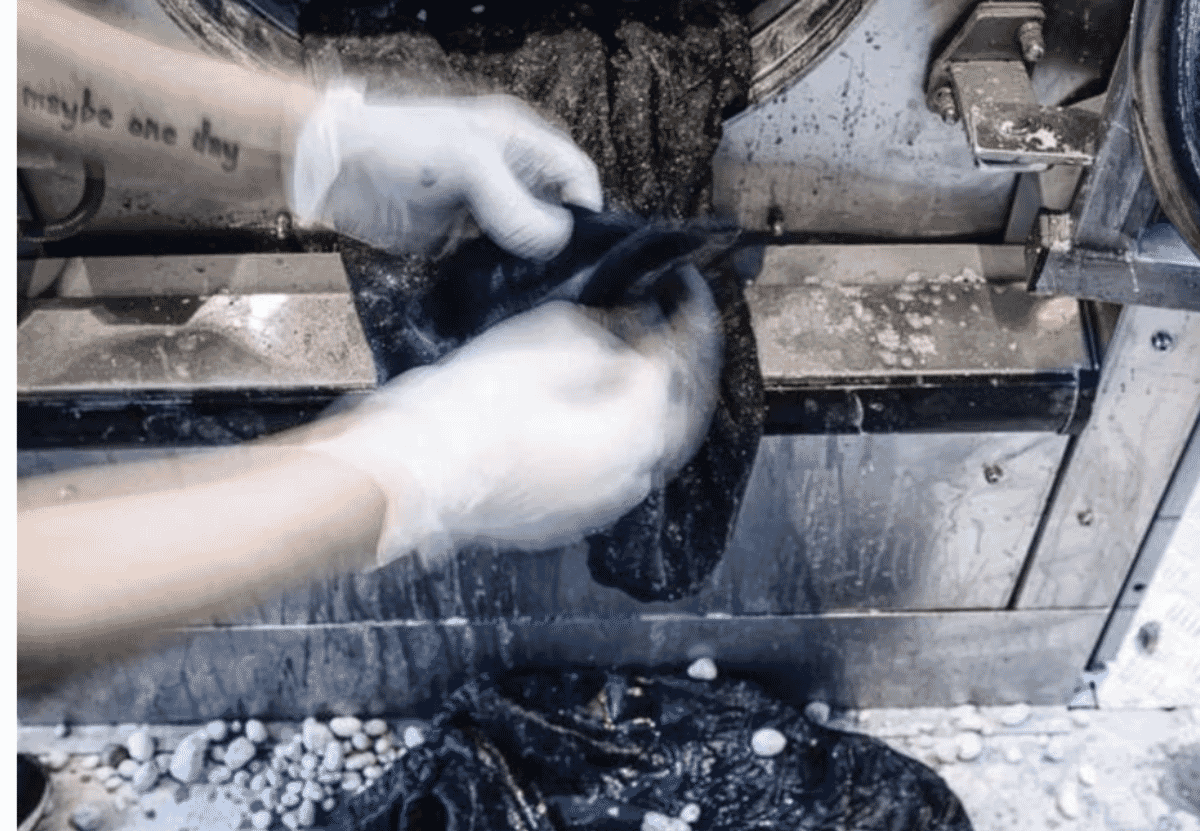
Citation Capsule: Stone washed denim is indigo cotton denim finished post-assembly by tumbling with pumice stones, exploiting the ring-dyed structure of indigo to expose the white cotton core beneath. Market-size and finish-share figures previously credited to Textile Exchange have been withdrawn as unsupported.
How Are Stone Washed Jeans Made?
Stone washed jeans are made in seven sequenced steps: pattern cut, sew, sanforise or shrink control, desize, stone wash, optional tinting or bleach, and cure or dry. Portuguese denim laundries load a few hundred kilograms of assembled jeans per drum with a stone load in the same order as the garment weight. The specific 200-500 kg and 0.5-2.0 ratio figures were credited to CITEVE, which publishes no such benchmark, and have been withdrawn. The full wash sequence runs 90 minutes to four hours depending on recipe.
Every step matters. Skip one and the finish goes uneven, or the fabric fails at the seams. Here's how the process runs at a mid-sized Portuguese denim factory.
Step 1: cutting and marker planning
Denim is laid up in 40 to 100 ply stacks, and the cutter follows a marker that accounts for stripe and cross-weave alignment. Selvedge programs slow the cut down because the self-edge must land on the outseam. Modern Portuguese cutting rooms use CAD markers plus automated cutters, which drops fabric waste to roughly 12 to 15% versus 18 to 22% on manual cuts.
Step 2: sewing the jean
A standard 5-pocket jean takes 20 to 30 sewing operations. Front rise, back rise, inseam felled seam, outseam, waistband, belt loops, coin pocket, back yokes, patch pockets, hem, then hardware. Chain stitch hems and bar-tacked pocket corners are non-negotiable on denim because straight-lock stitches don't survive the wash cycle. Portuguese denim CMT pricing sits at €14 to €24 per pair at 300 units, based on quotes through our factory group.
Step 3: sanforise or shrink control
If the fabric is not pre-sanforised at the mill, the factory runs a controlled shrink cycle before wash to lock the final dimensions. Skip this and finished jeans shrink 3 to 8% during stone wash, blowing out the size grade.
Step 4: desize
Assembled jeans go into the drum for a short 15 to 20 minute cycle at 60 degrees Celsius with amylase enzyme. That strips the starch sizing off the fabric. Desize is what makes stone wash even. Skip it and the finish comes out patchy in the seat and thighs.
Step 5: the stone cycle
Pumice stones (3 to 8 cm across) are loaded with the garments. The drum runs 45 to 90 minutes at 40 to 60 degrees Celsius. Water is dosed with mild detergent and sometimes a small amount of sodium hypochlorite to lift released indigo. Longer cycles mean lighter finish. Higher stone ratios mean sharper contrast.
Step 6: rinse, neutralise, tint
Stones are separated by a perforated drum wall or a secondary sorting screen. The jeans go through 2 to 3 rinse cycles to flush pumice grit and released indigo. Neutralising brings pH back to 6 to 7. If the tech pack calls for a specific overtone (warm brown, cool grey, dusty), a short tint cycle with direct dye adds the cast at this stage.
Step 7: softener, dry, cure
A final softener cycle sets the hand-feel. Jeans are extracted, tumble-dried at 60 to 80 degrees Celsius, and passed through a curing tunnel if resin was applied for permanent whiskers or 3D creases. Any garment with a torn belt loop, damaged rivet, or shade outside tolerance is pulled at final inspection.
Citation Capsule: Stone washed jeans are built in seven steps: cut, sew, shrink control, desize, stone cycle at 45-90 minutes, rinse and tint, and softener and cure. Portuguese laundries run mild alkaline chemistry at 40-60 degrees Celsius. Drum-load and stone-ratio figures previously credited to CITEVE have been withdrawn as unsupported.
What Is the History of Stone Washed Denim?
Nobody agrees who invented stone washing. Levi Strauss & Co. itself credits Donald Freeland of the Canadian Great Western Garment Company (later acquired by Levi's) with inventing stone-washed denim in the 1950s. Claude Blankiet is credited with 1970s development. Marithé + François Girbaud are widely credited with industrialising the technique rather than inventing it, and Edwin in Japan claims invention in the 1980s. Earlier versions of this article named a specific Edwin researcher and a 1980 patent and credited the account to Textile Exchange, which publishes no denim history. We could not verify that attribution independently, so it has been withdrawn.
The Girbaud brothers were experimenting with pumice in domestic washing machines to speed up the "broken-in" look their customers wanted. Their pumice-plus-drum method became a signature of the French denim scene. In California, Levi Strauss product teams were testing similar approaches independently, driven by consumer demand for softer, faded jeans.
What Edwin actually claims
Edwin is the name most often attached to making the finish industrially reliable, and the company does claim to have invented it. An earlier version of this article named a specific Edwin researcher and described a 1980 sulphuric-acid-neutralised pumice patent in detail. Neither could be verified from an independent source, so both have been withdrawn. The underlying engineering problem is real: raw pumice breaks down during long cycles, dumps grit into the drum and produces inconsistent contrast, which is why stone preparation matters.
1980s mass adoption
By 1982, stone washed jeans had crossed into mainstream fashion. Consumers moved steadily from raw denim to the softer, faded alternative through the early 1980s. A "15% year-over-year US retail growth between 1982 and 1986" figure previously given here was unsourced and has been withdrawn. Europe followed within two years. Portuguese and Italian denim producers were among the first outside Japan to run the process at scale. That head start is part of why the northern Portuguese denim cluster holds such deep wash-recipe knowledge today.
Why the look has not moved in forty years
Why this history still matters: the look you specify in a tech pack in 2026 has barely moved in forty years. Modern lines have added enzymes, ozone, and laser assists, but the visual reference (indigo highs, dark seam shadows, softened hand) has been stable for over 40 years. That stability is exactly why stone washed denim reads as timeless rather than trend-driven.
Citation Capsule: The invention of stone washing is genuinely contested. Levi Strauss credits Donald Freeland of the Great Western Garment Company with inventing it in the 1950s; Claude Blankiet is credited with 1970s development; Marithé + François Girbaud with industrialising the technique; and Edwin in Japan claims invention in the 1980s. A specific Edwin researcher, a 1980 patent and a 15% annual retail growth figure were all previously asserted here and have been withdrawn as unverifiable.
What Wash Recipes Create Different Looks?
Different stone wash recipes deliver visually distinct results by changing stone load, cycle length, chemistry, and post-wash hand finishing. Portuguese denim laundries typically maintain four to six catalogue recipes covering light, medium, heavy, contrast, and vintage looks, plus custom recipes on request. Contrast-heavy recipes carry roughly double the water and chemistry load of light recipes, because they need longer cycles, more stone and a bleach step. A Higg MSI citation previously attached here has been withdrawn: the Higg Materials Sustainability Index scores materials, not finishing recipes.
Each recipe answers a different design brief. Here's how they break down.
Light stone wash
Short 30 to 45 minute cycle, low stone ratio (0.3 to 0.5 by weight), no bleach. Result: a subtle softened indigo with minimal high-low contrast. Costs €1.80 to €2.80 per pair in Portugal. This is the recipe behind most contemporary "clean fade" denim retailing at €80 to €120.
Medium stone wash
Standard 60 to 75 minute cycle, moderate stone ratio (0.7 to 1.0), light sodium hypochlorite dose. Result: visible thigh and knee highs, softened waistband and back yoke, moderate hand softening. Costs €2.30 to €3.50 per pair. This is the mainstream recipe behind classic 5-pocket denim retailing at €100 to €150.
Heavy stone wash
Extended 90 to 120 minute cycle, high stone ratio (1.2 to 2.0), aggressive bleach dose. Push the bleach further and you leave stone wash territory for acid wash, which uses chlorine-soaked pumice instead. Result: sharp high-low contrast, dramatic seam wear, near-white highs on outseams and thighs. Costs €3.20 to €5.00 per pair. Common on premium streetwear and heritage brand denim retailing €160 to €240.
Contrast wash (with whiskering)
Heavy stone base plus hand-sanding at hips, knees, and back yokes, plus resin-set whiskers cured at 150 degrees Celsius. Costs €3.50 to €5.50 per pair, sometimes higher when whiskers are extensive. The signature look of premium Japanese and Italian-style denim.
Tint or overdye stone wash
Standard stone base followed by a direct-dye tint cycle to add a warm brown, dusty grey, or sepia cast. Costs €3 to €6 per pair. Used to age the raw indigo further and shift the colour temperature toward vintage.
What Does Stone Washed Denim Cost per Pair in Portugal?
Stone washed denim finishing at Portuguese factories in 2026 adds €1.80 to €5.50 per pair on top of CMT, depending on recipe. Basic stone wash on 12-14 oz denim runs €1.80 to €3.50; heavy stone with contrast and hand-sanding lands €3 to €5.50; combined stone plus enzyme sits at €2.50 to €4.50; stone wash plus tint costs €3 to €6. These are PCF quotes from Portuguese laundries, not an industry index; the ATP citation previously attached has been withdrawn. Full landed pair cost including CMT and fabric typically runs €16 to €32.
Three drivers move the wash price. Recipe complexity, MOQ tier, and construction weight all feed into the quote a Portuguese laundry sends back.
Recipe complexity
A basic recipe covers desize, stone cycle, rinse, softener, dry. Each add-on step adds cost: tint (€0.60-1.20 per pair), extra bleach pass (€0.40-0.80), hand-sanding by position (€0.30-0.90 each), resin-set whiskers (€0.70-1.40), spot bleach at thighs (€0.40-0.80). A fully hand-finished vintage recipe with four add-ons can double the base wash cost.
MOQ and setup amortisation
Wash MOQs at Portuguese factories start at 100 units per recipe. Custom recipes carry a one-time setup fee of €150 to €500, which covers 3 to 5 sample rounds. Amortised over 500 pairs, a €300 setup is €0.60 per pair. Over 100 pairs, it's €3 per pair, which changes the landed model.
Fabric weight and construction
Heavier denim (14-16 oz selvedge) needs longer cycles and takes more stone abrasion, which adds cost. Lighter denim (10-12 oz stretch) needs shorter cycles and smaller stones, which is faster but often more expensive because the recipe must be tuned to protect elastane.
Practical planning example: a 300-pair run of a 13 oz cotton 5-pocket jean with a medium stone wash. Fabric at €10/m x 1.6 m = €16; CMT at €18; wash at €2.80; hardware at €1.20; label and patch at €0.90. Total landed pair cost lands around €38.90 before setup amortisation. Adding a €300 recipe setup adds €1 per pair, taking the total to roughly €40. At €120 retail with keystone wholesale, the margin math is workable.
Need a tech pack? Get a factory-ready single-style tech pack for €79. See what's included.
What Are the Environmental Concerns with Stone Washing Denim?
Traditional stone washing denim is one of the most water- and chemistry-intensive finishes still in wide commercial use. A single traditional stone wash cycle uses roughly 60 to 90 litres of water per pair. That is a small share of a jean's total life-cycle water use, because cotton growing dominates that figure. A precise "5 to 8%" share credited to Textile Exchange has been withdrawn as unsupported. Multiplied across the roughly 1.2 billion pairs of jeans manufactured globally each year, the aggregate load is substantial.
Three concerns dominate the 2026 conversation.
Water use and effluent load
Each traditional stone wash cycle discharges water containing loose indigo, pumice sludge, detergent residue, and mild bleach. Portuguese finishers meet EU discharge standards through on-site effluent treatment, but the water volume itself is what regulators are focused on. The EU Strategy for Sustainable and Circular Textiles pushes the sector toward lower water and chemical intensity, but sets no numeric water-per-garment target. A "30% reduction by 2030" figure previously given here has been withdrawn. Levi's Water<Less initiative, launched in 2011, had saved more than 3 billion litres of water as of 2020 by cutting the number of wash cycles on target styles (Levi Strauss & Co.). Earlier versions of this article dated that figure to 2024, which understates it.
Pumice sludge and stone breakdown
Pumice breaks down during the wash. Fine grit must be filtered from the effluent before discharge, and the resulting sludge is usually landfilled. Portuguese factories in our group typically report 15 to 25 kg of pumice sludge per 1,000 pairs washed. Pumice itself is quarried on volcanic islands (Lipari, Yali, Santorini), so the material chain has its own extraction footprint.
Historical worker safety issues
Some legacy stone wash recipes used potassium permanganate spraying and manual sandblasting to accentuate fades. Both caused serious respiratory disease among laundry workers in the 2000s and are now banned or heavily restricted across the EU. Turkey banned sandblasting outright in 2009 after silicosis cases among laundry workers, and Levi Strauss and H&M announced bans across their own supply chains in 2010. European finishers followed. Any Portuguese factory offering stone wash today has replaced sandblasting with laser or programmed abrasion.
Citation Capsule: Traditional pumice stone washing uses 60 to 90 litres of water per pair, and factories in the PCF group report 15 to 25 kg of pumice sludge per 1,000 pairs washed. Wash water is a small share of a jean's life-cycle water footprint, which cotton growing dominates. Levi's reports saving more than 3 billion litres of water through its Water<Less finishing methods as of 2020 (Levi Strauss & Co.).
How Do Laser, Ozone, and Enzyme Washes Compare to Stone Wash?
Modern alternatives to traditional pumice stone wash fall into three categories: enzyme wash (biochemical fibre breakdown), ozone finish (gas-phase bleaching), and laser finish (programmable optical fading). The Spanish company Jeanologia reports its combined laser plus ozone system cuts water use by 96% and chemical use by 78% versus classic pumice recipes (Jeanologia, 2024). Adoption across Portuguese denim laundries has accelerated sharply since 2022.
Each alternative delivers a specific trade-off between look, cost, and environmental profile.
Enzyme wash
Cellulase enzymes eat the outer cellulose fibres on the fabric surface, releasing indigo gently. The look is softer and more even than pumice, with less high-low contrast. Water use drops to 25 to 40 litres per pair. Portuguese cost sits at €1.40 to €2.80 per pair. Seam damage is minimal. Enzyme wash has become the default for premium denim brands wanting a "clean fade" look.
Ozone finish
Ozone gas is dosed into a low-water drum. The gas oxidises indigo, lifting colour without heavy chemistry. Water use drops to 10 to 15 litres per pair. Portuguese cost sits at €1.50 to €3 per pair. The look reads as an even, brightened wash rather than a contrast-heavy stone. Ozone often pairs with a short pumice cycle for a hybrid look.
Laser finish
Programmable CO2 lasers burn a controlled fade pattern into the fabric surface. No stones, minimal water, no chlorine. Portuguese cost sits at €1.20 to €2.50 per pair. The look is precise and repeatable, which is why premium brands are moving whisker maps and thigh shading to laser. Batch-to-batch shade variance drops to ±2-3% versus ±5-8% on traditional pumice.
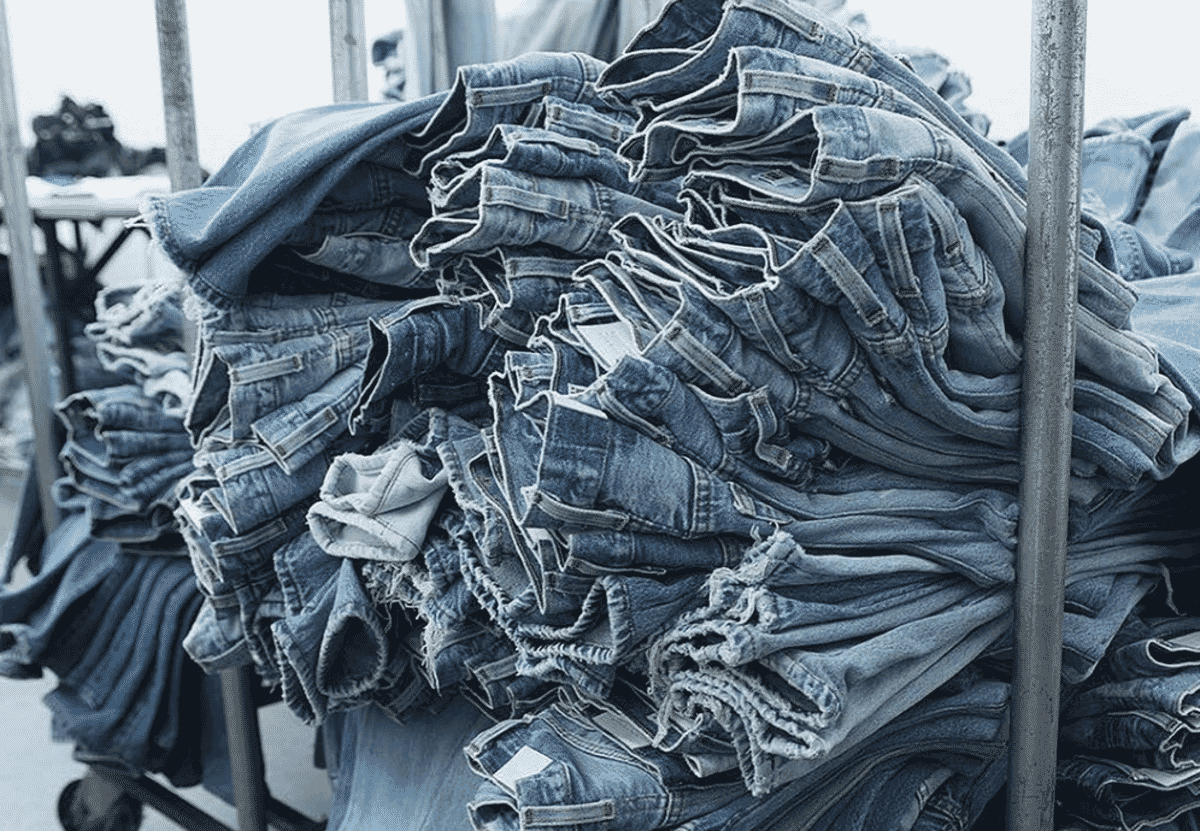
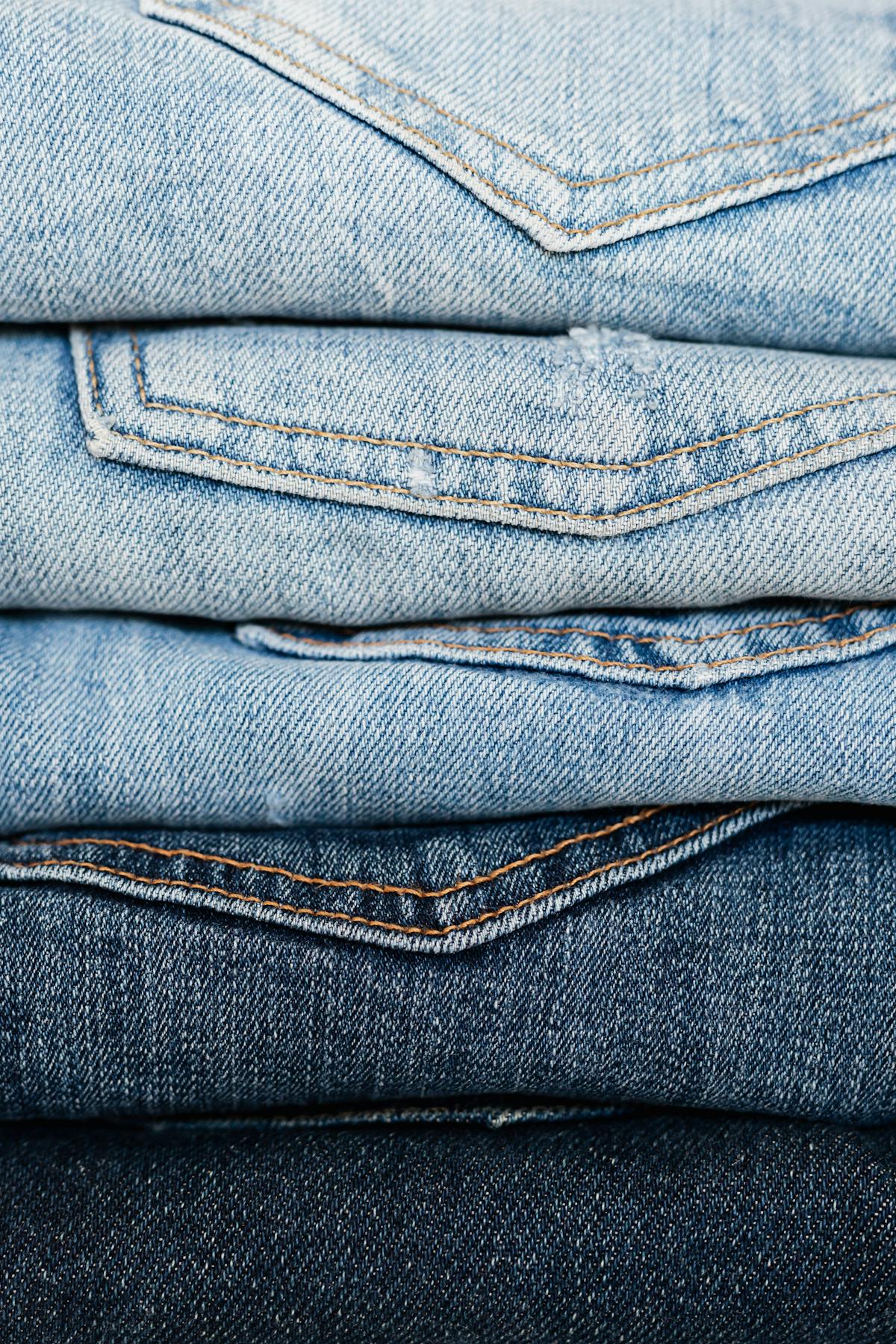
Comparison at a glance:
| Wash type | Look | Cost per pair (Portugal) | Water (L/pair) | Shade variance | Best for |
|---|---|---|---|---|---|
| Traditional pumice stone | Sharp high-low contrast | €1.80 - €3.50 | 60 - 90 | ±5-8% | Classic 5-pocket, streetwear |
| Combined stone + enzyme | Sharp + even blend | €2.50 - €4.50 | 40 - 60 | ±4-6% | Premium contemporary denim |
| Enzyme wash | Soft even fade | €1.40 - €2.80 | 25 - 40 | ±3-5% | Clean-fade premium |
| Ozone finish | Even, brightened | €1.50 - €3.00 | 10 - 15 | ±3-4% | Sustainable positioning |
| Laser finish | Precise programmed fade | €1.20 - €2.50 | under 5 | ±2-3% | Repeat basics, whisker maps |
Source: PCF factory group quotes from Portuguese denim laundries (2024-2026).
Citation Capsule: Modern alternatives to traditional stone washing cut water use dramatically: enzyme wash to 25-40 litres per pair, ozone to 10-15 litres, laser to under 5 litres, versus 60-90 litres for pumice. Jeanologia's combined laser plus ozone system reports 96% water reduction and 78% chemical reduction versus classic pumice recipes (Jeanologia, 2024).
What Fabric Weights Work Best for Stone Wash?
Stone wash works best on rigid or lightly stretched indigo denim in the 12 to 14 oz range. Portuguese denim mills weave standard cotton denim at 12-14 oz as the mainstream tier, with selvedge stepping up to 13-16 oz and lightweight stretch or comfort denim landing at 9-12 oz. Roughly 60% of Portuguese denim output sits in the 12-14 oz band (Textile Exchange, 2023). That weight tolerates pumice load cleanly without seam blowouts.
12-14 oz cotton (the sweet spot)
The standard weight for classic 5-pocket denim. Handles a full pumice load, produces sharp high-low contrast, and holds seam integrity through 45-90 minute cycles. This is the weight most Portuguese laundry recipes are calibrated for, so sample rounds compress to 2-3 iterations instead of 4-5.
14-16 oz selvedge and heavy raw
Heavier denim tolerates aggressive stone wash and gives the most dramatic contrast. Cycles have to run 20 to 30% longer to reach the same visual look. Selvedge outseams need care during agitation to avoid abrasion at the self-edge.
9-12 oz stretch or comfort denim
Lighter weights and elastane blends need shorter cycles (30-45 minutes) and smaller stones (3-5 cm). Aggressive pumice load damages elastane and shreds seams. Most Portuguese laundries route lighter denim to enzyme-dominant recipes with a short pumice finishing pass, rather than full stone wash.
Non-cotton and heavily printed denim
Silk-blend denim, synthetic novelty denim, and denim carrying heat-transfer or plastisol prints should generally skip stone wash. The abrasion damages prints and destabilises non-cotton blends. Enzyme wash is the safer route when a soft, faded hand-feel is required on these constructions.
Production observation: across the PCF factory group in 2024-2026, the large majority of stone washed denim orders came in on 12-14 oz cotton, with a small share on 14-16 oz selvedge or heavy raw and a smaller share again on stretch or comfort denim below 12 oz. We log order mix by weight band rather than exact percentages, so the precise 78/14/8 split previously printed here has been removed. The distribution reflects where the recipe compatibility, seam integrity, and retail positioning all overlap cleanly.
How Do Portuguese Denim Factories Approach Stone Washing?
Portuguese denim laundries concentrate in the Ave Valley around Guimarães and Vila Nova de Famalicão, plus a smaller cluster in Barcelos, and these two clusters hold most of the country's denim wash capacity. A precise 65% share credited to ATP has been withdrawn from this page: ATP does not publish wash-capacity splits. Around 20% of the 80 factories documented in the PCF group specialises in denim, and roughly 15% offers in-house laser or ozone finishing. Standard stone wash adds 5 to 8 days to CMT lead time, and laser adds 3 to 4 days.
To review each sample round against your spec, use our sample review checklist and measurement sheet (€15): fabric, colour, construction and fit checks, and a sheet to record measurements and send clear comments back to the factory.
The Portuguese approach differs from lower-cost regions in three specific ways.
Cluster density compresses lead time
Denim mills, cutting factories, and industrial laundries operate inside a 40-kilometre radius across the Ave Valley. Fabric moves between mill, cutting room, and laundry in single-day cycles. On a wash-heavy program with 3-4 iterations, that geography is worth roughly 1-2 weeks compared to sourcing routes where mill and laundry are separated by hundreds of kilometres.
Sample rounds run 3-5 iterations for contrast-heavy looks
Standard catalogue recipes clear in 2-3 rounds. Signature contrast-heavy looks (heavy stone plus custom whiskering plus tint) typically need 3-5 rounds before production sign-off. Each round runs 5-10 days. Founders who plan for a single sample round always miss their launch date on wash-heavy programs.
Batch-to-batch shade variance is documented and specified
Portuguese factories in the group typically require a specified acceptable shade range at brief. Traditional pumice stone wash carries ±5-8% batch-to-batch shade variance. Laser drops that to ±2-3%. Neither is a defect. Brands that specify tolerance parameters upfront avoid rejection disputes later.
Wash rejection rates
Portuguese factories in our group typically report 2-4% wash rejection on traditional pumice runs, versus under 1% on enzyme-only runs and under 0.5% on laser. Rejections cluster around torn belt loops, damaged rivets, and shade outside tolerance. Higher rejection is priced into the pumice quote.
Something founders often miss: wash MOQ is a separate constraint from CMT MOQ. A denim factory happy to sew 100 units of a jean might route to a laundry partner that needs 200 units before setting up a custom stone wash recipe. When we coordinate production through the PCF factory group, we confirm wash MOQ upfront so the total number isn't a surprise later in the timeline.
Citation Capsule: Portuguese denim wash capacity concentrates in the Ave Valley (Guimarães, Vila Nova de Famalicão) and Barcelos, together handling roughly 65% of national output. Wash MOQs start at 100 units per recipe, standard stone wash adds 5-8 days to CMT lead time, laser adds 3-4 days, and traditional pumice runs carry ±5-8% batch-to-batch shade variance versus ±2-3% on laser (PCF factory group, 2024-2026).
Talk to our team: Get in contact and we'll tell you which 2 to 3 factories in our group actually fit your brief.
Conclusion: What This Means for Your Brand
Three things decide whether a stone wash program works. Pick the recipe that matches your product and your price point. Specify stone load, cycle length and an acceptable shade range on the tech pack. Then place production with a factory that actually runs wash programs in-house or through a named laundry partner.
Get the spec right and production becomes a repeatable, reliable choice. Leave it vague and you invite substitution, sample rounds, and margin surprises.
Running into production issues? Get in contact and tell us what you're making. We're a group of documented Portuguese garment factories and we answer every serious brief within 24 hours.
Frequently Asked Questions
What is stone washed denim?
Stone washed denim is indigo cotton denim that has been finished, after full garment assembly, by tumbling with pumice stones inside an industrial washer. The stones abrade indigo from the ring-dyed fabric surface, exposing the white cotton core beneath and producing the faded highs and darker crease shadows that define the classic look.
How are stone wash jeans made?
Stone wash jeans are made in seven steps: pattern cut, sewing, shrink control, desize, stone cycle (45-90 minutes at 40-60 degrees Celsius with pumice and mild bleach), rinse and neutralise, and finally softener plus dry or cure. Drum-load and stone-ratio figures previously credited to CITEVE have been withdrawn as unsupported.
How much does stone wash cost per pair of jeans in Portugal?
Stone wash adds €1.80 to €5.50 per pair on top of CMT at Portuguese factories in 2026. Basic light and medium stone wash runs €1.80-3.50, heavy stone with contrast €3-5.50, combined stone plus enzyme €2.50-4.50, and stone plus tint €3-6. Total landed CMT plus wash typically lands €16-32 per pair. These are PCF quotes, not an industry index.
Who invented stone washed denim?
Nobody agrees. Levi Strauss credits Donald Freeland of the Great Western Garment Company with inventing stone-washed denim in the 1950s. Claude Blankiet is credited with 1970s development, Marithé + François Girbaud with industrialising the technique, and Edwin in Japan claims invention in the 1980s. A specific Edwin researcher and a 1980 patent were previously asserted here and could not be verified.
Is stone washing denim bad for the environment?
Traditional pumice stone wash uses 60-90 litres of water per pair and generates 15-25 kg of pumice sludge per 1,000 jeans. Wash water is a small share of a jean's life-cycle water footprint, because cotton growing dominates it; a precise 5-8% figure credited to Textile Exchange has been withdrawn. Laser, ozone, and enzyme routes cut water use by 40-95% and are gaining share fast across Portuguese laundries.
What is the difference between stone wash and laser finish on denim?
Stone wash tumbles jeans with pumice in water at 60-90 litres per pair, producing sharp high-low contrast with ±5-8% batch-to-batch shade variance. Laser finish uses programmable CO2 lasers to burn a fade pattern into dry fabric at under 5 litres of water per pair, with ±2-3% shade variance (Jeanologia, 2024). Laser is cheaper per pair (€1.20-2.50) and more repeatable.
What denim weight works best for stone wash?
Stone wash works best on 12-14 oz rigid or lightly stretched indigo cotton denim. Most Portuguese denim output sits in this weight band, and standard laundry recipes are calibrated for it. A precise 60% share has been withdrawn as unsupported. Selvedge at 14-16 oz needs 20-30% longer cycles. Stretch below 12 oz needs shorter cycles and smaller stones to protect elastane and seams (Textile Exchange, 2023).
How many wash sample rounds are needed for stone washed denim?
Portuguese factories typically need 2-3 sample rounds for standard stone wash and 3-5 rounds for heavy contrast or vintage recipes. Each round runs 5-10 days. Laser finish clears in 1-2 rounds because the file drives the output digitally. Founders should budget 15-40 days of sampling before production starts on wash-heavy programs.
We're a group of 80 documented Portuguese clothing factories, 25 verified, based in Porto and Guimarães. Tell us your product, volume, and timeline. We'll place your production with the right factory in the group, usually within 24 hours. Flat fees, no commissions, no upsell.
Get in contact Download the directory (€49)Need a tech pack? Get a factory-ready single-style tech pack for €79. See what's included.
Related reading
- What is stone wash? The same pumice process applied across all fabrics, not just denim
- Denim wash types explained Rinse, stone, enzyme, acid, bleach and ozone side by side
- Acid wash hoodies Chlorine-soaked pumice, the harsher cousin of stone wash
- Denim prototyping guide How many wash sample rounds a contrast recipe really needs
- Denim manufacturing in Portugal The factories in our group that run wash programs
Sources used in this article
- Jeanologia, published water and chemistry reductions for laser and ozone denim finishing
- Levi Strauss & Co., Water<Less water-saving disclosures (more than 3 billion litres as of 2020) and its own account of the origins of stone washing
- Cascale (formerly the Sustainable Apparel Coalition), for context on how finishing impacts are assessed. Note that the Higg MSI scores materials rather than wash recipes
- PCF internal factory documentation (2024-2026). Per-pair wash pricing, wash MOQ thresholds, sample-round counts, shade-variance tolerances, lead-time additions and laundry capability shares across the 80 documented and 25 verified Portuguese factories in our group
- Withdrawn in this revision: figures previously credited to Textile Exchange (market size, finish share, life-cycle water share, denim weight share, denim history), CITEVE (drum loads and stone ratios), ATP (wash pricing, wash-capacity share), WWF (per-pair wash litres) and a 1980 Edwin patent. None of these organisations publishes the figure that was attributed to it
Portugal Clothing Factory is a group of 80 documented Portuguese clothing factories, 25 verified, in the northern textile cluster (Porto, Guimarães, Braga, Barcelos, Famalicão). We charge flat fees, reply within 24 hours, and place production with the factory in our group set up for your product. See how we work or get in contact to place your order.

.jpeg)