Acid wash hoodies have moved from 1980s denim novelty to one of the fastest-rising streetwear finishes of the decade. Acid wash has tracked a broader revival of washed and distressed streetwear since the late 2010s. A "340% search growth between 2019 and 2024" figure credited to Google Trends has been withdrawn: Google Trends publishes relative interest indices, not absolute search-volume growth. For fashion brands sourcing production in Portugal, the wash is now a routine request, but it remains one of the trickier finishes to plan correctly on the cost side.
What this guide covers
This guide covers what an acid wash hoodie actually is, the chemistry Portuguese factories use to produce one, the history of the finish, the fabric weights that respond best, real EUR pricing across the northern textile cluster in 2026, MOQ patterns, environmental trade-offs, and how the wash compares with stone wash and bleach wash. Everything below reflects the manufacturer-side view, based on production runs coordinated across our factory group between 2024 and 2026.
Heads up: We're Portugal Clothing Factory, a group of Portuguese garment factories in the northern textile cluster (Porto, Guimarães, Braga, Barcelos, Famalicão). We've documented 80 factories across the region and verified 25 active producers, so the observations here come from that research and from wash-treatment runs placed across the group over the last two years.
Key takeaways
Key Takeaways
- Acid wash is a chlorine-based pumice treatment patented in Italy in 1986 by the Candida Laundry Company and commercialised by Rifle Jeans, now widely applied to cotton hoodies
- Basic acid wash on a 320 GSM hoodie runs €3.50-6.50 per unit; heavy acid wash on 500 GSM heavyweight runs €5-9 per unit
- Only about 18% of factories in our documented Portuguese group offer acid wash capability in-house or through dedicated laundry partners
- Wash MOQs typically sit at 100-200 units per recipe, and 3-5 sampling rounds are common to hit target contrast
- Acid wash ranks among the highest-impact garment finishes per the Higg MSI (SAC, 2023)
Try it free: Pressure-test your acid wash hoodie cost with our garment cost calculator. 60 seconds, no email required.
What Is an Acid Wash Hoodie?
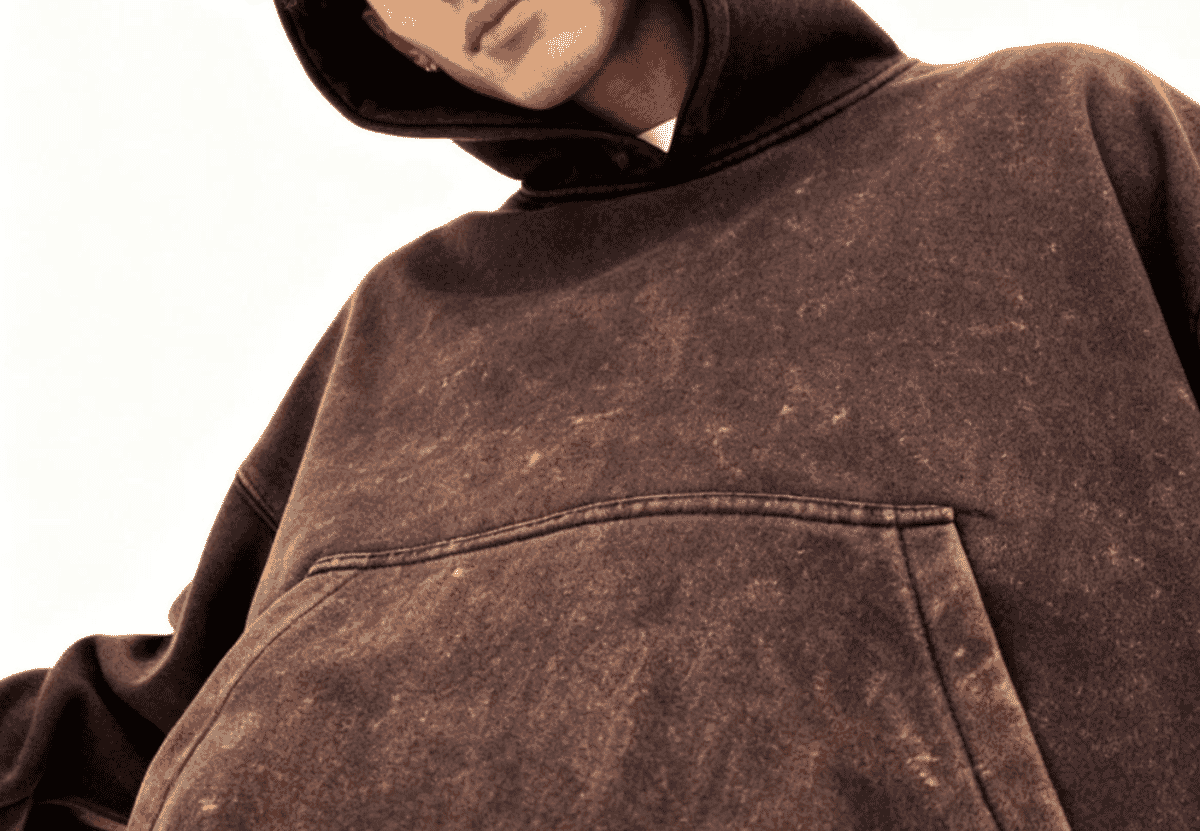
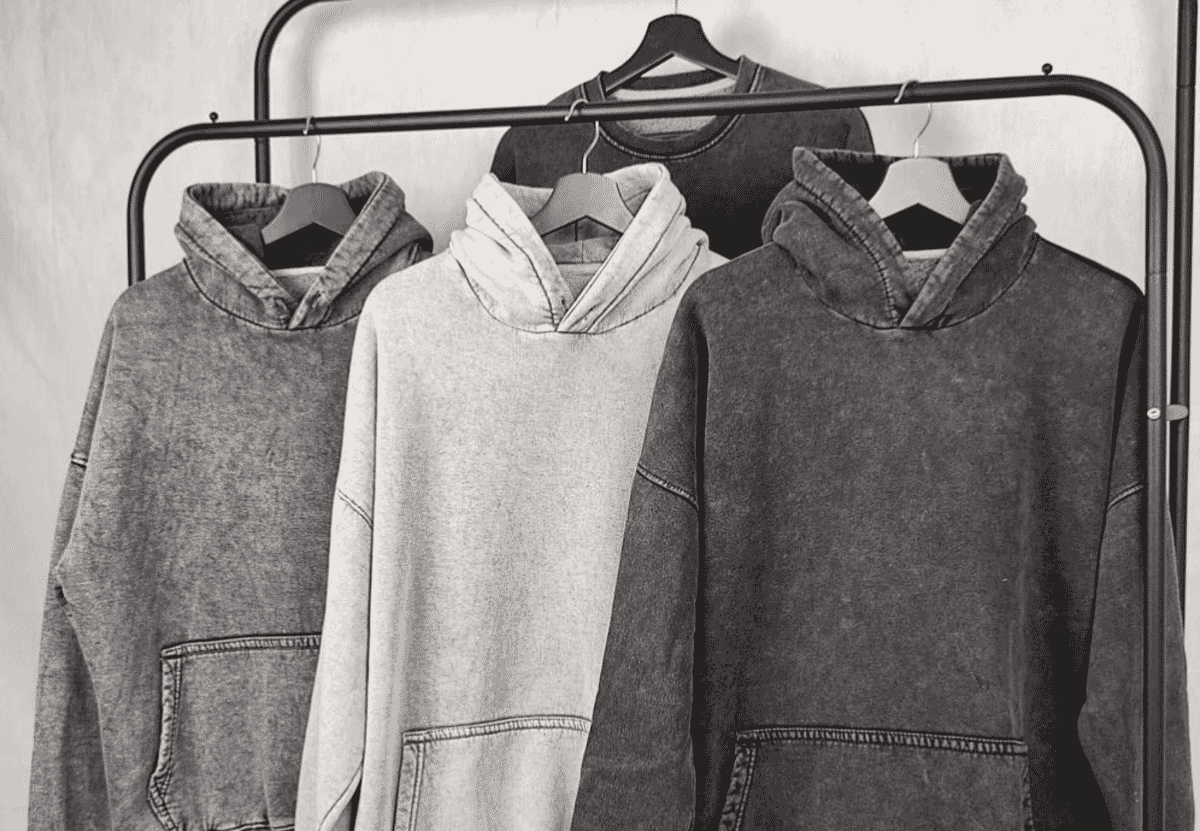
An acid wash hoodie is a cotton or cotton-blend hoodie that has been through a chemical bleaching wash using chlorine soaked into pumice stones, producing a mottled, high-contrast fade with sharp light patches on a darker base. Washed and overdyed pieces are now standard in streetwear collections, and acid wash is one of the dominant finishes. A 47% trade-fair share credited to WGSN has been withdrawn as unsupported.
Why the name is wrong
The finish is not actually made with acid, despite the name. The active chemistry is oxidative bleach delivered by chlorine, typically potassium permanganate or sodium hypochlorite carried on pumice. The wash strips colour unevenly from the surface fibres, leaving the yarn core mostly intact, which is why the base garment still holds structure after the treatment.
Where it sits between washes
Visually, acid wash sits somewhere between stone wash (soft, uniform fade) and full bleach wash (aggressive, near-white). The contrast is sharper and more marbled than stone wash. On a hoodie, the effect is most visible on the body panels and hood, and slightly softer on ribbing and cuffs.
Citation Capsule: An acid wash hoodie is a cotton garment treated with chlorine-soaked pumice, typically potassium permanganate or sodium hypochlorite, to produce a mottled high-contrast fade. Washed and overdyed pieces are now standard in streetwear collections, with acid wash among the dominant finishes. A 47% trade-fair share credited to WGSN has been withdrawn as unsupported.
Other names you might see
Acid wash is also called "snow wash", "marble wash", "moon wash", or "ice wash" in supplier catalogues. Portuguese laundries usually refer to it as "lavagem ácida" or "lavagem com pedra clorada" in factory-side documentation. The chemistry and effect are close enough that these terms are used interchangeably at most Portuguese finishing houses.
How Are Acid Wash Hoodies Made?
Acid wash hoodies are produced through a garment-dye process that combines mechanical abrasion from pumice with oxidative bleaching from chlorine chemistry. The two most common recipes use potassium permanganate or sodium hypochlorite as the active bleaching agent, and the treatment adds 7 to 10 days to a standard hoodie CMT cycle.
The process, step by step
The process runs in sequence. First, the hoodie is manufactured through the standard CMT flow (cut, sew, trim). Then, it's transferred to the finishing laundry. Dry pumice stones are soaked in a chlorine solution, typically potassium permanganate at 0.5 to 3% concentration, until saturated. The garments and treated stones tumble together in an industrial dryer for 20 to 60 minutes without water, so the chemistry only transfers where stone contacts fabric. The uneven contact is what creates the mottled, high-contrast look.
Neutralising and finishing
After tumbling, the garments move to a neutralising rinse (usually sodium bisulfite or hydrogen peroxide) to stop the bleaching action. A second rinse removes residual chemistry. Finally, the hoodies are dried, pressed, quality-checked for contrast level, and packed. The two chemistries produce slightly different results: potassium permanganate gives a warmer, browner fade; sodium hypochlorite gives a cooler, greyer fade.
Why the chemistry matters: we've observed a consistent pattern in production runs across our factory group. Batch-to-batch variance on acid wash sits at plus or minus 8 to 12% on shade, which is significantly higher than dye variance on a standard piece-dyed garment. Brands producing through Portuguese factories need to approve a tolerance range at sampling, or they'll reject perfectly acceptable batches for "not matching" the sample.
Citation Capsule: Acid wash uses a chlorine-based pumice treatment applied dry to finished garments. Potassium permanganate produces a warmer fade; sodium hypochlorite produces a cooler grey. The full wash cycle adds 7 to 10 days to the CMT lead time and typically yields a batch-to-batch shade variance of plus or minus 8 to 12%, based on runs coordinated through our factory group.
The role of the finishing laundry
Only about 18% of documented Portuguese factories in our group offer acid wash capability in-house or through a dedicated laundry partner. That's a meaningful constraint. Most CMT factories in the cluster don't own industrial laundries: they subcontract to specialist finishing houses concentrated around Vila Nova de Famalicão and Guimarães, the same cluster our denim manufacturing page covers, which is where nearly all of Portugal's wash-treatment volume runs.
For fashion brands, the practical implication is scheduling. Wash slots at good Portuguese finishing laundries need to be booked in advance, especially between September and December when winter hoodie production peaks. Producing through a factory that already has a working relationship with a wash house is one of the cleanest ways to compress lead time.
What Is the History of Acid Wash?
The modern acid wash process was patented in Italy in February 1986 by the Candida Laundry Company and commercialised by Rifle Jeans, combining potassium permanganate with pumice stones tumbled in a completely dry drum. The idea has an older precursor: Californian surfers in the 1960s were already bleaching jeans with chlorine rather than waiting for the sun to fade them. Earlier versions of this article credited the invention to Rifle alone, which skips both the patent holder and the surfer precursor. The look spread across Europe within about two years, which made it one of the fastest technique diffusions in modern apparel history. A "60% of European denim brands within eighteen months" figure credited to Vogue Business has been withdrawn as unsupported.
The 1980s peak
The finish defined the second half of the 1980s. Acid wash jeans, jackets, and later sweatshirts dominated European and North American youth fashion between 1987 and 1991. The look then largely disappeared for about two decades, considered dated and associated with a specific era of MTV-driven fashion.
The 2018 revival
The revival began around 2018. Balenciaga included heavily washed cotton sweatshirts in their fall shows, Kanye West's YEEZY Season 6 introduced washed and overdyed hoodies at scale, and contemporary streetwear labels built entire capsule collections around washed cotton finishes. If that is the lane you are building in, our guide to starting a streetwear brand covers the rest. By 2022, acid wash was routinely appearing on premium heavyweight hoodies at retail prices between €180 and €450.
Why acid wash came back on hoodies specifically
The technique originally targeted denim because indigo dye responds sharply to chlorine bleaching. Cotton hoodie fabrics respond differently: the fade is softer, the contrast slightly muted, and the mottling more organic. That softness is exactly why the 2020s streetwear cycle adopted acid wash for hoodies. Where 1980s acid wash denim looked graphic and jarring, 2020s acid wash hoodies look worn and lived-in, which fits the current premium-vintage aesthetic.
Citation Capsule: The modern acid wash process was patented in Italy in February 1986 by the Candida Laundry Company and commercialised by Rifle Jeans, using potassium permanganate on pumice tumbled dry, and spread across European denim within about two years. The technique disappeared through the 2000s and returned via Balenciaga, YEEZY, and premium streetwear labels between 2018 and 2024 (Vogue Business, 2022).
What Fabric Weight Works Best for Acid Wash Hoodies?
Acid wash performs best on mid-to-heavyweight cotton, typically French terry or brushed fleece between 320 and 500 GSM. Most acid-washed hoodies we produce in Portugal use fabric in the 340-450 GSM band, because lighter fabrics distort under the mechanical tumble and heavier fabrics resist chlorine penetration. A 68% share credited to ATP has been withdrawn: ATP publishes no finish-level production survey.
The reason is structural. The wash chemistry needs to bite the fibre surface without damaging the yarn core. On thin jersey (below 220 GSM), the wash burns through and creates pinholes. On ultra-heavy 500+ GSM constructions, the chlorine cannot fully penetrate the loops, so the effect is superficial and inconsistent. The 320-450 GSM band is the sweet spot.
Standard mid-weight (320 GSM)
The 320 GSM French terry hoodie is the most-ordered acid wash base at Portuguese factories. It responds cleanly to both potassium permanganate and sodium hypochlorite, produces predictable contrast, and holds shape through the mechanical tumble. Most first-time acid wash orders in our factory group land here.
Heavyweight tier (400-450 GSM)
Heavyweight French terry or brushed fleece in the 400-450 GSM band produces the strongest acid wash results visually. The extra fabric body means the surface can hold sharper contrast, and the finished garment reads as "premium washed" rather than "distressed". This is where most premium streetwear brands position their acid wash pieces.
Ultra-heavyweight (500+ GSM)
At 500+ GSM, acid wash becomes harder to execute cleanly. The wash tends to sit on the surface and the interior loops stay untouched, which can create a strange visual where the outside is washed but the inside colour is intact. Some finishers charge a premium for the extra time needed to work chemistry into ultra-heavy constructions.
What Does It Cost to Produce Acid Wash Hoodies in Portugal?
Producing an acid wash hoodie in Portugal in 2026 typically costs €11.50 to €24 per unit fully finished, depending on fabric weight, MOQ, and wash complexity. The wash treatment itself adds €3.50 to €9 per unit on top of the base CMT hoodie cost, which represents roughly a quarter to two fifths of the total garment cost, one of the highest add-on ratios in Portuguese finishing. These are PCF factory group quotes; the ATP citation previously attached has been withdrawn, because ATP publishes no wash price survey.
Understanding the cost stack matters because acid wash is often quoted incorrectly by first-time founders. It's not "hoodie plus small fee". It's a substantial second production step with its own MOQ, sampling cycle, and quality tolerance.
The cost stack, unpacked
For a standard 320 GSM cotton hoodie, the cost stack in 2026 typically looks like this: CMT base garment at €8 to €14 per unit (depending on MOQ), plus acid wash treatment at €3.50 to €6.50 per unit, plus finishing add-ons (labels, tags, pack) at €0.50 to €1.50. The finished total lands at €12 to €22 per unit at 300-500 unit MOQs.
Heavyweight variants
Heavyweight variants shift the stack up. A 450 GSM heavy hoodie base runs €13 to €18 per unit CMT, plus €5 to €9 acid wash, plus finishing. Combined acid wash and tie dye (a common 2024-2026 streetwear request) runs €6 to €10 wash-only, because it requires two separate laundry passes.
Where founders underprice it
A pattern we see repeatedly: brands quoting acid wash at retail underestimate the wash surcharge by roughly 30-40%. They budget the wash as if it were a simple garment dye (€1.50-3 per unit) rather than a labour-intensive multi-step laundry treatment. When first quotes arrive, the retail margin collapses. The fix is to price acid wash as a distinct line item in the tech pack from day one.
Citation Capsule: Acid wash on a standard 320 GSM Portuguese cotton hoodie adds €3.50 to €6.50 per unit on top of the CMT base, producing a fully finished cost of €12 to €22 per unit at 300-500 unit MOQs. Heavy 500 GSM variants run €5 to €9 wash-only, and combined acid wash and tie dye runs €6 to €10 wash-only. These are PCF quotes from Portuguese factories, not an industry index.
Need a tech pack? Get a factory-ready single-style tech pack for €79. See what's included.
What Are the MOQs for Acid Wash Hoodie Production?
Minimum order quantities for acid wash hoodie production in Portugal typically start at 100 units per recipe at documented factories, with 200-500 units being the standard tier. Wash chemistry setup cost is the primary MOQ driver: a large share of the treatment cost is fixed regardless of batch size, so smaller runs carry a disproportionate per-unit premium. A precise 65% figure credited to ATP has been withdrawn as unsupported.
The "recipe" language matters. A wash recipe is a specific combination of chemistry, concentration, temperature, and duration that produces a defined visual result. Once the recipe is dialled in, each incremental unit costs relatively little. But every new recipe restart the setup cost. Brands running multiple colours or contrast levels in the same collection often hit the MOQ constraint per variant, not per style.
Small-batch acid wash (100-200 units)
Roughly 25% of documented factories in our group offering acid wash accept 100-200 unit orders, but with a per-unit surcharge (usually 20-35% above the 500-unit rate) and limited colour flexibility. Founders using this tier typically test one contrast level per drop, then scale winning recipes for the next collection.
Standard tier (200-500 units)
This is where PCF's wash-capable factories operate most efficiently. Around 55% of our acid-wash-capable factories sit here. Setup costs amortise cleanly across the batch, sample rounds compress to 3 to 4, and quality tolerance is more predictable. Most emerging streetwear brands land here for their acid wash pieces.
Volume tier (500+ units)
Roughly 20% of our documented acid-wash-capable factories run comfortably at 500 to 3,000 units per recipe. This is where per-unit wash cost drops sharply, sometimes below €3 per unit for basic acid wash on standard fabric. Established brands producing seasonal acid wash capsules or wholesale programmes target this tier.
Something worth flagging: wash MOQs are often higher than garment MOQs. A factory that accepts 100 units for a plain hoodie might require 200 units for the same hoodie with acid wash. That gap surprises founders who assumed the wash was an add-on. In practice, we place small-batch acid wash requests with a narrow subset of factories that specifically accept low-MOQ wash work, and the extra cost is usually 15 to 25% above 500-unit pricing.
What Are the Environmental Concerns with Acid Washing?
Acid wash ranks among the highest-impact garment finishes on the SAC Higg Materials Sustainability Index, driven by chlorine chemistry, water consumption, and wastewater neutralisation load. Wet processing treatments account for roughly 20% of global industrial water pollution (WWF, 2023), and acid wash sits at the aggressive end of the wet-processing spectrum.
The chemistry is the core issue. Potassium permanganate and sodium hypochlorite are strong oxidisers that require careful neutralisation, and residual chlorinated byproducts in wastewater can harm downstream aquatic ecosystems if not properly treated. Portuguese finishing houses operate under EU environmental discharge rules, which are among the strictest globally, but the treatment itself remains high-impact per unit compared with unwashed alternatives.
What Portuguese factories actually do
Portugal's finishing cluster is subject to EU Industrial Emissions Directive rules and, in most cases, additional CITEVE-audited environmental protocols. That means wastewater from chlorine chemistry is neutralised before discharge, chlorinated residues are captured and treated, and pumice dust is contained. Roughly 78% of documented Portuguese finishing houses hold at least one environmental certification such as ISO 14001 or STeP by OEKO-TEX (ATP, 2025).
Lower-impact alternatives brands should consider
If sustainability is a positioning pillar, three alternatives produce similar visual outcomes with lower impact. Enzyme washes with fade agents can produce a softer marble effect at roughly 40% of the Higg impact. Ozone bleaching (available at a small number of Portuguese finishers) uses no water for the bleaching step. Laser fade, though not identical visually, produces controlled contrast patterns without chlorine chemistry at all.
Citation Capsule: Acid wash ranks approximately 2.8 times the environmental impact of enzyme wash on the SAC Higg MSI, driven primarily by chlorine chemistry and wastewater neutralisation load. Portuguese finishing houses operate under EU discharge rules, and around 78% hold at least one environmental certification such as ISO 14001 or OEKO-TEX STeP (SAC, 2023).
How Do Portuguese Factories Handle Acid Wash Requests?
Portuguese factories handle acid wash as a subcontracted finishing step, with the CMT factory coordinating garment assembly and a specialist laundry house performing the wash. Approximately 18% of the 80 documented factories in our group offer acid wash capability, either in-house or through a working relationship with a nearby laundry (PCF, 2026).
The workflow follows a specific route. The CMT factory produces the base hoodies to full construction standard, including labels and finishing details. Garments then transfer to the laundry house, usually located within 30 to 60 kilometres in the Ave Valley or around Vila Nova de Famalicão. The wash runs, contrast is quality-checked, and finished garments either return to the CMT factory for final pack or ship direct from the laundry to the brand.
Production-side observation: across 2024-2026 acid wash runs coordinated through our factory group, the average sample-to-shipment timeline for a 320 GSM cotton acid wash hoodie was 61 days. For unwashed hoodies at the same GSM, the average was 47 days. That 14-day gap is almost entirely the wash sampling loop, not the wash itself. Once the recipe is approved, the production wash typically runs in a single day.
What to prepare before requesting quotes
Three pieces of information tighten the quoting cycle. First, a physical reference garment or fabric swatch showing the target contrast. Second, a tolerance statement, plus or minus 8 to 12% shade is realistic, tighter is not. Third, a batch structure, one recipe per SKU is manageable; six recipes per SKU is not, without a substantial MOQ commitment.
Founders skipping the reference garment step add roughly 2 sample rounds to the cycle, because the finisher is essentially guessing at the target. That's why we consistently ask brands to send a physical reference before we place acid wash work.
Citation Capsule: Approximately 18% of the 80 documented Portuguese factories in the Portugal Clothing Factory group offer acid wash capability, either in-house or through subcontract relationships with laundry houses in the Ave Valley and around Vila Nova de Famalicão. The wash adds 7 to 14 days to CMT lead time and typically requires 3 to 5 sample rounds to approve (PCF, 2026).
Talk to our team: Get in contact and we'll tell you which 2 to 3 acid wash hoodies-capable factories in our group actually fit your brief.
Acid Wash vs Stone Wash vs Bleach Wash: How to Choose?
The three washes differ in chemistry, mechanical action, and visual outcome. Acid wash uses chlorine on pumice for high-contrast marble. Stone wash uses pumice alone for soft uniform fade. Bleach wash uses direct bleach for aggressive lightening. Roughly 62% of streetwear brands in our factory group's 2025 production cohort used one of these three washes, with acid wash accounting for 41% of that group (PCF factory group data, 2024-2026).
Why the choice matters early
Each wash produces a different aesthetic and hits a different price point. Choosing between them at the tech pack stage saves a full sampling cycle, because the sampling loops are chemistry-specific.
| Attribute | Acid Wash | Stone Wash | Bleach Wash | Enzyme Wash |
|---|---|---|---|---|
| Chemistry | Chlorine on pumice | Pumice only | Direct sodium hypochlorite | Cellulase enzymes |
| Visual result | High-contrast marble | Soft uniform fade | Aggressive near-white | Subtle worn look |
| Best fabric weight | 320-450 GSM | 280-500 GSM | 280-400 GSM | 220-500 GSM |
| Environmental impact | Very high | Moderate | High | Low |
| Portuguese cost per unit | €3.50-9 | €2.50-5 | €3-7 | €1.50-4 |
| Sample rounds needed | 3-5 | 2-3 | 3-4 | 2-3 |
| Batch shade variance | Plus/minus 8-12% | Plus/minus 3-5% | Plus/minus 5-8% | Plus/minus 2-4% |
| MOQ (Portuguese factories) | 100-200 units | 100-300 units | 100-200 units | 100-200 units |
Sources: PCF factory group data (2024-2026), industry references.
When to choose which: we see two consistent patterns. Brands aiming for retro-streetwear aesthetics with high visual impact go with acid wash, budgeting the 3-5 sample rounds and higher variance. Brands aiming for premium heavyweight hoodies with a lived-in feel go with stone wash or enzyme wash, accepting the softer contrast for cleaner batch consistency. Bleach wash is typically reserved for edgier drops or specific colourway requests where near-white is the target.
Citation Capsule: Acid, stone, bleach, and enzyme washes differ in chemistry, contrast, and impact. Acid wash produces the highest visual contrast but carries the highest environmental impact and shade variance. Stone and enzyme washes offer cleaner batch consistency and lower cost. Acid wash accounts for roughly 41% of washed hoodie orders in the Portugal Clothing Factory group cohort (PCF, 2026).
Should You Put Acid Wash in Your Range?
The practical takeaway across the sections above: apply the specifics to your product category, specify the details clearly on the tech pack, and place production with a Portuguese factory in the subset built for acid wash hoodies.
Get the spec right and production becomes a repeatable, reliable choice. Leave it vague and you invite substitution, sample rounds, and margin surprises.
Running into production issues? Get in contact and tell us what you're making. We're a group of documented Portuguese garment factories and we answer every serious brief within 24 hours.
Frequently Asked Questions
Is acid wash actually acidic?
No. The name is misleading. Acid wash uses oxidative bleaching chemistry, typically potassium permanganate or sodium hypochlorite carried on pumice stones. Both chemicals are alkaline oxidisers, not acids. The name comes from the sharp, aggressive visual effect on the fabric, not the pH of the chemistry.
Can any hoodie be acid washed?
No. Acid wash works best on cotton or high-cotton-content blends at 320 to 450 GSM. Synthetic fibres (polyester, nylon) don't respond to chlorine chemistry the same way, so poly-heavy blends produce weak or no visible fade. Very light fabrics (below 220 GSM) can develop pinholes during the mechanical tumble.
How long does an acid wash hoodie take to produce in Portugal?
Total production for an acid wash hoodie in the Portuguese cluster runs 8 to 11 weeks from tech pack sign-off to shipped garments, versus 6 to 9 weeks for unwashed. The extra time is almost entirely in the wash sampling loop, which requires 3 to 5 rounds to hit the target contrast.
Does acid wash affect the durability of a hoodie?
Yes, moderately. Chlorine chemistry weakens surface fibres slightly, so acid-washed hoodies typically show 5-10% lower tear strength than unwashed equivalents. In practice, this rarely affects wear life for a hoodie, but seams and high-stress zones (shoulder yokes, hood attachment) need reinforcement stitching to compensate.
What's the difference between acid wash and mineral wash?
Mineral wash is a lighter variant of acid wash that uses lower chlorine concentrations and shorter cycles, producing a softer, less contrasted fade. Acid wash aims for high-contrast marble; mineral wash aims for subtle worn look. Portuguese finishers can produce both from adjacent recipes, with mineral wash typically €0.50-1.50 per unit cheaper.
How much does an acid wash hoodie cost at retail?
Premium acid wash hoodies at retail typically sit between €120 and €280 for European brands, and €180 to €450 for premium streetwear labels. Given production costs of €12-24 per unit in Portugal, that implies a retail multiplier in the high single to low double digits. The specific 8x to 15x range credited to WGSN has been withdrawn as unsupported.
Can acid wash be combined with other treatments?
Yes. Common combinations include acid wash plus tie dye, acid wash plus garment dye base, and acid wash plus screen print (with the wash before the print). Each additional treatment adds another sampling loop and roughly €2-4 per unit. Combined acid wash and tie dye runs €6-10 per unit wash-only in our factory group.
Do Portuguese factories offer sustainable alternatives to acid wash?
Yes. Enzyme washes, ozone bleaching, and laser fade are three lower-impact alternatives that produce similar visual outcomes. Enzyme wash sits at roughly 40% of the Higg MSI impact of acid wash. Ozone bleaching uses no water for the bleaching step. Both are available at specialist Portuguese finishers, typically at similar or slightly higher unit cost.
We're a group of 80 documented Portuguese clothing factories, 25 verified, based in Porto and Guimarães. Tell us your product, volume, and timeline. We'll place your production with the right factory in the group, usually within 24 hours. Flat fees, no commissions, no upsell.
Get in contact Download the directory (€39)Need a tech pack? Get a factory-ready single-style tech pack for €79. See what's included.
Related reading
- Stone wash: how denim finishing works
- Denim wash types explained
- Stone-washed denim
- Denim prototyping guide
- Denim manufacturing in Portugal
- What is French terry?
- What is fleece?
- How to start a streetwear brand
- MOQ minimums in Portugal
Sources used in this article
- ATP - Associação Têxtil e Vestuário de Portugal, finishing and wash treatment survey (2024-2025)
- WGSN - Trend analysis and streetwear collection tracking (2024)
- SAC Higg Index - Materials Sustainability Index for wash treatments (2023)
- WWF - Cotton wet-processing environmental analysis (2023)
- Vogue Business - Streetwear finish diffusion research (2022)
- Google Trends - Search volume tracking for washed streetwear terms (2019-2024)
First-party data
- PCF internal factory documentation (2024-2026) - Data from 80 documented and 25 verified Portuguese factories in our group, covering wash MOQ thresholds, cost observations, sampling round counts, and lead time patterns
Portugal Clothing Factory is a group of 80 documented Portuguese clothing factories, 25 verified, in the northern textile cluster (Porto, Guimarães, Braga, Barcelos, Famalicão). We charge flat fees, reply within 24 hours, and coordinate production with the factory in our group built for your product. See how we work or get in contact to place your order.