Germany still makes clothing, but much less than its reputation suggests, and most of the best-known German makers produce mainly for their own brands. If you want a German factory to make your collection, your realistic options are usually small sewing workshops rather than the famous names.
This guide lists 10 clothing manufacturers in Germany, each checked on its own website in October 2026: four established producers that still make in Germany, and six workshops that say they sew for other brands. It also covers what the official figures say about the industry, how to vet a German workshop, and why many brands also look at Portugal.
Heads up: We're Portugal Clothing Factory, a group of documented clothing factories in northern Portugal. None of the German companies below is part of our group, and we don't place orders with them or send brands to them. We list them from their own published information so you can contact them directly.
Key Takeaways
- Germany had 95 clothing businesses with 50 or more employees in December 2024, out of 433 textile and clothing businesses of that size (textil+mode, Destatis data).
- The famous names mostly make their own brands. Trigema, MEY, Falke and Merz b. Schwanen still produce in Germany, but none advertises production for other fashion brands.
- Workshops that sew for other brands are small. Manomama states clothing typically from 50 pieces; Näherei Zeulenroda says it sews from one piece.
- "Made in Germany" often means part of the process. Some German companies cut in Germany and sew elsewhere, and say so openly.
- Labour is the big cost difference: Germany's minimum wage is €13.90 an hour in 2026 (Bundesregierung); Portugal's is €920 a month (DECO PROteste).
How Big Is Clothing Manufacturing in Germany Today?
Small, and shrinking. In December 2024 Germany had 433 textile and clothing businesses with 50 or more employees: 338 in textiles and only 95 in clothing (textil+mode, Konjunktur 02.2025, Destatis data). Small workshops below that size are not counted in those figures, and they are where most contract sewing for small brands happens.
The trend is down. In 2024 the industry's turnover fell 4.3% and employment fell 4.2%. Domestic clothing production fell 11.3% on the year, while textiles fell 3.0% (same report).
Germany is also a large clothing importer. In 2024 it imported €36.5 billion of clothing and exported €25.4 billion, much of it re-exports of garments made elsewhere. Textiles were closer to balanced, with €11.3 billion exported and €10.9 billion imported.
The industry's strength sits more in textiles than in sewing: fabrics, technical textiles and nonwovens. That matters for brands, because a German mill that weaves or knits your fabric is far easier to find than a German factory that will sew 300 pieces of your design.
Citation Capsule In December 2024 Germany had 433 textile and clothing businesses with 50 or more employees, of which 95 were in clothing. Industry turnover fell 4.3% in 2024, employment fell 4.2% and domestic clothing production fell 11.3%. Germany imported €36.5 billion of clothing in 2024 and exported €25.4 billion (textil+mode, Konjunktur 02.2025, based on Destatis data).
Which Well-Known Manufacturers Still Make Clothing in Germany?
These four companies still run their own production in Germany. All four make mainly for their own brands, so treat them as benchmarks for German quality rather than as suppliers for your label.
1. Trigema (Burladingen, Baden-Württemberg)
Trigema W. Grupp KG was founded in 1919 and describes itself as Germany's largest maker of sports and leisurewear (Trigema). It sells its range as "100% Made in Germany", with knitting, finishing, cutting and sewing in its own German plants (Trigema homepage).
- Makes: T-shirts, polos, sweatshirts, sportswear and leisurewear.
- For businesses: sells workwear to companies, made in Germany. We found no public offer to produce collections for other fashion brands.
2. MEY (Albstadt, Baden-Württemberg)
MEY was founded in 1928 and makes underwear, lingerie and loungewear. The company says it still makes 66% of its products in its own plants in Germany, Portugal and Hungary (MEY), and knits about 90% of its fabrics at its headquarters in Lautlingen. It also states that all its material is certified to OEKO-TEX Standard 100 (MEY sustainability).
- Makes: underwear, lingerie, loungewear and fine-gauge knits.
- For other brands: not offered publicly.
3. Falke (Schmallenberg, North Rhine-Westphalia)
Falke was founded in May 1895 and is best known for socks and hosiery. It says about 90% of its legwear is made in its own production sites, including part of the range at its Schmallenberg headquarters and a second German site in Dorfchemnitz, with further plants in Italy, Serbia, Slovakia and South Africa (Falke).
- Makes: socks, tights, legwear, plus knitwear and sportswear under its own brand.
- For other brands: not offered publicly.
4. Merz b. Schwanen (Berlin, knitting in Albstadt)
Merz b. Schwanen traces its roots to 1911; the brand was revived after its founders found an old Merz b. Schwanen henley at a Berlin flea market in 2010. Its "Originals" line is knitted on vintage loopwheel machines at its German production site in Albstadt (Merz b. Schwanen). The company says another part of its range has been made with a family-run manufacturer in Portugal since 2016 (Merz b. Schwanen).
- Makes: loopwheel jersey T-shirts, henleys and basics.
- For other brands: not offered publicly.
Worth knowing: Two of these four German companies make part of their range in Portugal. German brands producing in northern Portugal is a common pattern, and it is the kind of production our team places and manages. See how Portuguese factories compare.
Which German Manufacturers Make Clothing for Other Brands?
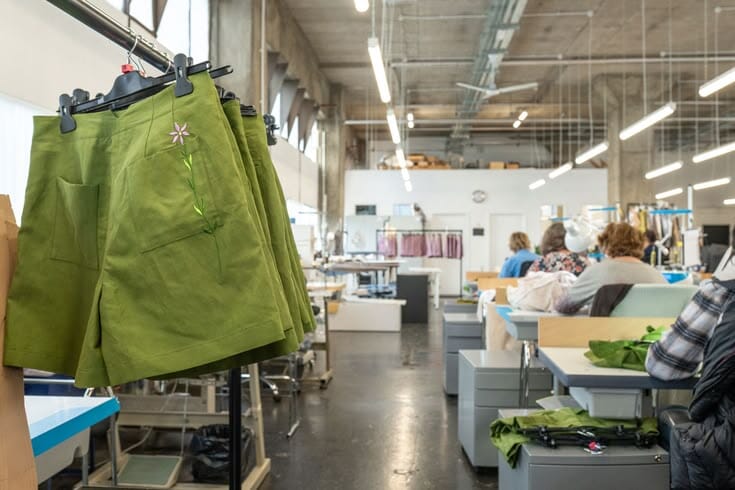
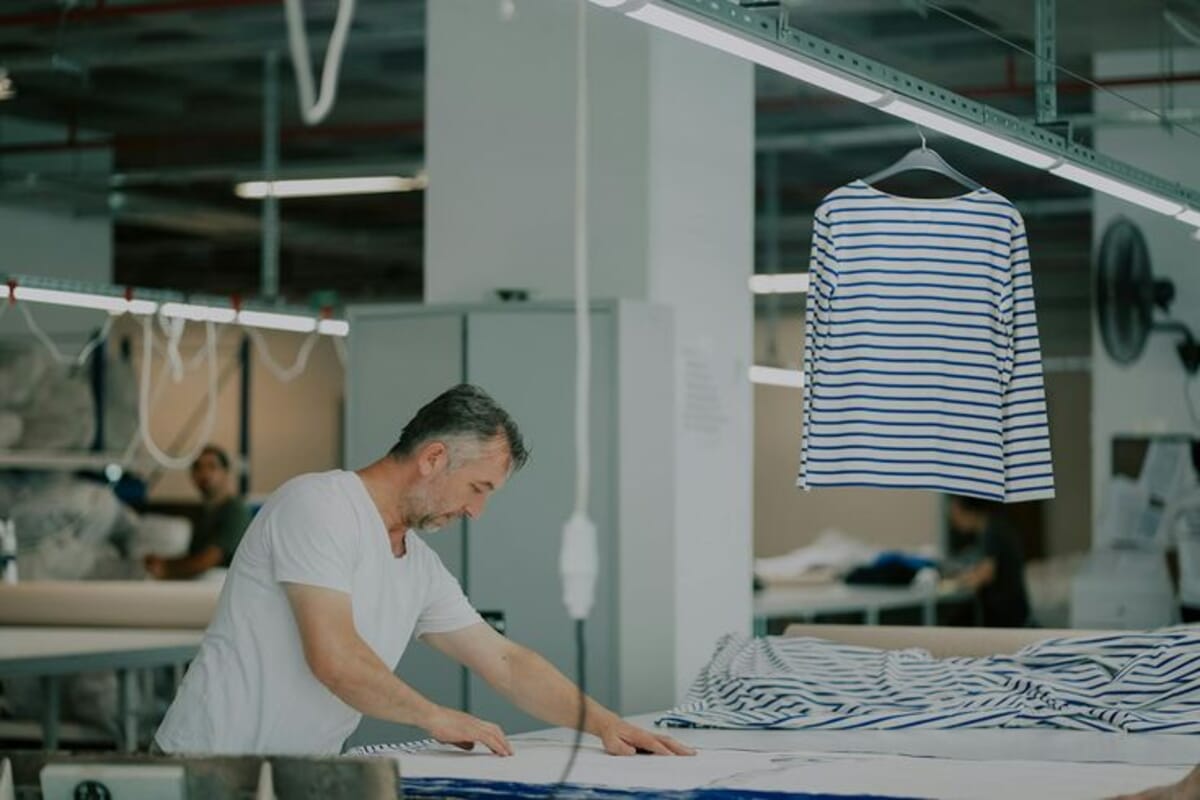
These six companies say on their own websites that they sew for other businesses, with the sewing done in Germany. Most are small workshops. That suits samples and short runs, but check capacity before planning a larger season.
5. Manomama (Augsburg, Bavaria)
Manomama was founded in Augsburg in 2010 and sews in Augsburg. Its business site offers white-label development and production for other fashion labels, plus workwear, bags and giveaways for companies. It states a typical minimum of 50 pieces for clothing and 100 for giveaways (Manomama B2B).
6. Stieglitz Textilien (Sehmatal-Cranzahl, Saxony)
Stieglitz Textilien is a sewing business in the Ore Mountains that makes cycling and running wear "Made in Germany". Its website offers contract production (Lohnfertigung), small series and sample production, including costing and pattern-making (Stieglitz Textilien).
7. GD Modeatelier (Brackenheim, Baden-Württemberg)
GD Modeatelier is a sewing workshop that offers contract sewing for labels, from single pieces to series, plus sample making, pattern-making and grading (GD Modeatelier).
8. Die Näherei (Groß Quenstedt, Saxony-Anhalt)
Die Näherei advertises series production for fashion brands in Germany. Its services cover consultation, pattern development, sampling and the full production of garments (Die Näherei).
9. Näherei Zeulenroda (Zeulenroda-Triebes, Thuringia)
Näherei Zeulenroda is an industrial sewing business offering contract sewing, cutting, labelling, embroidery and printing. It says it sews from a single piece, for one-offs, small series and large series (Näherei Zeulenroda). It works across many textile products, not only apparel, so confirm garment experience for your category.
10. Studio NiMa (Berlin)
Studio NiMa runs a studio with a sewing room in Berlin where it makes first samples, sample duplicates and small series (Studio NiMa). It is a development partner more than a volume factory: ask which steps of a larger run would be made in Berlin.
The 10 at a glance
| # | Company | Location | Makes | Production for other brands |
|---|---|---|---|---|
| 1 | Trigema | Burladingen, Baden-Württemberg | Tees, polos, sweatshirts, sportswear and leisurewear | Own brand; workwear sold to companies |
| 2 | MEY | Albstadt, Baden-Württemberg | Underwear, lingerie and loungewear | Own brand |
| 3 | Falke | Schmallenberg, North Rhine-Westphalia | Socks, hosiery and legwear | Own brands |
| 4 | Merz b. Schwanen | Berlin; knitting in Albstadt | Loopwheel jersey basics | Own brand |
| 5 | Manomama | Augsburg, Bavaria | Clothing, bags, workwear, giveaways | Yes: white label for other labels |
| 6 | Stieglitz Textilien | Sehmatal-Cranzahl, Saxony | Cycling and running wear | Yes: contract, small series, samples |
| 7 | GD Modeatelier | Brackenheim, Baden-Württemberg | Contract sewing, samples, patterns | Yes: for labels, single pieces to series |
| 8 | Die Näherei | Groß Quenstedt, Saxony-Anhalt | Series production for fashion labels | Yes: small series and sampling |
| 9 | Näherei Zeulenroda | Zeulenroda-Triebes, Thuringia | Contract and industrial sewing | Yes: from one piece |
| 10 | Studio NiMa | Berlin | First samples, sample duplicates, small series | Yes: samples and small series in Berlin |
From each company's own website, checked October 2026. Minimums only where the company publishes one. None of these companies is part of the Portugal Clothing Factory group.
Citation Capsule Most well-known German clothing manufacturers, such as Trigema, MEY, Falke and Merz b. Schwanen, produce mainly for their own brands. Contract production for other labels in Germany is concentrated in small sewing workshops, such as Manomama in Augsburg, which states a typical clothing minimum of 50 pieces, and Näherei Zeulenroda in Thuringia, which says it sews from a single piece.
What Does "Made in Germany" Mean for Clothing?
Often less than buyers assume. A garment has several stages, knitting or weaving, dyeing, cutting, sewing and finishing, and German companies place them in different countries. Two examples, both stated openly on the companies' own websites:
- Speidel (Bodelshausen) says it designs, knits all its fabrics and cuts in Bodelshausen, and sews in its own plants in Hungary and Romania (Speidel).
- Comazo (Albstadt) says it dyes, finishes and cuts in Albstadt, and sews in its own plants in Croatia and Romania and at a long-standing partner in Bosnia (Comazo).
Neither is doing anything wrong; they are transparent about it. But if your marketing depends on German origin, ask every supplier which steps happen where, and get it in writing.
How Do You Vet a German Clothing Manufacturer?
Five checks, all quick. Our guide on how to find a clothing manufacturer covers the wider process.
Read the Impressum. German business websites must publish one. It names the legal entity, the owner or managing director, and usually a register number.
Check the register. Where a register number is given, look it up on handelsregister.de. Sole traders may not be registered, which is normal for small workshops.
Verify certificates by number. Check OEKO-TEX labels with the OEKO-TEX label check and GOTS claims in the GOTS certified suppliers database. A logo on a website is not a certificate. Our certifications guide explains the differences.
Ask where each step happens. Knitting or weaving, cutting, sewing and finishing. That is the only way to know what "Made in Germany" means for your product.
Ask for a comparable sample. A physical garment of the same construction, not photos of a different category.
How Do German Costs Compare With Portugal?
Labour is the biggest difference. Germany's statutory minimum wage is €13.90 an hour from 1 January 2026 (Bundesregierung). Portugal's national minimum wage on the mainland is €920 a month in 2026, paid 14 times a year, or €12,880 a year (DECO PROteste).
| Germany | Portugal (mainland) | |
|---|---|---|
| Statutory minimum wage, 2026 | €13.90 per hour | €920 per month, 14 payments |
| Clothing businesses | 95 with 50+ employees (Dec 2024) | Large northern cluster; exports about €5.5 bn in 2025 |
| EU market access | Yes | Yes |
Sources: Bundesregierung (2026), DECO PROteste (2026), textil+mode Konjunktur 02.2025 (Destatis), RTP / Lusa with provisional INE data (2025).
Minimum wages are a floor, not a factory's actual wage bill, so they show the direction of the gap rather than a price. The only reliable comparison is two quotes on the same tech pack. Our guide to clothing manufacturing costs in Portugal explains what goes into a Portuguese quote, and CMT versus full package explains why quotes on different bases are not comparable.
Try it free: Estimate a Portuguese unit cost in the garment cost calculator. 60 seconds, no email required.
Why Do Brands Also Consider Portugal?
Capacity, mostly. Germany's clothing industry is small and its contract sewing layer is made up of small workshops. Northern Portugal has a dense cluster of garment factories, particularly in knit and jersey, and Portuguese textile and clothing exports were about €5.5 billion in 2025 (RTP / Lusa, provisional INE data).
Portugal is also inside the EU, so there are no customs duties to Germany and delivery is a matter of days by road. Some German companies already produce there: MEY makes part of its range in its own Portuguese plant, and Merz b. Schwanen works with a family-run manufacturer in Portugal.
What we do
Our team places and manages production with documented factories in northern Portugal, from 100 units per style. Across the 80 factories we document, the median minimum is 175 units per style, and production runs 7 to 10 weeks for most of the group. See our guides to minimum orders and lead times in Portugal.
When Germany is the better choice
If German origin is central to your brand story, if you need very small runs close to your studio, or if your product depends on a German fabric or technical process, contact the German workshops above directly. Many brands do both: samples and a small capsule close to home, the core range where capacity and cost suit the volume.
Conclusion: Choosing Between German and Portuguese Production
Germany has real clothing manufacturers, but the famous names make mainly their own brands, and contract sewing for other labels sits with small workshops. Check every German supplier on its own Impressum, register entry and certificates, and ask where each step of the garment is made.
If you need more capacity than a small workshop offers, or a lower unit cost inside the EU, compare a Portuguese quote on the same tech pack before you decide.
Talk to our team: Want a Portuguese quote to compare? Get in contact with your product, quantity and timeline; every serious brief gets an answer within 24 hours.
Frequently Asked Questions About Clothing Manufacturers in Germany
Are there still clothing manufacturers in Germany?
Yes, but far fewer than most brands expect. In December 2024 Germany had 433 textile and clothing businesses with 50 or more employees, and only 95 of them were in clothing. Several well-known names, such as Trigema, MEY and Falke, still make part or all of their range in Germany, mostly for their own brands.
Which German manufacturers make clothing for other brands?
Mostly small sewing businesses. Examples that state it on their own websites include Manomama in Augsburg (white-label production for other fashion labels), Stieglitz Textilien in Saxony, GD Modeatelier in Baden-Württemberg, Die Näherei in Saxony-Anhalt, Näherei Zeulenroda in Thuringia and Studio NiMa in Berlin for samples and small series.
What is the minimum order at a German clothing manufacturer?
It depends on the workshop, and most do not publish one. Of the companies in this list, Manomama states clothing typically from 50 pieces and Näherei Zeulenroda says it sews from a single piece. Ask every workshop directly, and confirm whether the minimum applies per style, per colour or per size.
Is it more expensive to make clothes in Germany than in Portugal?
Labour costs are higher. Germany's statutory minimum wage is €13.90 an hour in 2026, while Portugal's is €920 a month, paid 14 times a year. Minimum wages are not factory wages, so they only show the direction of the gap. Ask both countries for quotes on the same tech pack to see the real difference for your product.
Is "Made in Germany" clothing actually sewn in Germany?
Not always. Check where each step happens. Speidel, for example, says it knits its fabrics and cuts in Bodelshausen but sews in its own plants in Hungary and Romania, and Comazo says it dyes, finishes and cuts in Albstadt but sews in Croatia, Romania and Bosnia. Both state this openly on their own websites.
How do I check a German manufacturer before ordering?
Read the Impressum, which German business websites must publish, and check the register entry on handelsregister.de where one is given. Verify certificates by number in the OEKO-TEX or GOTS databases, ask for a sample of a comparable garment, and check the public insolvency notices before paying a deposit.
Why do German brands also produce in Portugal?
Portugal's northern textile cluster has far more garment capacity, especially in knit and jersey, at lower labour cost and within the EU. Some German companies say so themselves: MEY makes part of its range in its own plant in Portugal, and Merz b. Schwanen has worked with a family-run manufacturer in Portugal since 2016.
Can Portugal Clothing Factory produce in Germany?
No. We place and manage production with documented factories in northern Portugal, from 100 units per style. None of the German companies in this list is part of our group. If your range needs German origin, contact those companies directly.
We're a group of 80 documented Portuguese clothing factories, 25 verified, based in Porto and Guimarães. Tell us your product, volume, and timeline. We'll place and manage your production with the right factory in the group, usually replying within 24 hours. Flat fees, no commissions, no upsell.
Get in contact Download the directory (€39)Need a tech pack? Get a factory-ready single-style tech pack for €79. See what's included.
Sources used in this article
- textil+mode (Gesamtverband der deutschen Textil- und Modeindustrie), Konjunktur 02.2025, Destatis figures for January–December 2024; businesses with 50 or more employees.
- Bundesregierung, Mindestlohn 2026 auf 13,90 Euro erhöht.
- DECO PROteste, Salário mínimo 2026: 920 euros.
- RTP / Lusa, Portuguese textile and clothing exports in 2025 (provisional INE data).
- Company websites, checked 21 October 2026: Trigema, MEY, Falke, Merz b. Schwanen, Manomama, Stieglitz Textilien, GD Modeatelier, Die Näherei, Näherei Zeulenroda, Studio NiMa, Speidel, Comazo.
- PCF quoting and production records, 2024 to 2026, for the Portuguese minimums and lead times. Our own operational records, not survey data.
Portugal Clothing Factory is a group of documented Portuguese clothing factories in the northern textile cluster (Porto, Guimarães, Braga, Barcelos, Famalicão). We charge flat fees, reply within 24 hours, and place and manage production with the factory in our group built for your product. See how we work or get in contact.