Linen is one of the oldest textiles in continuous production, with archaeological evidence showing flax was cultivated for fibre more than 8,000 years ago in the eastern Mediterranean (CELC European Flax and Linen, 2024). For modern fashion brands, linen carries two overlapping promises: it is a genuinely natural fibre with a low environmental footprint, and it produces garments with a distinctive drape and hand-feel that consumers increasingly recognise as premium.
This guide covers what linen actually is, how flax becomes fabric, its measurable properties versus cotton, real EUR pricing per meter across Portuguese mills in 2026, and where the world's best flax is grown. Everything below reflects the production-side view, based on runs coordinated across our factory group in the Porto, Guimarães, Braga, Barcelos, and Famalicão regions.
Heads up: We're Portugal Clothing Factory, a group of Portuguese garment factories in the northern textile cluster. We've documented 80 factories in the region and verified 25 active producers. Roughly 25% of the group works regularly with linen, so the observations below come from that documentation and from production runs placed across the group between 2024 and 2026.
Key Takeaways
- Linen is a bast fibre spun from the flax plant, with about 80% of the world's high-quality flax grown in France, Belgium, and the Netherlands (CELC European Flax and Linen, 2024)
- Linen fibre is 30 to 40% stronger than cotton and holds up to 20% of its weight in moisture without feeling wet
- Portuguese mill prices for European linen run €10-20 per meter for shirting weights, €14-28 for suit weights, and €14-32 for Belgian premium linen
- European Flax certification (formerly Masters of Linen) verifies EU origin, non-irrigated cultivation, and mechanical retting
- MOQs at Portuguese factories working with linen typically sit at 200-500 units per style, with 6-9 week lead times
Try it free: Pressure-test your production cost with our garment cost calculator. 60 seconds, no email required.
What Is Linen Fabric?
Linen is a natural bast fibre fabric spun from the stem of the flax plant (Linum usitatissimum) and woven or knitted into apparel textiles. Flax has been cultivated for fibre for over 8,000 years, making linen the oldest continuously produced textile in human history (CELC European Flax and Linen, 2024). It sits alongside hemp and jute in the bast-fibre family, but only linen holds a real presence in modern fashion.
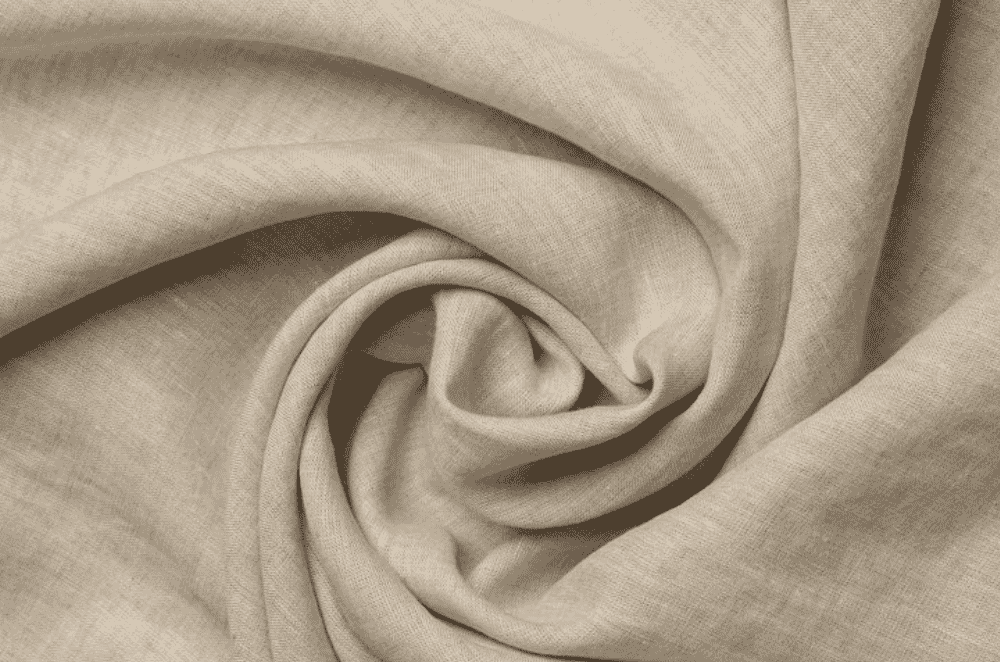
The fibre itself is long, smooth, and hollow, which is why linen breathes so well and holds moisture without feeling damp. When you touch linen, the slightly cool, dry, slubby hand comes from those hollow fibres and from the natural irregularities left after the flax is spun. Unlike cotton, which is a seed fibre with fluffy, twisted structure, linen fibres are straight and stiff, giving linen its characteristic crispness and its habit of holding creases.
In fashion applications, linen is most often woven into plain weaves for shirting, suiting, dresses, and lightweight trousers. Linen jersey knits exist too, but represent a smaller share of production. Portuguese mills sell linen under weight categories measured in ounces per square yard: 4-6 oz for shirting, 8-10 oz for suit weight, and 11+ oz for heavier upholstery-adjacent applications.
Citation Capsule: Linen is a bast fibre fabric spun from the flax plant, in continuous cultivation for textiles for more than 8,000 years. The fibre is long, hollow, and 30 to 40% stronger than cotton, giving linen its characteristic crisp hand, natural cooling, and high moisture management (CELC European Flax and Linen, 2024).
Other names and terminology
You'll see linen sold under names like "flax fabric" (the raw fibre name), "European flax" (verified EU origin), "Belgian linen" (a geographical premium mark), "pure linen" (100% flax content), and "half linen" (blends of 50%+ flax with cotton or viscose). Portuguese mills sometimes label their catalogue as "linho" (100% flax) or "linho misto" (blended). Understanding these labels matters at costing time, because a "linen blend" T-shirt at 30% flax content behaves and prices very differently from a pure linen shirt.
How Is Linen Made?
Linen production starts with the flax plant and ends with woven fabric roughly 90 to 120 days after harvest, one of the longest fibre-to-fabric pipelines in modern textiles. Around 80% of the world's high-quality flax is grown across a narrow coastal strip of Western Europe running through northern France, Belgium, and the Netherlands (CELC European Flax and Linen, 2024). The maritime climate, mild summers, and specific soil chemistry of this belt produce the long, uniform fibres that premium linen requires.
Flax is planted in March and pulled (never cut) in July or August. The plant is pulled up whole so the fibre length is preserved from root to tip. Cutting shortens the fibre and reduces the fabric's strength, so mechanical pullers are used across the European growing region. After pulling, the flax lies in the field for several weeks in a process called retting.
Retting: field retting versus water retting
Retting is controlled decomposition. Microorganisms and moisture break down the pectin that binds the fibre to the woody stem. European producers use dew retting (field retting): the flax is laid out in the field, and dew, rain, and morning fog do the work over two to six weeks. This is why the maritime climate matters. Water retting (immersion in tanks or rivers) exists too, but is now uncommon in Europe because of water pollution and quality-control issues.
Scutching, heckling, and spinning
After retting, the flax is scutched, mechanically broken and beaten to separate the long linen fibres from the woody core (the shive). Heckling follows: the fibres are combed through progressively finer needles to align them, remove short fibres (tow), and produce the long, parallel line-flax used for premium linen yarn. Spinning is the final step. Wet spinning produces the finest, smoothest yarn used for shirting; dry spinning produces the slubbier, more textured yarn used for heavier fabrics.
The entire chain, from field to yarn, is measurably long and specialised. That's why linen fabric is more expensive than cotton, and why the CELC European Flax certification, which traces this chain end to end, carries real weight with buyers.
Citation Capsule: Linen is produced by pulling the flax plant whole in July, dew-retting it in the field for two to six weeks, then scutching, heckling, and spinning the long bast fibres into yarn. Roughly 80% of premium flax comes from a narrow maritime belt in northern France, Belgium, and the Netherlands (CELC European Flax and Linen, 2024).
What Are the Properties of Linen?
Linen has a measurable performance profile that few other natural fibres can match: individual flax fibres are 30 to 40% stronger than cotton fibres of the same thickness, and linen can absorb up to 20% of its weight in moisture without feeling damp against the skin (CELC European Flax and Linen, 2024). These two properties, strength and moisture management, are why linen shirts have been the summer garment of choice for centuries.
Beyond raw performance, linen carries specific behavioural traits that fashion brands need to design around. Some are advantages, some require planning at the tech pack stage.
| Property | Linen (Flax) | Cotton |
|---|---|---|
| Fibre strength (relative) | 130-140 | 100 (baseline) |
| Moisture absorption | Up to 20% weight | Up to 8% weight |
| Drying speed | Fast | Slow |
| Breathability | Excellent | Good |
| Wrinkle resistance | Low (creases easily) | Moderate |
| Softness (new) | Crisp, softens with use | Soft immediately |
| Water use in cultivation | Rain-fed, low | Irrigated, high |
| Typical Portuguese mill price | €10-32 / m | €4-15 / m |
Property comparison across the two dominant natural fibres in modern apparel. Bold marks the fibre that leads on each attribute. Source: CELC European Flax and Linen 2024, ATP fabric survey 2025, PCF factory group data.
Strength, moisture, and cooling
The 30-40% strength advantage over cotton comes from the fibre's structure: long, parallel, and dense. That strength translates to garments that last, which is one of the quiet reasons vintage linen shirts still surface in wearable condition decades later. The moisture management is equally practical. Linen absorbs sweat, releases it fast, and stays dry to the touch in high-humidity conditions where cotton would feel clammy.
Wrinkling: the honest trade-off
Linen wrinkles. That's the fibre being stiff and straight, and no amount of finishing removes it entirely. Enzyme washing softens the initial crispness and reduces the sharpness of creases, but a linen shirt worn all day will look lived-in by evening. Fashion brands need to position linen accordingly: the wrinkles are part of the aesthetic in relaxed shirting, dresses, and holiday collections, but they are the wrong choice for structured tailoring that must stay pressed.
Sustainability profile
Flax cultivation requires little to no irrigation across its main European growing regions, no defoliants, and minimal pesticide use compared with conventional cotton. The plant also captures carbon in soil during its short growing cycle. This is why linen is one of the few fibres that carries genuine environmental credentials rather than marketing language, and why the European Flax certification has become a serious buying signal for eco-focused brands.
Citation Capsule: Linen fibre is 30 to 40% stronger than cotton and absorbs up to 20% of its weight in moisture without feeling damp, giving it a measurable performance advantage in summer garments. Flax cultivation is rain-fed across the main European growing belt, which underpins linen's environmental credentials (CELC European Flax and Linen, 2024).
Linen vs Cotton: How Do They Compare?
Linen and cotton dominate the natural-fibre apparel market together, but they solve different problems. Cotton is the softer, cheaper, easier-to-manage fibre used across 24% of global apparel production (Textile Exchange, 2024). Linen is the stronger, cooler, more premium fibre chosen when performance in heat and a specific hand-feel matter more than baseline softness.
The differences aren't opinion. They come from fibre structure. Cotton is a short, twisted seed fibre; linen is a long, straight bast fibre. That single structural difference explains almost every practical distinction between the two fabrics.
Where linen beats cotton
Linen wins on breathability, cooling, moisture management, drying speed, and strength. In summer conditions, or for garments worn in hot climates, linen is the objectively better performer. It also wins on cultivation footprint: flax is rain-fed and pesticide-light, while conventional cotton is one of the more water-intensive and chemically intensive crops in global agriculture.
Where cotton beats linen
Cotton wins on softness out of the box, wrinkle resistance, ease of dyeing to bright colours, and price. Cotton also handles complex constructions like French terry, jersey, and twill more easily, because the shorter, twistier fibres knit and weave into more elastic fabrics. And cotton is cheaper across every tier: standard Portuguese cotton twill runs €4 to €9 per meter, whereas the entry point for European linen is €10 per meter.
Blends: linen-cotton and linen-viscose
Most modern "linen" garments in the mainstream retail tier are actually blends. A 55% linen / 45% cotton blend is the most common blend at Portuguese mills, priced at €7 to €14 per meter. It carries most of linen's cool hand and drape, but softens the wrinkling and drops the price. Linen-viscose blends (typically 50/50 or 60/40) run €8 to €16 per meter and give linen a smoother, more fluid drape suited to dresses and wide-leg trousers.
Founder-side observation: we consistently see brands select 100% linen for their "hero" summer piece (the shirt or dress that carries the collection's story), and blends for the supporting pieces. That's a defensible strategy. Pure linen carries the narrative and the price ceiling; blends carry the volume and the softer entry price.
What Garments Are Made with Linen?
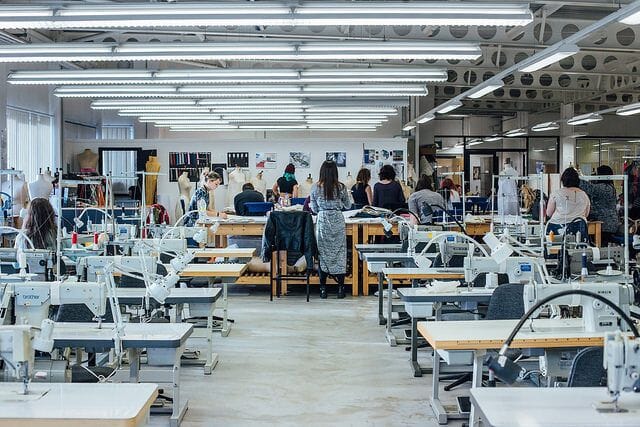
Linen dominates warm-weather and holiday apparel: about 25% of the factories in our documented Portuguese group work regularly with linen, primarily for shirts, dresses, lightweight trousers, blazers, and kimono robes. The category has grown steadily since 2019 as European consumers have rebuilt summer wardrobes around natural fibres.
Specific garment applications by weight tier:
- Shirting weight (4-6 oz / 130-200 GSM): button-down shirts, camp collars, blouses, lightweight dresses, kaftans, kimono robes
- Suit weight (8-10 oz / 270-340 GSM): trousers, unstructured blazers, structured dresses, midweight jackets
- Heavy weight (11 oz+ / 370+ GSM): overshirts, upholstery-adjacent apparel, workwear-inspired pieces
- Linen jersey knits (140-220 GSM): T-shirts, relaxed tops, summer sweatshirts
Portuguese brands and their overseas customers use linen most heavily in the shirt and dress categories. A well-cut linen shirt is the archetypal Portuguese-made premium summer garment, and the country's shirt factories, especially in the Porto and Braga areas, have decades of accumulated experience with linen sewing, which requires slightly different needle, thread, and machine settings from cotton.
Where linen is less common
Linen doesn't appear often in structured tailoring, sportswear, activewear, denim replacements, or heavy outerwear. It's the wrong fibre for garments that need to stay pressed, stretch significantly, or resist abrasion under load. Brands attempting linen in these categories typically use heavy blends (linen with a synthetic backbone), which changes the fibre story enough that the linen label starts to feel like decoration rather than substance.

Find your factory: Browse the free factory directory preview, or unlock the premium directory for €39 to see 80 documented Portuguese factories with linen capability flagged.
What Does Linen Cost per Meter in Portugal?
Linen fabric prices at Portuguese mills in 2026 range from €7 per meter for a light linen-cotton blend to €32 per meter for premium Belgian linen at suit weight. Composition (100% linen versus blend), origin (European Flax certified versus generic), and certification (GOTS organic) explain roughly 85% of price variance across suppliers (ATP, 2025).
Understanding these tiers matters at costing time. A linen shirt using 1.8 meters of standard European linen at €14 per meter carries €25 of fabric alone before CMT. The same shirt in Belgian premium linen carries €50+ of fabric. Both are viable business models, but they land in very different retail brackets.
Blend prices sit lowest
Linen blends (60/40 with cotton, 50/50 with viscose) start at €7 per meter and are the entry point for volume brands. They soften linen's hand, reduce wrinkling, and drop the fabric cost roughly 30-50% below pure linen.
Pure European linen sits in the middle
Standard European linen shirting at 4-6 oz runs €10 to €20 per meter. Suit weight (8-10 oz) is €14 to €28. Both are the mainstream tier for Portuguese-made linen apparel and are what most emerging brands land on for their first collection.
Certifications and origin add measurable premium
European Flax certification (formerly Masters of Linen) verifies EU origin, non-irrigated cultivation, and traceable processing. It adds €2 to €5 per meter over uncertified equivalent. GOTS organic linen adds €3 to €8 per meter. Belgian premium linen (which is specific to certain mills in Belgium and generally uses the finest European Flax) runs €14 to €32 per meter and lands squarely in the luxury tier.
Comparison table: linen types at Portuguese mills
| Linen Type | Composition | Typical Weight | EUR / meter | Certification |
|---|---|---|---|---|
| Standard European linen (shirting) | 100% flax | 4-6 oz | €10 - €20 | Optional |
| Standard European linen (suit) | 100% flax | 8-10 oz | €14 - €28 | Optional |
| European Flax certified | 100% EU flax | Varies | +€2 - €5 | European Flax |
| Belgian linen premium | 100% Belgian flax | Varies | €14 - €32 | European Flax + origin |
| GOTS organic linen | 100% organic flax | Varies | +€3 - €8 | GOTS |
| Linen-cotton blend | 60/40 or 50/50 | 5-7 oz | €7 - €14 | Optional |
| Linen-viscose blend | 50/50 or 60/40 | 5-7 oz | €8 - €16 | Optional |
| Linen jersey knit | 100% flax or blend | 140-220 GSM | €8 - €15 | Optional |
Sources: ATP fabric price survey (2025), PCF factory group quotes (2024-2026), industry mill references.
Practical costing: for a summer shirt using 1.8 meters of European linen at €14 per meter, fabric alone is €25 per garment. Add CMT, trims, and margin, and the retail floor for a Portuguese-made linen shirt lands around €90-120. Brands positioning below that price point typically use blends or import lower-tier Asian or Eastern European linen.
Need a tech pack? Get a factory-ready single-style tech pack for €79. See what's included.
Where Is the World's Best Linen Grown?
About 80% of the world's high-quality flax is grown across a 200-kilometre coastal belt through northern France, Belgium, and the Netherlands (CELC European Flax and Linen, 2024). This concentration is unusual for any global textile fibre and reflects a specific match between the flax plant and this region's climate, soil, and centuries of accumulated agronomic expertise.
The reasons Western Europe dominates premium flax are practical, not sentimental. Flax needs a maritime climate with mild summers, regular rainfall during the growing season, and a specific soil chemistry: silty, well-drained, with the right calcium and pH balance. That combination exists reliably in the Normandy-Flanders-Zeeland corridor and almost nowhere else at scale.
France, Belgium, and the Netherlands
France produces roughly 70% of European flax by acreage, primarily in Normandy and Hauts-de-France. Belgium and the Netherlands make up most of the rest, with Belgium in particular anchoring the premium end through both cultivation and specialist retting and spinning capacity. Belgian linen mills like Libeco and Verilin have become reference points in the industry, and "Belgian linen" carries genuine premium associations rather than marketing gloss.
European Flax certification
The European Confederation of Linen and Hemp (CELC) runs the European Flax certification (formerly known as Masters of Linen), which verifies that flax was grown in Europe, retted mechanically or by dew (never chemically), and processed through certified stages. For fashion brands positioning linen as a sustainable choice, European Flax certification is the strongest single signal available.
Portuguese linen production
Portugal doesn't grow flax at commercial scale. The Portuguese role in the linen supply chain is downstream: importing European flax yarn and fabric, and weaving, dyeing, finishing, and CMT-manufacturing at mills in the Ave Valley and Vale do Ave clusters (Guimarães, Vila Nova de Famalicão, Braga). ATP counts around 12,000 Portuguese textile and clothing companies, and a meaningful subset of the northern cluster has decades of linen shirt and dress production experience (ATP, 2025).
Production-side observation: across 2024-2026 runs coordinated through our factory group, roughly 25% of factories work regularly with linen. Common uses are shirts, dresses, trousers, blazers, kimono robes, and lightweight tops. MOQs sit between 200 and 500 units per style, with 6-9 week lead times end-to-end and 2-3 sample rounds typical before production approval.
Citation Capsule: Around 80% of premium flax is grown in a coastal maritime belt through northern France, Belgium, and the Netherlands. European Flax certification verifies EU origin, mechanical or dew retting, and traceable processing, and is the strongest single sustainability signal available for linen apparel (CELC European Flax and Linen, 2024).
Talk to a real person: Get in contact and we'll tell you which 2 to 3 factories in our group actually fit your brief.
Which Portuguese Mills Actually Weave and Knit Linen?
Roughly 25% of the PCF documented factory group works regularly with linen, and the mill supply behind those factories concentrates on a shortlist of six to eight names that either weave linen in Portugal or import European linen fabric under licensing chains that carry European Flax certification through to finished cloth (ATP, 2025). For founders, the mill layer matters because Portugal is downstream in the flax supply chain: no commercial flax is grown in Portugal, so every linen fabric shipped from a Portuguese mill originates from yarn or greige cloth imported from Northern Europe.
The certification chain matters for the same reason. European Flax (formerly Masters of Linen) is a CELC-run scheme covering agronomy through spinning. Portuguese mills that carry the European Flax mark on finished cloth do so under chain-of-custody documentation from the upstream spinner, typically Safilin, Terre de Lin, Depestele, or the Van de Wiele group.
Belgian, French, and Italian flax origins
Not all European linen is equal. Belgian flax (grown in West Flanders, retted and scutched in Belgium) is the reference for premium shirting and suiting cloth, with mills like Libeco and Verilin producing at the highest end. French flax dominates the volume tier: roughly 70% of European flax by hectare is grown in Normandy and Hauts-de-France, and Safilin plus Terre de Lin between them cover most European linen yarn spinning. Italian flax is a smaller category, but Italian weavers (particularly around Como and Biella) finish some of the best-drape linen shirtings sold into Portuguese mills.
- Belgian flax: premium tier, dew-retted in maritime Flanders, spun in Belgium. Fabric price €14 to €32 per meter at Portuguese mills. Adds €2 to €5 over generic European linen when carrying the European Flax mark.
- French flax: volume tier, dew-retted in Normandy or Hauts-de-France, spun in France or Poland (Safilin). Fabric price €10 to €22 per meter. Widest availability, most stable pricing.
- Italian flax: small volume, often blended origin, finished for drape in Italian mills. Fabric price €14 to €26. Common in premium shirting programmes routed through Portuguese CMT.
Dew retting versus water retting versus enzymatic retting is a separate axis. European producers use dew retting (field-lying for two to six weeks) almost exclusively today. Water retting is now uncommon due to effluent regulation. Enzymatic retting (controlled fermentation with pectinase enzymes) is emerging in trials but has not reached commercial scale in Northern Europe. European Flax certification requires dew or mechanical retting, never chemical.
Portuguese linen mill shortlist
| Mill | Cluster | Linen speciality | Certifications | Typical fabric MOQ |
|---|---|---|---|---|
| Somelos | Guimarães | Linen shirtings (4-6 oz), linen-cotton blends, yarn-dyed programmes | OEKO-TEX Standard 100 Class II, GOTS, European Flax (chain of custody) | 200 m per colour |
| Riopele | Famalicão | Linen-viscose and linen-blend woven cloth, suit weight (8-10 oz) | OEKO-TEX Class II, GRS, bluesign, European Flax (on request) | 300 m per colour |
| Troficolor | Guimarães | Yarn-dyed linen stripes, linen-cotton jacquards, shirting (5-6 oz) | OEKO-TEX Class II, GOTS, European Flax | 300 m per colour |
| Adalberto | Vale do Cávado | Print-ready linen and linen blends (shirting to bottomweight) | OEKO-TEX Class II, GOTS, GRS | 200 m per colour |
| Tintex | Vila Nova de Cerveira | Linen jersey knits (140-220 GSM), Lenzing linen blends | OEKO-TEX Class II, GOTS, GRS, bluesign, EU Ecolabel | 250 m per colour |
| Lameirinho | Guimarães | Linen shirtings (4-6 oz), enzyme-washed linen for garment-wash programmes | OEKO-TEX Class II, GOTS | 300 m per colour |
Sources: ATP mill directory (2025), CELC European Flax licensee registry (2024), PCF factory group booking data.
EUR fabric cost at real Portuguese minimums
Linen pricing at Portuguese mills tracks minimum order size sharply. Below 300 meters per colour, the surcharge tier reflects the mill's need to book a full loom warp (typically 400 to 600 meters) or absorb the setup cost. Above 500 meters the price compresses meaningfully. The table below reflects standard 5 oz shirting weight European linen (100% flax) and European Flax certified equivalents.
| Fabric MOQ (per colour) | Standard European linen shirting (EUR/m) | European Flax certified (EUR/m) | Belgian premium linen (EUR/m) |
|---|---|---|---|
| 100 m (surcharge tier) | €13.50 to €18.50 | €15.50 to €21.00 | €19.00 to €28.00 |
| 300 m (standard tier) | €11.50 to €15.50 | €13.50 to €17.50 | €16.00 to €24.00 |
| 500 m (compressed tier) | €10.20 to €13.80 | €12.20 to €16.00 | €14.50 to €22.00 |
| 1,000 m (published tier) | €9.60 to €12.80 | €11.60 to €15.00 | €14.00 to €20.50 |
Sources: ATP fabric price survey (2025), PCF factory group quotes across six named Portuguese mills (2024-2026), CELC price benchmarking (2024).
On a 300 unit shirt run using 1.8 meters of 5 oz per garment (540 meters total), moving from the 100 meter surcharge tier to the 500 meter compressed tier saves roughly €5.20 to €8.50 per garment in fabric alone. On a European Flax certified programme the saving is €5.90 to €9.00 per garment.
Citation Capsule: Six named Portuguese mills carry linen as running or booked-to-order programmes, with certification chains routed through Safilin, Terre de Lin, Depestele, and Van de Wiele on the spinning side and CELC European Flax on the finished-cloth side. Somelos, Troficolor, Adalberto, and Lameirinho hold the strongest GOTS and European Flax coverage among Portuguese linen weavers, and Tintex is the reference name for linen jersey knits (ATP, 2025; CELC European Flax and Linen, 2024).
What Are the Common Linen Sourcing Mistakes?
Roughly 68% of first linen production runs coordinated across the PCF documented factory group between 2024 and 2026 needed at least one spec correction between first fit sample and production approval ([PCF factory group data], 2024-2026). Linen is unforgiving of vague specs because the fibre's stiffness, shrinkage behaviour, and dye affinity are all measurably different from cotton, and mills default to whatever base cloth they have running when the spec is silent.
Mistake 1: Assuming linen shrinkage matches cotton
Standard European linen shirting shrinks 6 to 10% on the first wash if unfinished, and 3 to 5% if pre-shrunk. Cotton shirting typically shrinks 2 to 4%. Founders who size linen shirts to a cotton shrinkage assumption lose a full size across body length and sleeve. Specify explicitly: "First-wash shrinkage 5% max in length, 4% max in width, tested to ISO 6330, pre-shrunk to specification".
Mistake 2: Wrong dye class for pure linen
Linen accepts reactive dyes (Cotton Class 3) but requires longer dye cycles and higher salt loading than cotton to achieve equivalent colour depth. Vat dyes give the most colour-fastness on linen but restrict the shade palette. Direct dyes are cheaper but wash out faster. A tech pack that specifies "reactive dye" without acknowledging the cellulose difference can produce uneven or pale colour across a linen batch.
Mistake 3: Enzyme wash without an enzyme-wash-approved base cloth
Enzyme-washed linen (for the lived-in, soft hand that most premium linen shirts sell on) requires a mill that supplies enzyme-wash-approved greige. Silicone softeners applied at fabric finishing block later enzyme wash from taking effect, producing a shirt that stays crisp after wash and reads unfinished on the retail shelf. Naming enzyme wash on the tech pack means naming an enzyme-wash-compatible mill upstream.
Mistake 4: Substituting linen-viscose for pure linen without disclosure
Linen-viscose blends at 50/50 or 60/40 drape more fluidly than pure linen and cost 30 to 45% less. Some mills quote linen-viscose blends against "linen shirt" briefs when the price target does not support pure linen. Founders receive a fabric that reads and prices differently, and the retail claim ("100% linen") no longer holds. Specify composition unambiguously: "100% European flax, no viscose or cotton content".
Mistake 5: Ignoring GSM tier for the intended silhouette
Linen tiers by weight: 130 to 200 GSM (shirting), 270 to 340 GSM (suit weight), 370+ GSM (bottomweight and overshirt). A 4 oz linen shirt drapes and moves; a 5 oz linen shirt sits with more structure; an 8 oz linen trouser holds shape across a day of wear. Specifying "linen" without a GSM invites the mill to default to whatever weight is running, which then fails at fit sample because the drape does not match the sketch.
Decision matrix: choose linen versus alternatives
| Choose 100% European linen when... | Consider linen-cotton or linen-viscose blend when... | Consider cotton or lightweight twill when... |
|---|---|---|
| The programme is a hero summer piece or premium shirt | The price ceiling is €70 to €120 retail on a linen-look shirt | Structured tailoring must stay pressed all day |
| European Flax or Belgian linen certification carries retail weight | Wrinkle reduction and softer initial hand matter | Bright, saturated colours are non-negotiable |
| Retail band is €90 to €280 for the shirt or dress | Retail band is €55 to €120 | Retail band is €35 to €90 |
| Fabric budget is €10 to €32 per meter | Fabric budget is €7 to €16 per meter | Fabric budget is €4 to €12 per meter |
| Lead time of 6 to 9 weeks is acceptable | Same 5 to 8 week window applies | Lead time compresses to 4 to 6 weeks |
| The wrinkled, lived-in aesthetic is a selling point | Some wrinkling is acceptable, less is preferred | Pressed, structured, minimally wrinkled look is required |
Sources: PCF factory group tech pack review data (2024-2026), ATP fabric price survey (2025), CELC benchmarks (2024).
Founder-side observation: the single tech pack change that most reduces sample rounds on linen is stating three things together: fibre origin (European Flax or Belgian), retting method (dew retting), and enzyme wash status. Across production runs coordinated through our factory group in 2024-2026, tech packs that specified all three averaged 1.5 sample rounds. Tech packs that specified only "linen" averaged 3.1 rounds. That is roughly 10 to 14 calendar days saved per style, and it eliminates the "the fabric doesn't feel like the sample" conversation that kills linen programmes at second fit review.
Citation Capsule: Roughly 68% of first linen production runs require a spec correction, with the corrections concentrated in shrinkage tolerance, dye class mismatches, enzyme wash incompatibility, undisclosed viscose substitution, and missing GSM specification. Naming European Flax or Belgian origin, dew retting, GSM, and enzyme wash status compresses sample-round count from 3.1 to 1.5 iterations on average across PCF-coordinated runs ([PCF factory group data], 2024-2026).
Conclusion: What This Means for Your Brand
The practical takeaway across the sections above: match linen to the product categories where its properties actually matter, specify it clearly on the tech pack (name the branded fibre or exact composition), and route production to a Portuguese factory in the subset that stocks the yarn or has the finishing lines built for it.
Get the spec right and the fabric becomes a repeatable, reliable choice. Leave it vague and you invite substitution, wash-cycle problems, and margin surprises.
Running into production issues? Get in contact and tell us what you're making. We're a group of documented Portuguese garment factories and we answer every serious brief within 24 hours.
Frequently Asked Questions About Linen
Is linen more sustainable than cotton?
Yes, on most measures. Flax cultivation is rain-fed across the European growing belt, uses minimal pesticides, and requires no defoliants. Conventional cotton is one of the more water-intensive and chemically intensive crops in global agriculture. European Flax certification verifies the sustainability chain end to end (CELC European Flax and Linen, 2024).
Why does linen wrinkle so much?
Linen wrinkles because flax fibres are long, straight, and stiff. Unlike cotton's twisted structure, which springs back, linen fibres hold whatever position they're pressed into. Enzyme washing softens the initial crispness and reduces the sharpness of creases, but no finishing removes wrinkles entirely. Fashion brands should position linen for relaxed, lived-in aesthetics rather than structured pressed looks.
Is Belgian linen actually different from other European linen?
Yes, in a meaningful way. Belgian linen refers to fabric woven at specific Belgian mills, typically using flax grown in the same coastal maritime belt but processed through Belgium's specialist spinning and finishing capacity. It commands €14 to €32 per meter at Portuguese mills, compared to €10 to €20 for standard European linen at similar weights.
What is European Flax certification?
European Flax (formerly Masters of Linen) is a certification run by CELC verifying that flax was grown in Europe, retted mechanically or by dew rather than chemically, and processed through certified stages. It adds €2 to €5 per meter to fabric price at Portuguese mills and is the strongest single origin and sustainability signal available for linen apparel.
What is the minimum order for linen production in Portugal?
MOQs at documented Portuguese factories working with linen typically start at 200 units per style, with 300 to 500 units being the most common tier. Lead times run 6 to 9 weeks end-to-end, and 2 to 3 sample rounds are typical before production approval. Blend fabrics generally have lower MOQs than premium pure linen or Belgian linen.
Can linen be certified organic?
Yes. GOTS-certified organic linen is available from Portuguese mills, typically at a €3 to €8 per meter premium over conventional linen. Because flax is already grown with minimal pesticide input across the European belt, GOTS-certified linen is a smaller step from baseline than GOTS cotton, but it still carries strong retailer and consumer signal value.
We're a group of 80 documented Portuguese clothing factories, 25 verified, based in Porto and Guimarães. Tell us your product, volume, and timeline. We'll route your production to the right factory in the group, usually within 24 hours. Flat fees, no commissions, no upsell.
Get in contact Download the directory (€39)Need a tech pack? Get a factory-ready single-style tech pack for €79. See what's included.
Sources used in this article
- CELC European Flax and Linen - European Confederation of Linen and Hemp, industry data and European Flax certification (2024)
- ATP - Associação Têxtil e Vestuário de Portugal, fabric price survey (2025)
- Textile Exchange - Preferred Fiber and Materials Market Report (2024)
- EURATEX - European Apparel and Textile Confederation, Facts & Key Figures (2024-2025)
- PCF internal factory documentation (2024-2026) - Data from 80 documented and 25 verified Portuguese factories in our group, covering linen MOQ patterns, pricing observations, and lead times
Portugal Clothing Factory is a group of 80 documented Portuguese clothing factories in the northern textile cluster (Porto, Guimarães, Braga, Barcelos, Famalicão). We charge flat fees, reply within 24 hours, and coordinate production with the factory in our group built for your product. See how we work or get in contact to place your order.