Key Takeaways
- Sampling is not optional. Every reputable factory requires at least a pre-production sample before bulk. Skipping it guarantees problems in the final shipment.
- Four main sample types. Proto, fit, size set, and pre-production (PP). Each serves a specific purpose and happens at a specific stage. You don't need all four for every project.
- Budget 2 to 3x bulk unit cost per sample. A garment that costs €15 to manufacture in bulk will cost €30-€45 per sample due to manual cutting, custom patterns, and machine setup.
- Plan for 2 to 3 rounds. Most new styles require 2 to 3 sample iterations before a PP sample is approved. Each round takes 7 to 14 days in Portugal.
- Your tech pack determines sample quality. An incomplete brief produces an inaccurate sample. CITEVE (2024) attributes 60% of QC failures to incomplete tech packs. Every ambiguity becomes a defect.
- The PP sample is your legal reference. Keep it. It's the standard against which the bulk shipment is compared and your grounds to reject if production doesn't match.
- Sample fees are often refundable. Many Portuguese factories credit sampling costs against your first bulk order above 100-300 units. Always clarify upfront.
- Portugal sampling is roughly 4 to 6 weeks faster than Asia. Same factory speed, dramatically faster courier transit between rounds.
Heads up: We're Portugal Clothing Factory, a group of 80 documented Portuguese clothing factories. The numbers below come from running sample rounds with our 80 documented Portuguese factories between 2024 and 2026. EUR throughout, manufacturer-group lens.
Need a tech pack? Get a factory-ready single-style tech pack for €79. See what's included.
Why Sampling Exists (and Why You Can't Skip It)
Here's a scenario that plays out dozens of times a week in the fashion industry: a brand founder has a design, sends reference images to a factory, gets a quote, and places a production order. Six weeks later, 200 garments arrive that don't fit right, use the wrong construction technique, and have a finish that looks nothing like the reference photo.
This is avoidable. It's avoided by sampling.
Sampling is the bridge between what you designed and what gets manufactured at scale. It's where the pattern is built, the construction is tested, the fit is assessed, and the material quality is confirmed before a single unit of bulk production is cut. Every professional factory requires it. Attempting to bypass it is the most reliable way to waste both your budget and your production window, particularly as fashion brands face mounting pressure to compress time-to-market while protecting margins (McKinsey & BoF State of Fashion, 2024).
In our placement records since 2021, the brands that ran 2-3 properly disciplined sample rounds reported defect rates of 1-3% on bulk shipments. The brands that pushed for "just send us the order, we'll skip sampling" averaged 8-22% defect rates and lost the price gap many times over in rework and returns.
This guide walks you through the full sampling process: what each stage does, what it costs in Portugal, how long it takes, what to send the factory, what to inspect when samples arrive, and how to give feedback that actually moves things forward.
What Do You Need to Prepare Before Ordering a Sample?
The tech pack
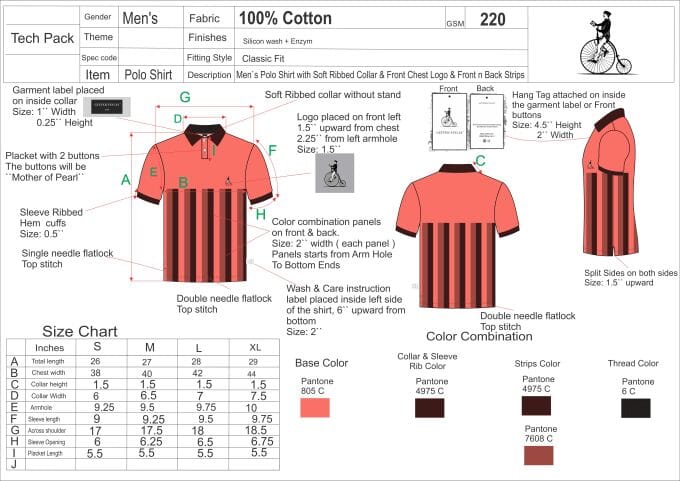
The tech pack is the single most important document in your production relationship. It's your garment's blueprint, the complete technical specification that tells the factory exactly what to make. A complete tech pack includes:
- Technical flat sketches (front, back, detail views)
- Points-of-measure (POM) table with grading rules across all sizes
- Construction notes (seam allowances, stitch type and SPI, hem finish)
- Fabric specifications (weight in GSM, composition, weave or knit structure)
- Trim details (zippers, labels, buttons, thread colours, elastic specs)
- Colour references (Pantone codes or physical colour standards)
- Care label content compliant with EU Regulation 1007/2011
- Acceptable measurement tolerances (typically ±1 cm for knits, ±0.5 cm for wovens)
Factories receive dozens of enquiries per week. A complete tech pack signals professionalism and gets your project taken seriously. An incomplete brief produces an inaccurate sample, and every revision round costs time and money. If you don't have one yet, see our full walkthrough on how to create a tech pack before approaching any factory.
Citation Capsule: CITEVE (2024) attributes roughly 60% of QC failures in Portuguese textile production to incomplete tech packs. The €290-€600 tech pack investment per style on the market (or €79 with our service) consistently saves 1 to 2 sample revision rounds, which alone justifies the cost.
If you don't have a tech pack, get one made before approaching factories. Most Portuguese factories will quote politely on incomplete briefs and then iterate at your expense; better to arrive with a complete document, particularly given the Portuguese cluster's reputation for technically rigorous sample development (Citeve, 2024).
The reference garment
If you have an existing garment with a fit you love, a tee that drapes perfectly, a jacket with the right proportions, ship it as a reference alongside your tech pack. A physical reference is worth pages of written specification. Factories can feel the weight, assess the seam construction, and understand the intended result immediately. We've watched first-time sample turnaround times drop by 30% when a physical reference accompanies the brief.
Fabric swatches or specifications
If you have specific fabric requirements, source swatches or define the exact specification before ordering the proto. If your intended fabric isn't available yet, sampling in a substitute fabric (similar weight and structure) is standard practice for the proto stage. For fit-critical garments (tailoring, performance wear), insist on near-final fabric from the fit-sample stage onward.
Realistic timeline expectation
Before placing a sample order, mentally commit to the timeline:
- New style with new factory: 6 to 12 weeks from brief to approved PP sample
- New style with familiar factory: 4 to 8 weeks
- Reorder of approved style: 2 to 3 weeks (PP only)
If your launch window is 8 weeks away and you're starting from scratch, you're already late. Plan accordingly. For a deeper breakdown of how production schedules unfold week by week, see our guide on Portuguese clothing production lead times.
What Are the Four Main Sample Types?
Stage 1: Proto sample (prototype)
What it is. The first physical version of your garment, made from substitute fabrics that approximate your final material in weight and structure. Not necessarily the right colour or final composition.
What it's for. Assessing the silhouette, proportions, construction method, and overall design intent. Not meant to look finished. Meant to test whether the pattern works.
What to check.
- Overall silhouette: does it match your design intent?
- Seam placement and construction
- Proportion: are the pockets, collar, and cuffs where they should be?
- Major fit issues
- Construction approach (factory may have used a method that won't scale)
Timeline: 7 to 14 days from tech pack submission to arrival in Portugal.
Cost: 2 to 3x bulk unit cost. A €15 hoodie equates to a €30-€45 proto sample.
Pro tip. Don't reject a proto because it's in the wrong colour or fabric. It's not supposed to look finished. Assess structure and construction only.
Stage 2: Fit sample
What it is. Made using the actual (or close-to-actual) pattern from the approved proto, typically in final or near-final fabrics. Focuses on how the garment fits a real body.
What it's for. Confirming measurements, assessing drape and movement, testing how the garment looks and feels when worn. This is where you do a real fit session: put it on a fit model or a person whose measurements match your target size.
What to check.
- All key measurements against your specification sheet (within tolerance)
- How it moves: can the wearer sit, raise arms, move freely?
- Fabric behaviour: does it drape as expected?
- Finishing quality: are hems straight, zippers smooth?
- Label placement and care content
Timeline: 7 to 14 days per round.
Cost: 2 to 3x bulk unit cost.
Note. This stage is sometimes combined with the proto stage for simple garments. For complex or fit-critical garments (fitted dresses, tailored jackets, performance wear), it's always a separate stage.
Stage 3: Size set sample
What it is. Samples produced in every size the style will be sold in (e.g., XS through XL).
What it's for. Validating that grading is correct, that scaling the pattern up and down from the base size produces garments that fit correctly across all sizes. A pattern that fits perfectly in Medium can still produce a Large that's too narrow in the shoulders.
When you need it. Only after the proto and fit samples are approved. Never order a size set until you're satisfied with the base size fit. If the Medium doesn't work, the Small and XL will be wrong too.
Cost: One sample per size × 2 to 3x unit cost.
Timeline: 10 to 14 days.
Skip it if. You're producing in a single size for initial testing, or you're a very experienced brand with confidence in your grading rules.
Stage 4: Pre-production sample (PP sample / Golden Sample)
What it is. Produced on the actual production line using all final approved materials. The exact fabric, the exact trims, the exact labels, the exact wash treatment.
What it's for. This is your final quality check before bulk production begins. It confirms that the factory's production line can reproduce the approved sample consistently. It is also your legal reference document.
Critical rule. Keep the PP sample physically in your hands after approving it. When your bulk shipment arrives, compare it directly against the PP sample. If there are discrepancies, you have grounds for a quality claim based on failure to match the approved standard.
Timeline: 10 to 14 days after all materials are confirmed.
Cost: 2 to 3x unit cost.
In our placement records, brands that lost or discarded the PP sample post-approval consistently struggled to win quality disputes against factories. The PP sample is the single most important physical document in your supplier file.
Sample Types Summary Table
| Sample type | Purpose | Made in | Timeline | Cost | When to order |
|---|---|---|---|---|---|
| Proto | Test design and construction | Substitute fabric | 7-14 days | 2-3x unit | First contact with new factory |
| Fit sample | Test measurements and drape | Final or near-final fabric | 7-14 days | 2-3x unit | After proto approved |
| Size set | Validate grading across sizes | Final fabric | 10-14 days | 2-3x unit × sizes | After fit approved |
| Pre-production (PP) | Final approval before bulk | Final materials, production line | 10-14 days | 2-3x unit | Before bulk production begins |
| Salesman sample (SMS) | Sales and marketing | Final materials | 7-14 days | 2-3x unit | Optional, for wholesale buyers |
| TOP (Top of Production) | Confirm bulk production | Bulk production materials | Pulled from production | Bulk price | During bulk production |
Source: see in-text citations in this section.
Citation Capsule: The four main clothing sample types are proto (design validation), fit (measurement and drape confirmation), pre-production/PP (final approval using bulk materials), and TOP/golden sample (production-quality reference). Most new styles require 2 to 3 rounds before bulk production; complex garments may need 4 to 5.
How Many Sample Rounds Should You Expect?
The number of rounds depends on three factors: garment complexity, brief quality, and your tolerance for incremental changes.
| Scenario | Typical rounds | Total sampling time |
|---|---|---|
| Simple style (basic tee, fleece), complete tech pack | 2 rounds | 4-6 weeks |
| Mid-complexity (jacket, structured dress), complete tech pack | 2-3 rounds | 5-8 weeks |
| Complex style (outerwear, tailoring), complete tech pack | 3-5 rounds | 7-12 weeks |
| Any style, incomplete tech pack | Add 1-2 rounds | +2-4 weeks |
| Reorder of existing approved style | 1 round (PP only) | 2-3 weeks |
Sources: PCF placement records 2024-2026.
On average, brands go through 2.3 rounds of sampling before bulk production approval for a new style in our pipeline. Experienced brands working with long-term factory relationships consistently hit PP approval in 2 rounds. First-time brand founders working from a vague brief typically need 4 to 5.
The single biggest variable: tech pack completeness. Brands that arrive with a CITEVE-grade tech pack hit 2 rounds. Brands that arrive with a sketch and verbal description hit 4-5.
What Does Sampling Cost in Portugal?
The 2 to 3x rule
Sampling costs more than production because it requires manual work that bulk production automates: custom pattern cutting, hand-guided assembly, machine setup for a single garment, and the factory's time managing a one-piece job alongside bulk orders.
Budget per style, three-stage development:
| Stage | Average cost (€) | Notes |
|---|---|---|
| Proto sample | €150-€400 | Substitute fabric, basic construction |
| Fit sample | €120-€350 | Near-final fabric, full construction |
| PP sample | €200-€500 | Final materials, production line run |
| Total per style | €470-€1,250 | Before revision rounds |
| Each additional revision | €120-€350 | Same as fit sample cost |
Source: see in-text citations in this section.
For complex garments (outerwear, tailored pieces, performance wear), total sampling can reach €1,200-€2,500 per style when custom materials and multiple revision rounds are involved.
Sample fee refundability
Many Portuguese factories offer to credit sampling fees against your first bulk order above a minimum threshold (typically 100 to 300 units). Always ask upfront:
- Is the sample fee refundable?
- What bulk order size qualifies for the credit?
- Does the credit apply per style or per order?
- What's the credit ceiling per sample (some factories cap at €150-€250)?
In our experience, refundability is roughly 50/50 across the Portuguese factory pool. Specialist factories more often refund; export-tier factories rarely do. The factory-selection stage matters here, so vet candidates carefully. Our guide on how to find a clothing manufacturer covers what to ask before you commit a sampling fee.
Hidden sampling costs
Beyond the per-sample fee, budget for:
- Courier shipping per round: €25-€80 EU, €100-€220 to North America
- Fit model time: €60-€120 per session if you don't have an in-house model
- Photography of the sample for documentation: internal cost
- Your team's time: measuring, photographing, writing comments
- Pattern revision fees: €50-€200 per significant pattern change
Realistic all-in cost for a 3-round sampling cycle on a single moderate-complexity style: €1,400-€2,800 per style.
Try it free: Pressure-test these numbers for your specific product with our garment cost calculator. 60 seconds, no email required.
.jpeg?format=webp)
Citation Capsule: Portuguese clothing samples typically cost 2-3x the bulk production unit cost. For a 3-round sampling process (proto, fit, PP), budget €470-€1,250 per style. Complex outerwear or tailored pieces can push sampling to €1,200-€2,500 per style. Many factories credit sampling fees against the first bulk order above a minimum quantity threshold.
What's the Step-by-Step Sampling Workflow?
Step 1: Submit your brief
Send your tech pack, reference garment (if available), and fabric specifications. Include your target timeline and bulk quantity so the factory can assess priority. Specify whether you want stock-fabric proto or final-fabric proto (latter takes longer and costs more but eliminates a round of fabric translation).
Step 2: Confirm the quote and timeline
The factory confirms sampling cost, timeline, and any materials they'll need to source. For non-stocked fabrics, factor in 2 to 4 weeks of sourcing time before sampling begins. Get the quote and timeline in writing before you transfer the sample fee.
Step 3: Approve the proto
When the proto arrives, assess construction, proportion, and silhouette. Not colour or finish. Provide clear, specific feedback (template below). "The shoulder seam sits 2 cm too far forward" is actionable. "This doesn't look right" is not.
Step 4: Iterate to fit sample
After proto corrections, the fit sample is produced in final or near-final fabric. Run a proper fit session: measure every key dimension against your spec sheet and document discrepancies with photos. Test movement (sit, reach, walk).
Step 5: Approve the PP sample
The PP sample is your final checkpoint. Assess everything: construction, measurements, materials, labels, finishing, packaging. If it passes, sign off and release the bulk production order. Keep the PP sample physically.
Step 6: Monitor production with TOP sampling
Some factories pull a TOP (Top of Production) sample from the bulk production line partway through. This is an early-warning system. It catches issues before all 500 units are sewn incorrectly. We recommend insisting on TOP sampling for first-run productions over 300 units.
Sample Feedback Template (the one we use)
Vague feedback is the single biggest cause of unnecessary sample rounds. Use this template for every sample round.
SAMPLE FEEDBACK - [Style] - Round [N] - [Date] Overall result: APPROVE / APPROVE WITH MINOR REVISION / REVISE / REJECT CONSTRUCTION:
- [Specific issue with location and fix]
- Example: "Right armhole has skipped stitches at 3cm below shoulder seam. Tighten thread tension on machine, re-sew section." FIT (against tech pack POM table):
- Chest width: target 56cm ±1cm. Measured: 58.5cm. REVISE: reduce 2.5cm.
- Sleeve length: target 64cm ±1cm. Measured: 64.2cm. PASS.
- [Continue for every POM] FABRIC AND HAND:
- [Comments on weight, drape, surface] TRIMS AND LABELS:
- [Specific verification: zipper, drawcord, branded label, care label] COLOUR:
- [Pantone reference vs sample. Photograph in daylight.] PHOTOS ATTACHED:
- 6 reference photos with annotations ACTION REQUESTED:
- Revise items 1, 3, and 5
- Resubmit sample by [date]
- Confirm receipt of feedback within 48h
Brands that send this template structure cut sampling timelines by roughly 25-30% in our placement records compared to brands sending freeform email comments.
Common Mistakes That Extend the Sampling Timeline
Vague feedback. "I don't like it" sends the factory to guess at what you want. "The armhole is 3 cm too high and the hem should be 2 cm longer" gets the next sample in 10 days.
Approving a sample that isn't right. Some founders rush to production because they're excited. Then 300 units arrive with the same issue. The sampling stage exists precisely to prevent this. If you have any doubt, do another round.
Changing specs mid-sampling. Each spec change resets part of the work already done. Finalise your design before sampling begins. Changes during sampling are expensive and time-consuming. Mid-sampling spec changes typically add €300-€800 and 2 to 3 weeks per style.
Not checking labels and trims. The PP sample is your last chance to confirm your care label composition is correct, branding label placement is right, and zippers and buttons are exactly what you specified. Many quality disputes trace back to label or trim issues that should have been caught at PP.
Ignoring the PP sample. The most common quality dispute in apparel manufacturing is "the production doesn't match what I ordered." That claim requires a PP sample as evidence. Without one, you have no reference point and limited leverage.
Approving over email without physical inspection. Photographs lie. Lighting hides defects. Insist on physical samples in your hands before approving anything. The €40-€80 courier fee is trivial against a 200-unit reorder.
Skipping the size set on graded styles. Brands that skip the size set on size-graded products report fit-related return rates 2 to 3x higher than brands that invest in the size-set sample. If you're weighing whether a private-label base would speed sampling, see our comparison of private label vs custom manufacturing.
Not photographing the approved PP for your records. Even if you keep the PP, take 8 to 12 detailed reference photos in daylight before storing it. Photos travel; physical samples don't.
How Do You Work with Portuguese Factories on Sampling?
Factories in Portugal's textile cluster, particularly in Braga, Porto, Guimarães, and Vila Nova de Famalicão, are experienced working with international emerging brands through the sampling process, and the cluster houses hundreds of vertically integrated manufacturers across the Northern region (ATP Portugal, 2024). Many offer comprehensive onboarding that includes tech pack review, fabric recommendation, and sampling project management.
For EU-based brands, the practical advantages of Portuguese sampling are significant: each revision round requires 2 to 3 day courier delivery rather than the 2 to 3 week shipping cycle from Asian factories. A 3-round sampling process that takes 10 to 12 weeks from China can complete in 5 to 6 weeks from Portugal. Not because the factory works faster, but because the samples travel faster.
For US, UK, and other non-EU brands, Portugal still beats Asia on transit: 4 to 6 day DHL or FedEx shipping versus 7 to 14 day combined transit and customs from China. Sample feedback cycles compress accordingly. For a full breakdown of the regional tradeoffs, see our comparison of Portugal vs China vs Turkey manufacturing.
Some Portuguese factories offer digital (3D) sampling as a pre-physical step using CLO3D or Browzwear. This doesn't replace physical sampling for approval but can identify major construction issues before a physical proto is made, reducing the number of physical rounds needed by roughly one in our experience.
Citation Capsule: EU-based brands using Portuguese sampling cut revision cycles from 10-12 weeks (Asian factories) to 5-6 weeks, primarily because each round travels by 2-3 day courier rather than 2-3 week shipping. US, UK, and other non-EU brands still see 4-6 day transit via DHL/FedEx, compressing sample feedback cycles compared to Asian sourcing.
The August consideration
Most Portuguese factories close for 2 to 3 weeks in mid-August for the traditional summer break. The shutdown ripples through fabric mills, dye houses, and trim suppliers. If your sampling timeline crosses early-to-mid August, expect a 3 to 4 week pause regardless of how well-organised your brief is. Lock fabric and trims by mid-July if your sampling cycle will run through August.
Running into production issues? Get in contact and tell us what you're making. We're a group of Portuguese factories and we answer every serious brief within 24 hours.
Conclusion
Sampling is not a bureaucratic formality. It's the phase of production where your design idea becomes a manufacturable reality. Where the pattern is proved, the fit is confirmed, and the factory demonstrates its capability to produce your product to specification. Brands that invest in proper sampling consistently get better bulk production results. Brands that rush past it consistently get expensive surprises.
The key to efficient sampling is preparation. A complete tech pack, a clear brief, fast feedback turnaround, and a realistic timeline plan are all within your control. The factory's job is to build accurately from what you give them. Your job is to give them something complete enough to build from. If your end product is streetwear, also see our guide on how to price a streetwear collection to anchor your sampling investment against achievable retail margins.
Whether you're ordering your first sample from a Portuguese factory or your fiftieth from an established relationship, the fundamentals don't change: be specific, be responsive, and never release bulk production from a sample you're not fully satisfied with.
Talk to a real person: Get in contact and we'll tell you whether your brief is ready to ship to factories or needs another week of tech-pack work.
Frequently Asked Questions
How much does a clothing sample cost in Portugal?
Portuguese clothing samples typically cost 2 to 3 times the bulk production unit cost because they require manual pattern cutting and custom machine setup. A garment that costs €15 to produce in bulk will cost approximately €30-€45 per sample round. For a new style going through three stages (proto, fit, PP), budget €470-€1,250 per style. Complex garments (outerwear, tailored pieces, performance wear) can push sampling to €1,200-€2,500 per style. Many factories credit sampling fees against your first bulk order above a minimum quantity threshold.
How many sample rounds do you need before production?
Most new styles require 2 to 3 rounds: a proto to validate design and construction, a fit sample to confirm measurements and drape, and a PP sample as final approval using actual bulk materials. Simple styles with a complete tech pack can sometimes reach PP approval in 2 rounds. Complex garments or styles developed from incomplete briefs may require 4 to 5 rounds. Reorders of previously approved styles typically require only 1 round (PP only) to confirm materials and production consistency.
What is a pre-production sample and why is it important?
A pre-production (PP) sample is produced on the actual production line using all final approved materials: the exact fabric, trims, labels, and finishes that will be used in bulk. It confirms that the factory's production line can consistently reproduce the approved design before bulk production begins. It is also your legal reference document: keep the PP sample physically and compare your bulk shipment against it on arrival. Discrepancies from the PP sample are your grounds for a quality claim. Never release a bulk production order without a signed-off PP sample.
How do I give feedback on a clothing sample?
Effective sample feedback is specific and measurable. State what is wrong and how to fix it: "The chest measurement is 3 cm too wide. Reduce to 52 cm" is actionable. "It doesn't fit right" is not. Photograph the sample on a fit model or dress form and annotate the photos directly using a tool like Adobe Acrobat or PowerPoint. Send the marked-up photos alongside a written comments document. Include a measurement table showing your specification versus the sample's actual measurement for every key dimension. Use the feedback template above for consistency.
Are sample fees refundable in Portugal?
Often, but not always. Roughly half of Portuguese factories credit sample fees against the first bulk order above 100-300 units. Specialist factories are more likely to refund; export-tier factories less so. Always ask upfront and get the policy in writing. Confirm: minimum bulk quantity, per-sample credit ceiling, applies-per-style or applies-per-order. Don't assume.
What's the difference between proto and fit samples?
Proto samples test the pattern and construction in substitute fabric (the silhouette and seam approach). Fit samples test how the garment fits a real body in final or near-final fabric (the measurements and drape). For simple garments, the two stages are sometimes combined. For fit-critical garments (tailoring, performance wear, structured outerwear), they're always separate.
How long does the full sampling process take from a Portuguese factory?
Realistic timelines: simple style with complete tech pack 4 to 6 weeks; mid-complexity 5 to 8 weeks; complex 7 to 12 weeks. Add 2 to 3 weeks if your timeline crosses mid-August. Add 1 to 2 weeks per round if your tech pack is incomplete. The single biggest accelerator is arriving with a complete tech pack and a physical reference garment.
Can I do digital sampling instead of physical?
Digital (3D) sampling using CLO3D or Browzwear is increasingly available at Portuguese factories. It's a useful pre-physical step that catches major construction issues before the first proto, but it doesn't replace physical sampling for approval. The fabric drape, hand-feel, and real fit cannot be reliably simulated. Use digital sampling to compress your physical rounds, not to skip them.
What should I do with the approved PP sample?
Keep it. Photograph it in detail (8-12 photos in daylight). Store it somewhere safe with the production reference number. When your bulk shipment arrives, compare it side-by-side against the PP sample within 48 hours of receipt. If there are discrepancies beyond your tolerance, raise the issue with the factory before paying the balance. The PP sample is your single most important quality-dispute document.
Should I ship samples internationally or use a fit model in Portugal?
Both, depending on stage. For early proto rounds, courier delivery to your location is fine because you're checking construction. For fit-critical rounds, consider hiring a Portuguese fit model for a same-day session to compress the cycle. Some Porto-based services offer fit-modelling sessions at €60-€120 per hour, with same-day video walkthrough so you can join remotely.
We're a group of 80 documented Portuguese clothing factories based in Porto and Guimarães. Tell us your product, volume, and timeline. We'll route your brief to the right factory in the group, usually within 24 hours. You work directly with the factory. No commissions, no pitch, no upsell.
Get in contact Download the directory (€39)Need a tech pack? Get a factory-ready single-style tech pack for €79. See what's included.
Sources
- CITEVE, Quality Report on Portuguese Textile Production (2024). Reference for Portuguese textile quality benchmarks and sampling defect-rate context across the Northern Portugal cluster.
- ATP, Associação Têxtil e Vestuário de Portugal (2025). Reference for Portuguese factory ecosystem composition, regional cluster geography (Braga, Porto, Guimarães, Vila Nova de Famalicão), and EU-export production context.
- TechPacker, Types of Garment Samples (2025). Reference for industry-standard sample type taxonomy (proto, fit, PP, TOP/golden sample) and per-stage approval purposes.
- BusinessDojo, Cost to Make a Clothing Sample (2025). Reference for cross-market sample cost benchmarks used in the Portugal-vs-other-markets comparison.
- Visionise, Sample Types and Timelines (2025). Reference for sampling timeline expectations across complexity tiers (simple, mid, complex).
- Yoke Apparel Manufacturing, Garment Sampling Guide (2025). Reference for sample feedback protocols and revision-round expectations.
- PCF internal sampling records (2024-2026), aggregated across 200+ Portuguese sample rounds for first-round rejection rates, per-round cost ranges, average revision-round counts by garment complexity, and EU-vs-Asia transit time comparisons.
Related reading
- First meeting with a clothing manufacturer
- How to create a tech pack
- Clothing production lead times in Portugal
- Quality control in Portuguese clothing production
- CMT vs full package production
- Common mistakes when starting a clothing brand
.jpeg)