A well-built tech pack is the single cheapest insurance policy in apparel production. CITEVE (2024) attributes 60% of quality failures in Portuguese textile production to incomplete or ambiguous technical specifications, not to factory error. In Portugal, where production cycles are tight and factories juggle dozens of small brands at once, a vague tech pack is the fastest way to burn weeks and thousands of euros.
This guide isn't a design-school tutorial on how to sketch flats. It's the manufacturing-side view: what factories need on the page before they cut a single metre of fabric, what gets a sample rejected in the first round, and what Portuguese factories specifically expect that overseas brands often miss. If you're preparing to send files to a mill or a CMT unit in Northern Portugal, this is what your document should contain.
Heads up: We're Portugal Clothing Factory, a group of Portuguese factories. The data below comes from auditing 200+ incoming tech packs since 2021 and routing sample rounds across 100+ vetted Portuguese factories. EUR throughout, manufacturer-group lens.
Key Takeaways
- A complete tech pack reduces sample iterations by up to 60% in our placement records
- Portuguese factories expect metric measurements, GSM-rated fabrics, and Pantone TCX colour codes, not imperial or RGB values
- Each rejected sample costs €100-€400 in direct production cost and adds 2 to 3 weeks to the calendar
- Missing trims, stitch types, and tolerance tables cause the majority of first-round rejections
- A factory-ready tech pack contains at least 12 components, from flats to care labels
- Brands sending complete tech packs receive quotes in 5 to 10 days vs 15 to 20 for incomplete briefs
Try it free: Pressure-test your production cost with our garment cost calculator before commissioning a tech pack. 60 seconds, no email required.
What Is a Tech Pack and Why Does It Matter for Production?
A tech pack is a technical document that translates a design idea into manufacturable instructions. It contains flats, measurements, materials, construction notes, and trims. According to a 2024 industry survey by Apparel News, 68% of brands that skip a formal tech pack experience production delays of three weeks or more.
For a factory, the tech pack is the contract. Everything they quote, cut, and sew references that document. When sections are missing or contradictory, the factory either stops production and emails back (which costs days) or makes an educated guess (which usually costs a sample).
Citation Capsule: A tech pack functions as the legal and technical brief between brand and factory. Industry data shows 68% of brands without formal tech packs face production delays exceeding three weeks (Apparel News, 2024), making the document a direct lever on lead time and cost.
The difference between a design deck and a tech pack
A lookbook or moodboard shows intent. A tech pack shows execution. We've received 60-slide brand decks with zero construction detail more times than we can count. Beautiful, unmanufacturable. The tech pack strips out the poetry and leaves the numbers.
If a pattern maker can't open your file at 9am and start cutting paper by 11, it's not a tech pack yet.
Need a tech pack? Get a factory-ready single-style tech pack for €79. See what's included.
Why Do So Many Tech Packs Get Rejected on First Sample?
First-sample rejection rates in Portugal sit between 40% and 55% across the small-brand segment in our placement records (2024-2026). The root cause is almost never sewing skill. It's gaps in the brief: missing stitch callouts, no tolerance ranges, wrong colour system, or fabric composition listed as "cotton blend" with no percentages.
Brands moving from Asia to Portugal often underestimate how much more detail EU factories require upfront. The collaborative, iterative model of Asian sampling, where the factory fills creative gaps for you, doesn't exist here. Portuguese factories are small, fast, and precise, but they aren't set up to fill gaps. If it's not in the document, it doesn't get made. That's the trade-off for speed and quality.
What Does a Factory-Ready Tech Pack Need to Contain?
A production-ready tech pack contains at minimum 12 sections, each directly actionable by a pattern maker, cutter, and sewer. EURATEX guidance for European apparel manufacturing lists technical drawings, BOM, graded measurements, construction, and labelling as the non-negotiable core. Skip one and you're back to email ping-pong.
The 12-section overview
| # | Section | What it contains | Why factories need it |
|---|---|---|---|
| 1 | Cover page | Style number, season, size range, designer contact | Routing to the right pattern maker |
| 2 | Technical flats | Front, back, side vector drawings | Pattern construction baseline |
| 3 | Detail callouts | Pocket, collar, cuff, hardware close-ups | Resolves ambiguity in flats |
| 4 | Bill of Materials (BOM) | Every fabric, trim, label, packaging item | Sourcing and costing |
| 5 | Points of measure (POM) | Measurements with tolerances across grade | Pattern grading and QC |
| 6 | Measurement diagram | Visual showing where each POM is taken | Eliminates measurement disputes |
| 7 | Construction notes | Stitch types, SPI, seam allowances | Sewing line setup |
| 8 | Trims and labels | Main, care, size, hangtag with placement | Final assembly and compliance |
| 9 | Colourways | Pantone TCX (fabric) and TPG (trims) | Dye lot matching |
| 10 | Print/embroidery artwork | Vector files, placement, colour count | Decoration vendor or factory print room |
| 11 | Packaging specs | Polybag, hangtag placement, folding, carton ratios | Final packing |
| 12 | Care label content | EU 1007/2011 compliant fibre composition + symbols | Regulatory compliance |
Skip any of these and you're guaranteeing at least one extra sample round.
Cover page and style summary
One page. Style name, style number, season, size range, target wholesale price, and designer contact. It sounds trivial. It isn't. When a factory juggles 30 styles a week, the cover page is how your file gets routed to the right pattern maker.
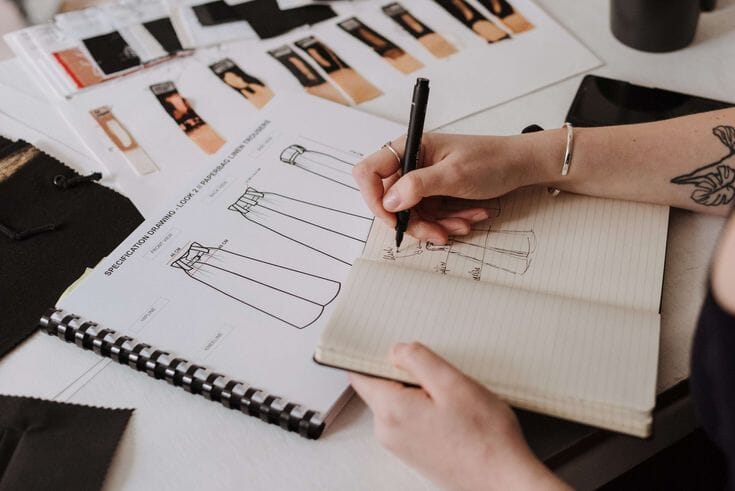
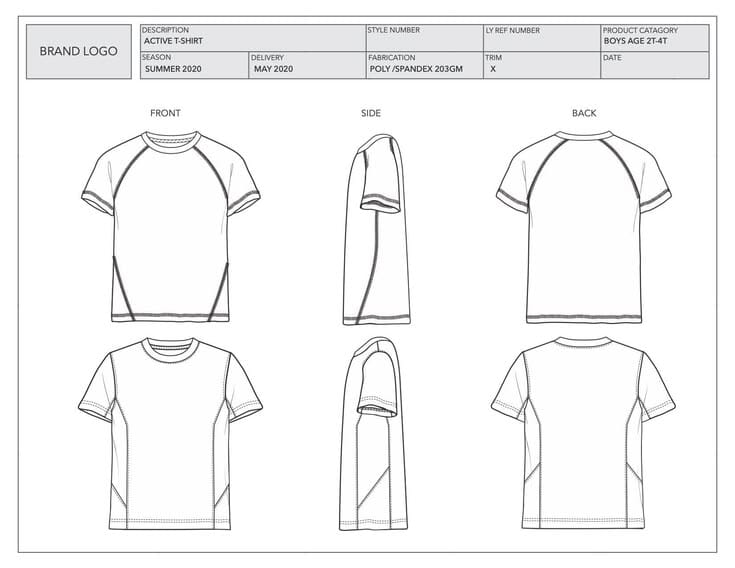
Technical flats (front, back, side)
Clean, black-and-white vector drawings. No shading, no photography. Every seam, dart, topstitch, and closure must be visible. If your flat doesn't show a seam, the factory won't sew one.
Bill of Materials (BOM)
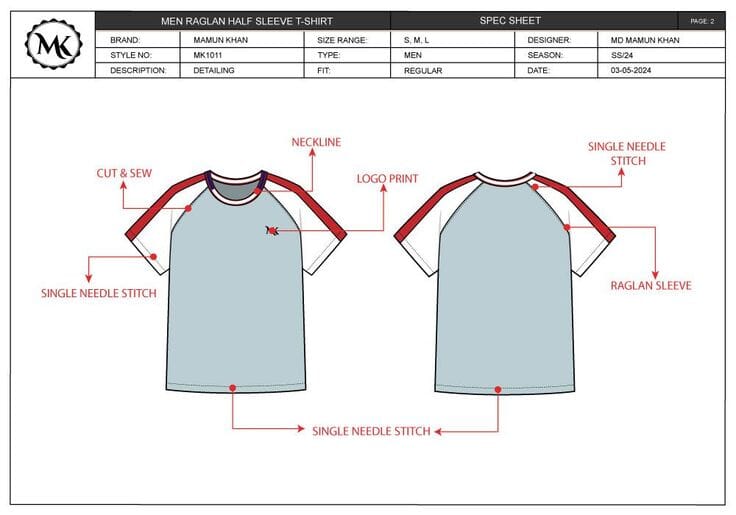
Every fabric, trim, thread, label, and packaging item, listed with placement, quantity per garment, composition, supplier reference if you have one, and colour. The BOM is where Portuguese factories spend most of their sourcing hours when it's incomplete. A BOM with named suppliers cuts sourcing time by roughly 40% in our placement records.
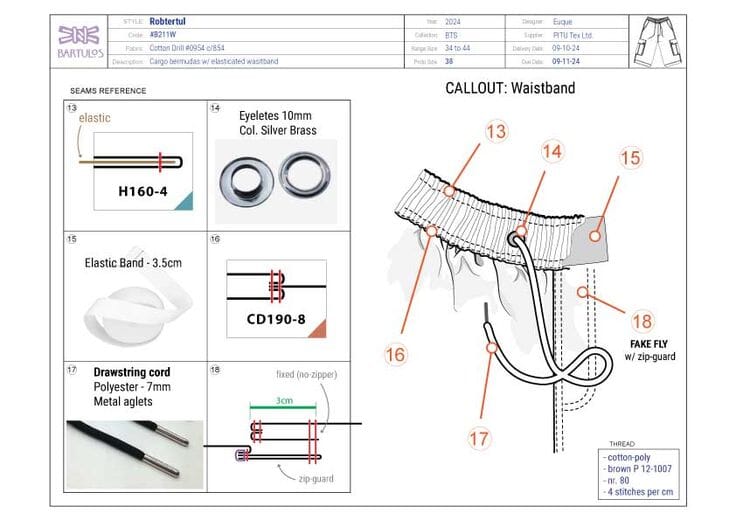
Points of measure (POM) and graded spec sheet
Measurements in centimetres, across the full size range, with tolerance ranges (typically ±0.5 cm for critical POMs, ±1 cm for non-critical). Include a measurement diagram. A spec sheet without a diagram is almost impossible to interpret consistently.
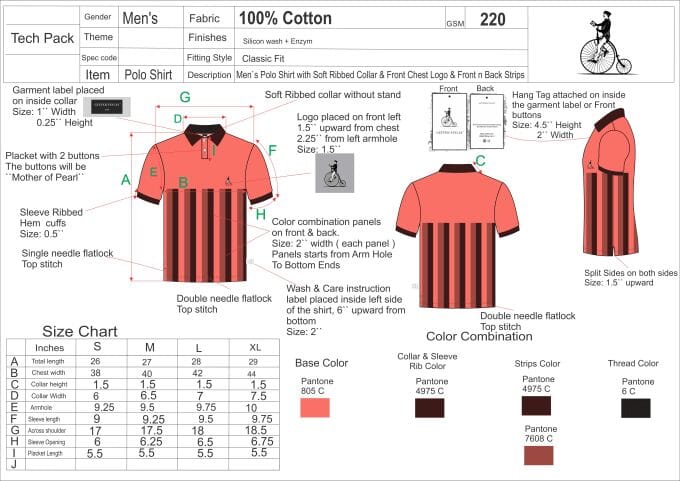
Construction and stitch details
Stitch types by ISO 4915 or SPI (stitches per inch), seam allowances, and any reinforcement. "Double-needle hem" is not enough. Factories need SPI, thread weight, and seam class.
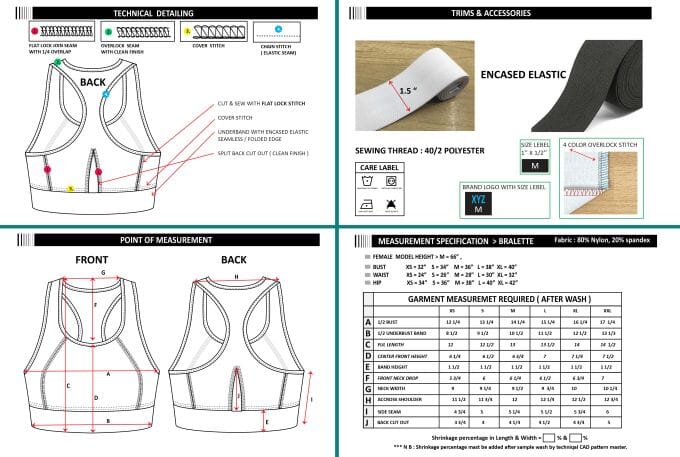
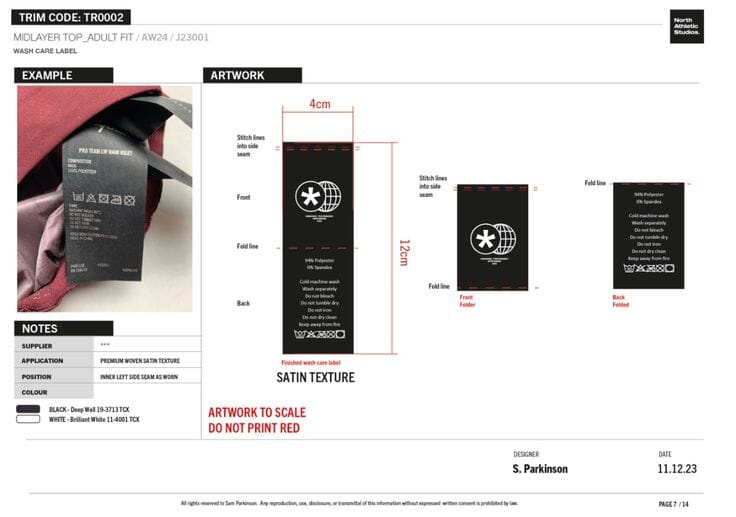
Trims and labels
Main label, care label, hang tag, size label, and any branded trim. Placement, dimensions, and supplier or spec. Care labels must meet EU Regulation 1007/2011 on textile fibre names and labelling.
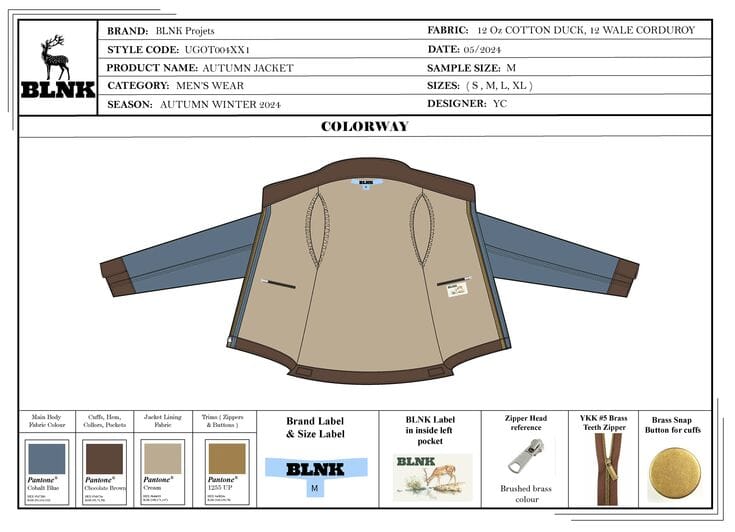
Colourways
Pantone TCX references for fabric, Pantone TPG or TPX for print and plastic components. RGB and HEX are for screens. Dye houses don't use them.
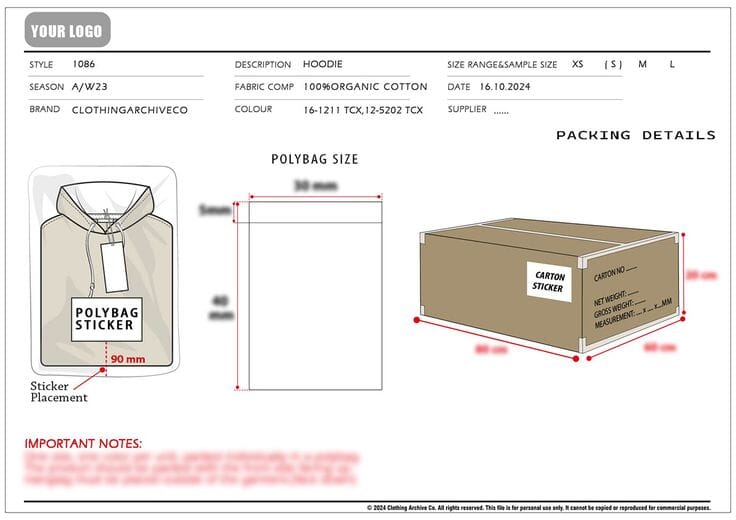
Packaging and folding specs
Polybag size, hang tag placement, folding diagram, carton pack ratios. If you're selling to retailers with specific carton rules, this section matters more than you think.
What Do Portuguese Factories Specifically Expect?
Portuguese factories operate on European standards and expect metric, ISO-compliant, and EU-regulation-ready files from day one. According to ATP (2025), over 80% of Portugal's apparel exports go to EU markets, which shapes the documentation factories are built to handle.
Here's what trips up brands arriving from the US or the UK.
Metric measurements, not imperial
Centimetres and grams. Always. If your tech pack lists inches, the pattern maker will convert it, add a rounding error, and your sample will land 3 mm off across every POM. That compounds into a failed fit.
GSM-rated fabrics, not "medium weight"
Fabrics are specified by grams per square metre, composition percentage, and construction (jersey, interlock, French terry, single jersey). "Medium-weight cotton" isn't a spec. "220 GSM, 95% cotton, 5% elastane, single jersey, combed" is.
Pantone TCX for fabric, TPG for solid trims
Portuguese dye houses work off the Pantone Textile library. Supplying a TCX code gets you a dye-lot match within Delta-E 1.0 in most mills. Supplying a web hex gets you a best-guess.
EU-compliant care labelling
Five care symbols in the order required by ISO 3758, fibre content in local languages where applicable, and country of origin. In our intake audit of 200+ incoming tech packs between 2024 and 2026, 47% arrived with care labels non-compliant with EU Regulation 1007/2011, mostly missing fibre percentages or country of origin.
A realistic size range
European small brands typically grade XS-XXL. Sending a US size 2-14 grade without a European equivalency table creates confusion at the pattern stage. Include both if you sell across regions.
How Much Does an Incomplete Tech Pack Actually Cost?
Each rejected sample in Portugal costs between €100 and €400 in direct production cost (depending on garment complexity), plus 2 to 3 weeks of calendar time. That's before you count freight, pattern revisions, and your own opportunity cost.
The real cost math
| Scenario | Sample cost per round | Total samples | Direct cost | Calendar delay |
|---|---|---|---|---|
| Complete tech pack | €100-€400 | 2 rounds | €200-€800 | 4-6 weeks |
| 70% complete tech pack | €100-€400 | 3-4 rounds | €300-€1,600 | 6-12 weeks |
| Sketch + verbal brief | €100-€400 | 4-6 rounds | €400-€2,400 | 8-18 weeks |
For a brand with three styles each needing three sample rounds because the tech pack was 70% complete: roughly €900-€4,800 in sampling fees, plus 6 to 12 weeks of lost calendar. That often equals or exceeds the cost of hiring a freelance technical designer to build the pack properly the first time.
Cost callout
- Sample cost per rejected iteration: €100-€400
- Calendar delay per iteration: 2-3 weeks
- Typical brand with 3 styles, 3 rounds each: €900-€3,600 + 6-9 weeks lost
- Freelance technical designer to build a clean tech pack: €150-€400 per style, one-time
- PCF tech pack service: under €100 per style, launching soon
The brands that move fastest in Portugal aren't the ones with the biggest budgets. They're the ones whose tech packs need the fewest clarifying emails. Every email to the factory is roughly 24 hours of lost time because of batching.
What Are the Most Common Tech Pack Mistakes?
In our intake review over the last 24 months, five mistakes account for roughly 80% of sample rejections. Avoiding these is worth more than any framework.
Mistake 1: No tolerance table
Without tolerances, every POM is pass-or-fail. Add a ±0.5 cm tolerance for critical POMs (chest, waist, length) and ±1 cm for non-critical (cuff, hem) and sample approval rates climb sharply.
Mistake 2: Flats without seam visibility
If you can't see the seam on the flat, the pattern maker has to invent one. They usually invent it differently than you would. Add a side view and a detail callout for any non-standard construction.
Mistake 3: Fabric listed as "similar to this swatch"
Swatches get lost. Compositions differ. Always send a fabric reference with GSM, composition percentages, finish, and ideally a supplier or swatch card number. Where possible, also ship a physical swatch.
Mistake 4: RGB colours with no Pantone
Dye houses cannot dye to RGB. Supply a TCX or TPG reference, or your factory will pick the closest Pantone and call it done.
Mistake 5: Missing trim suppliers
If you don't supply trims, the factory will source them, add a margin, and you've lost control of cost and aesthetic. Name your supplier, even if it's a European distributor. For first-time founders, ask the factory for their trim supplier list and pick from it.
Mistake 6: Missing care label content
EU Regulation 1007/2011 requires fibre composition and country of origin on every garment label. Care symbols must follow ISO 3758. Missing this content stops the order at customs in some markets.
Mistake 7: No PPS approval rule in the document
The tech pack should state explicitly that bulk production requires a signed pre-production sample (PPS). Brands that don't write this in often discover the factory has started bulk before PPS approval.
Mistake 8: Print artwork at the wrong resolution
Print files should be vector (.AI, .EPS, .PDF) or 300 DPI raster at print size. Web-resolution PNGs printed at scale produce visible pixelation. This is the single most avoidable artwork mistake.
A Worked Example: Tech Pack for a 320 GSM Cotton Hoodie
Abstract guidance only goes so far. Here's what an actually factory-ready tech pack for a basic streetwear hoodie looks like in practice. We use this as a teaching reference with brands every week.
Cover page
- Style number: HD-001-FW26
- Style name: Heavyweight Pullover Hoodie
- Season: AW26
- Size range: XS-XXL (EU sizing)
- Designer contact: [name@brand.com]
- Brand: [Brand name]
- Target retail: €85-€95
- Target FOB Portugal: €18-€24
Fabric (BOM excerpt)
- Body fabric: 320 GSM, 80% combed cotton / 20% recycled polyester, French terry, brushed back, OEKO-TEX 100 certified
- Rib (cuff/hem): 380 GSM, 95% cotton / 5% elastane, 2x2 rib
- Hood lining: Optional self-fabric or 220 GSM cotton jersey contrast
- Drawcord: Flat woven cotton, 12 mm width, metal aglets matched to main label hardware
- Eyelets: Antique brass, 8 mm interior diameter
- Thread: Coats Astra polyester, weight 120, colour matched to main fabric
Points of measure (chest size M, ±0.5 cm)
| POM | Measurement | Tolerance |
|---|---|---|
| Chest, 1 cm below armhole | 58 cm | ±0.5 |
| Body length, HPS to hem | 71 cm | ±0.5 |
| Sleeve length, shoulder to cuff | 65 cm | ±0.5 |
| Sleeve opening (cuff) | 11 cm | ±0.3 |
| Hood height | 38 cm | ±0.5 |
| Hood width at face opening | 24 cm | ±0.5 |
| Hem width laid flat | 56 cm | ±0.5 |
Construction callouts
- Body seams: 4-thread overlock, 12 SPI
- Topstitching: single needle, 10 SPI, 6 mm from edge
- Pocket attachment: bartack reinforcement at corners, 12 stitches
- Hood: 2-piece hood with centre seam, double-needle topstitch finish
- Cuff and hem: 2x2 rib, attached with 4-thread overlock and coverstitch finish
Trim placement
- Main label: centre back neck, 4 cm from HPS
- Care label: side seam, left side, 8 cm above hem
- Size label: stacked under main label
- Hangtag: attached to right cuff with cotton string and unbranded pin
Print/embroidery
- Chest logo: embroidery, max 8 cm wide × 3 cm high, placed 18 cm down from HPS, centred
- Embroidery digitisation file supplied as DST format, satin stitch
- Thread colour: Madeira Polyneon 1843 (cream)
Care label content (EU 1007/2011 compliant)
- 80% cotton / 20% recycled polyester (body)
- 95% cotton / 5% elastane (rib)
- Made in Portugal
- ISO 3758 care symbols: machine wash 30°C / do not bleach / tumble dry low / iron low / do not dry clean
- Multi-language fibre composition for target markets (DE, FR, ES, IT minimum for EU sales)
A complete tech pack for this hoodie runs 18 to 24 pages including flats, detail callouts, and graded measurements. That document, sent to a factory in Famalicão or Guimarães, gets a quote in 5 to 7 business days and a first sample 4 to 5 weeks later. The same garment briefed verbally with sketches typically takes 12 to 16 weeks to first sample because of email ping-pong.
Category-Specific Tech Pack Requirements
Not every category needs the same level of detail in the same sections. Where you spend your tech pack effort changes by category. From auditing 200+ incoming packs:
Jersey basics (t-shirts, light hoodies, sweats)
The risk lives in fit and fabric weight. Spend 60% of tech pack effort on POM accuracy and fabric specification, 40% on construction and trims. Construction is largely standardised across factories, so over-specifying stitch types here adds little value. Under-specifying GSM and composition guarantees fit problems.
Wovens (shirts, dresses, blouses)
Risk lives in pattern construction and fit. Spend 50% on POM and grading, 30% on construction (yoke construction, dart placement, button spacing), 20% on fabric and trims. Wovens are where fractional measurement errors compound into bad-fitting samples.
Tailoring (blazers, structured trousers, coats)
Risk lives in interior construction and canvassing. Spend 40% on POM, 40% on construction (canvas type, fusing specs, internal pocket bag construction, lining attachment, pad stitching), 20% on fabric and trims. Tailoring tech packs are typically twice the page count of jersey packs and require a tailoring-experienced technical designer to build properly. Felgueiras-cluster factories can quote a tailoring tech pack as bulk-ready or send back 4-5 specific construction questions; the gap predicts whether you're working with the right factory.
Denim
Risk lives in wash development and fit. Spend 30% on POM, 30% on construction (rivet placement, bartacks, pocket bag construction, fly construction), 40% on the wash recipe (bleach time, enzyme stages, hand sanding, tinting). The wash is often more complex than the garment construction, and most denim tech pack failures trace to wash specs rather than construction.
Outerwear (parkas, technical jackets)
Risk lives in component coordination and weatherproofing. Spend 30% on POM, 30% on construction, 20% on hardware and trims (zipper specs, snap brands, drawcord systems), 20% on weatherproofing specs (seam tape requirements, water column ratings, fabric DWR finish). Outerwear tech packs are the longest in the industry, often 30+ pages per style, and the most expensive to commission.
| Category | Typical tech pack length | Realistic freelance cost | Sample rounds expected |
|---|---|---|---|
| Jersey basics | 12-16 pages | €150-€250 | 1-2 |
| Wovens | 16-24 pages | €200-€350 | 2-3 |
| Tailoring | 22-32 pages | €350-€600 | 2-4 |
| Denim | 18-26 pages + wash recipe | €300-€500 | 2-3 |
| Outerwear | 28-40 pages | €450-€750 | 3-4 |
If a freelancer quotes you €150 to build a tech pack for a structured blazer, they're not going to deliver something a Portuguese tailoring factory can produce. Match the budget to the category.
Tech Pack Tools and Templates Compared
The tooling decision affects build speed and how easily factories can read your file. The realistic options:
| Tool | Best for | Cost | Pros | Cons |
|---|---|---|---|---|
| Adobe Illustrator + Excel POM | DIY, full control | €60/month | Industry standard, factories accept it | Steep learning curve, manual updates |
| Techpacker | Small brands, single-collection | €25-€85/month | Web-based, photo-driven, simple | Limited construction detail templates |
| Backbone PLM | Scaling brands, multi-collection | €15-€45 per style | Strong PLM features, easy reorder management | Moderate learning curve |
| Centric PLM | Mature brands, retail | €5,000+/year | Full PLM, factory portal integration | Overkill for sub-€2M brands |
| Custom Illustrator templates (free) | Founders comfortable in Illustrator | €0 + Illustrator subscription | Full customisation | Time investment to set up |
| Google Sheets + Figma | Bootstrapped, pre-launch | €0 | Cheapest option | Factories need help reading it |
The most common combination across the brands we place: Adobe Illustrator for flats, Excel for POM and BOM, exported as a single PDF. About 70% of incoming packs use this stack. Techpacker accounts for roughly 15%. Backbone PLM covers another 10%. The rest are mixed (Figma exports, Word documents, hand-drawn).
The factories don't care which tool you used. They care whether the PDF is searchable, the flats are vector-resolution, the measurements are in cm, and the BOM is itemised. A messy Illustrator file is worse than a clean Techpacker export. A clean Excel file is better than a sloppy Centric PLM output.
Version Control: How to Handle Tech Pack Revisions
Tech packs change. Sample feedback drives revisions, fabric availability triggers BOM updates, and final adjustments after PPS often require version 4 or 5 of the document. Brands that don't manage versioning end up shipping the wrong tech pack to the factory and producing the wrong sample.
The discipline that works:
- Filename convention:
[StyleNumber]_TechPack_v[N]_[YYYY-MM-DD].pdf. Example: HD-001-FW26_TechPack_v3_2026-04-22.pdf - Change log on page 2 of every revision: what changed, who requested it, when. Three lines is enough.
- Single source of truth: one shared folder (Google Drive, Dropbox, Notion). Email attachments are the worst possible distribution method because they fragment the version history.
- Lock the document at PPS approval: once PPS is signed, the tech pack version becomes read-only. Any post-PPS changes require explicit factory acknowledgement and trigger a re-quote if material.
- Archive prior versions: keep v1, v2, v3 in an archive folder. The factory may need to refer back when a defect appears in bulk; without prior versions, the dispute resolution becomes a guessing match.
About 20% of mid-production disputes we mediate trace back to version-control failure: the brand says "I sent you the updated tech pack" and the factory says "we cut to the version you signed off on". Both are right, both wrong. Version control prevents the dispute entirely.
EU Compliance Deep Dive
EU Regulation 1007/2011 is the headline requirement, but the regulatory landscape is broader than fibre composition labelling. A factory-ready tech pack should reference these requirements explicitly:
Currently mandatory
- Fibre composition labelling (EU 1007/2011): percentages stated in descending order, terms drawn from the regulation's approved list (e.g., "cotton" not "100% pure natural cotton")
- Care symbols (ISO 3758): five symbols in the order washing / bleaching / drying / ironing / professional cleaning
- Country of origin: "Made in Portugal" only if cut-and-sew happens in Portugal; "Made in EU" is not a substitute
- REACH compliance (EU 1907/2006): no restricted chemicals in fabric finishes, dyes, or trim hardware
- Multi-language labelling: for products sold cross-border in EU, fibre composition typically required in the destination country's official language
Coming through 2025-2027
- ESPR (Ecodesign for Sustainable Products Regulation): rolls out by product category through 2027, requires Digital Product Passport (DPP)
- Digital Product Passport (DPP): QR code or NFC tag linking to product data: composition, supply chain, recyclability, repair options
- Recycled content disclosure: percentages of pre-consumer and post-consumer recycled content, batch-verifiable
- Microplastic shedding declarations: for synthetic and synthetic-blend fabrics
- Repairability and durability targets: to be set by category
The brands that are building DPP-ready tech packs now (placeholder QR field on the care label, supply chain tracking in the BOM) will have a structural advantage when ESPR enforcement begins. Most Portuguese factories with OEKO-TEX, GOTS, or GRS certifications already capture the underlying data; brands just need to make space for it in the document.
Founder Archetype: Which Tech Pack Approach Fits You
Match your background to the right tech pack strategy:
| Archetype | Realistic approach | Budget per style | Why |
|---|---|---|---|
| First-time creative founder, no production experience | Hire freelance technical designer | €250-€400 | The cost of mistakes outweighs the saving |
| Designer-founder with Illustrator skills | DIY using template + factory walk-through | €0-€100 + 10 hours | You can build, but get factory feedback before sampling |
| Engineer/operations founder | Techpacker or Backbone PLM + freelance review | €100-€250 | Structure-friendly, but needs domain expertise input |
| Marketer-first founder | Specialist sourcing partner or full freelance package | €290-€600 | Outsource the part you don't know |
| Returning fashion industry founder | Custom Illustrator templates, in-house | €0 + senior time | You already know what to produce |
| International (non-EU) founder | Specialist sourcing partner to handle EU compliance | €290-€600 | The compliance layer is the part you don't see |
The mistake we see most across all archetypes: founders who under-invest in the first style's tech pack. The first style sets the template structure for every future style, so getting it right pays compounding dividends. Founders who spend €350 on the first style's tech pack typically pay €150 per style for styles 2 through 10 because they reuse 70% of the structure.
How Should Small Brands Approach Tech Packs?
Small brands don't need Adobe Illustrator mastery. They need a factory-readable file with every required section filled. A 2025 BoF / McKinsey survey of 200 emerging brands found that 58% used templates or freelance technical designers rather than building tech packs from scratch.
If you're producing small quantities, the tech pack is even more important, not less. Factories running short runs can't absorb the cost of reworking a vague brief the way a large-volume mill can.
Use a template
Free and paid templates exist from Techpacker, Backbone PLM, and several open-source Illustrator files. Start from a template, don't invent the structure.
Hire a technical designer for the first style
€150-€400 per style for a clean tech pack, once, saves thousands over the life of the brand. You'll reuse 70% of the structure for every future style.
Ask your factory for their template
Most Portuguese factories will share a preferred template or review a draft before sampling starts. It's the single most underused service in the industry. Ask before you pay anyone for a tech pack from scratch.
Realistic budget by brand stage
| Stage | Tech pack approach | Cost per style | When |
|---|---|---|---|
| Pre-validation | Template + DIY | €0-€100 | Before testing demand |
| First production | Freelance technical designer | €150-€400 | First commercial PO |
| Scaling | In-house technical designer or specialist sourcing partner | €290-€600 | 5+ styles per season |
| Mature brand | Full PLM (Backbone, Centric) | €5,000-€20,000 / year | Multi-collection per year |
How Does a Portuguese Tech Pack Differ from Asian Production Briefs?
Portuguese tech packs expect more detail upfront and less iteration during sampling than Asian equivalents. Asian suppliers, particularly in Bangladesh and Vietnam, often provide in-house technical design support as part of their service. Portuguese factories generally do not. That's a structural difference, not a quality gap.
In Asian production, the factory might take a rough brief, develop the spec, and send you a proto for review. In Portugal, the factory expects the spec to arrive fully developed and builds to it. The upside is a 4 to 6 week lead time instead of 12 to 16. The downside is your document has to carry more weight.
Citation Capsule: Portugal's apparel lead times average 4 to 6 weeks compared with 12 to 16 weeks from Asian sources, but factories expect fully-developed tech packs upfront rather than iterative brief-building during sampling. Tech-pack discipline is the trade you make for speed.
The August Consideration
Most Portuguese factories close for 2 to 3 weeks in mid-August for the traditional summer break. The shutdown ripples through fabric mills, dye houses, and trim suppliers. Tech-pack timing matters around this window:
- Submit final tech pack by early July if you want sampling to complete before August
- If you submit in late July, expect first sample mid-September at the earliest
- Sampling that crosses August often costs 3 to 4 extra weeks of calendar time
- Lock fabric and trim suppliers (with supplier names in your BOM) by mid-July to avoid double delays
Brands new to Portuguese sourcing get hit hardest here. Build August out of your timeline from the first Gantt sketch.
Running into production issues? Get in contact and tell us what you\'re making. We\'re a group of Portuguese factories and we answer every serious brief within 24 hours.
Tech Pack Audit Checklist
Print this. Use it before you send any file to a factory.
Cover page - [ ] Style number and name - [ ] Season and year - [ ] Size range (with EU/US equivalency if relevant) - [ ] Designer contact and brand name - [ ] Target wholesale or retail price
Flats and details - [ ] Front, back, side vector drawings - [ ] Every seam visible - [ ] Detail callouts for non-standard construction - [ ] Pocket, collar, cuff close-ups
BOM - [ ] Fabric: GSM, composition %, construction, finish - [ ] Every trim listed with placement and supplier - [ ] Threads named with weight - [ ] Labels and hangtags specified
POM and grading - [ ] Measurements in centimetres - [ ] Tolerances stated for every POM - [ ] Full graded size range (XS-XXL or equivalent) - [ ] Measurement diagram included
Construction - [ ] Stitch types per ISO 4915 or SPI - [ ] Seam allowances stated - [ ] Reinforcement points called out
Colourways - [ ] Pantone TCX for fabric - [ ] Pantone TPG for solid trims - [ ] No RGB or HEX as primary reference
Compliance - [ ] Care label content per EU 1007/2011 - [ ] Fibre composition percentages stated - [ ] Country of origin specified - [ ] Care symbols per ISO 3758
Print/embroidery artwork - [ ] Vector files (or 300 DPI at print size) - [ ] Placement specified with measurements - [ ] Colour count stated
Packaging - [ ] Polybag size - [ ] Hangtag placement - [ ] Folding diagram - [ ] Carton pack ratios if wholesale
PPS clause - [ ] Document states bulk requires signed PPS
If you have all 30+ checkboxes filled, your tech pack is factory-ready.
Frequently Asked Questions
How long does it take to create a complete tech pack?
A single style takes roughly 6 to 12 hours for an experienced technical designer, or 15 to 25 hours for a founder building from scratch for the first time. Each subsequent style in the same category drops to roughly 3 to 5 hours because you reuse structure (size grading, BOM templates, label content). For a 4-style first collection, budget 40 to 80 hours total if you're DIY, or €600 to €1,600 if you hire out.
Can I send a tech pack in imperial units to a Portuguese factory?
Technically yes, practically no. Portuguese factories will convert, but each conversion introduces rounding error, and rounding error compounds across a size grade. ATP member factories handle EU-bound production by default and work in metric. Convert before sending. Use centimetres, grams, and Celsius.
Do I need a tech pack for sampling, or only for production?
You need one for sampling. A sample produced without a tech pack is a styling exercise, not a manufacturing test. Sampling without a tech pack cannot validate a factory's ability to produce at grade, which defeats the point of sampling.
What's the difference between a tech pack and a BOM?
A BOM (Bill of Materials) is one section of a tech pack. It lists every material and trim in the garment. The tech pack contains the BOM plus flats, measurements, construction, colourways, labels, and packaging. The BOM is one chapter in the book.
Who owns the tech pack, the brand or the factory?
The brand owns the tech pack. Even when a factory helps develop it, the brand retains IP unless a contract says otherwise. Portuguese factories generally won't claim ownership, but it's worth writing the ownership clause into your NDA or production agreement before sharing files.
Can AI tools generate a usable tech pack?
AI tools can draft flats, suggest BOM structures, and generate measurement templates. They cannot make manufacturing decisions. AI-generated files still require a human technical designer to be factory-ready: the structure is fine, but tolerance ranges, stitch callouts, and trim specifications need human judgement. Useful for first drafts. Not ready to send to your factory unreviewed.
How much should I pay for a freelance technical designer?
€150-€400 per style is the realistic European market rate. Below €150, you're getting a template fill-in rather than a real technical document. Above €400, you're paying for senior technical designer time, which is appropriate for complex outerwear or tailoring but overkill for jersey basics. Our tech pack service runs €79 per style for a factory-ready single-style pack with 2 to 3 revision rounds delivered in 5 business days.
What if my factory says the tech pack is "good enough"?
A vague approval at the brief stage often turns into rejection at the sample stage. Insist the factory walks the document with you and flags any gaps before sampling starts. The 30-minute walk-through with the factory's technical contact saves you 2 to 3 weeks of revision rounds.
Do I need separate tech packs per colourway?
No. One tech pack per style, with all colourways listed in the colourway section. Pantone references for each colourway, with any colour-specific construction notes (e.g., contrast topstitching) flagged. Multiple-tech-pack-per-colourway is a sign of structural confusion in the document.
What gets included in a "full package" tech pack vs CMT?
Full package tech packs include sourcing references for the factory's preferred mills (you say "fabric similar to Mill X reference Y" or trust the factory to source within your spec). CMT tech packs require your own fabric and trim sourcing references because you're supplying them. The construction sections are identical; the BOM is structured differently.
Conclusion
A tech pack is the cheapest way to buy speed and predictability in apparel production. The brands that ship on time in Portugal aren't working with secret factories or special relationships. They're sending documents that a pattern maker can open at 9am and cut by 11. Everything else, the lead time, the cost per unit, the sample approval rate, flows from that.
If you're preparing your first production run in Portugal, audit your tech pack against the 12 sections above before you send it. If you're on your third round of samples with the same factory, the document is almost certainly where the problem lives, not the sewing.
Talk to a real person: Want us to review your tech pack before you commit to production? Get in contact and we'll flag the issues before you run into them during sampling.
References
- CITEVE (2024) - Quality Report on Portuguese Textile Production
- ATP - Associação Têxtil e Vestuário de Portugal (2025)
- EURATEX (2025) - European Apparel Manufacturing Guidance
- European Commission (2024) - EU Regulation 1007/2011
- Apparel News (2024) - Tech Pack Industry Survey
- Business of Fashion / McKinsey (2024) - State of Fashion
- Sourcing Journal (2024) - European Sampling Failures Analysis
- PCF internal tech pack audit (2024-2026), 200+ incoming files reviewed
We're a group of 80+ vetted Portuguese clothing manufacturers based in Porto and Guimarães. Tell us your product, volume, and timeline. We'll match your brief to the right factory in the group, usually within 24 hours. You work directly with the factory. No commissions, no pitch, no upsell.
Get in contact Download the directory (€39)Need a tech pack? Get a factory-ready single-style tech pack for €79. See what's included.
Related reading
- CMT vs full package production in Portugal
- First meeting with a clothing manufacturer
- How to order a clothing sample
- Common mistakes when starting a clothing brand
- Quality control in Portuguese clothing production
- Clothing production lead times in Portugal