Womenswear is the largest apparel category in the world and the hardest to grade correctly. Those two facts are related: the market rewards fit, and fit is where most first orders fail.
The global women's apparel market is estimated at about $1.18 trillion in 2026, with Europe holding around 30% of it (Global Growth Insights, 2026). This guide covers what makes womenswear production different, how to choose a factory by construction rather than by claim, and what a wider size range really costs.
Heads up: We're Portugal Clothing Factory, a group of documented Portuguese clothing factories in the northern textile cluster. Minimums, lead times and development observations below come from factory quoting and production our team has handled between 2024 and 2026. Market figures come from published sources, named inline.
Key Takeaways
- A market of about $1.18 trillion in 2026, with Europe holding around 30% (Global Growth Insights, 2026).
- Womenswear grading is non-linear. A mathematical size scale produces garments that fit at the middle and fail at the extremes.
- Factories specialise by construction, not by gender. "Womenswear manufacturer" is not a capability.
- The median minimum across our documented factories is 175 units per style, and minimums are often counted per colour or per size and colour.
What Makes Women's Clothing Manufacturing Different?
Grading, primarily. Everything else follows from it. Womenswear competes on fit more than on any other attribute, and fit is decided when a pattern is scaled across sizes.
Menswear grades relatively predictably: measurements scale in fairly consistent proportion across a size range. Womenswear does not. The relationship between bust, waist and hip changes shape as sizes increase, and the change is not linear.
A straight mathematical grade, adding the same increment to every measurement at every size, produces a garment that fits well at the sample size and progressively worse at both ends of the range. It is one of the most common causes of high return rates on a first womenswear order.
Correct grading requires fit samples at more than one size, usually the sample size plus one at each end of the range. That costs money and time, and skipping it costs more. Our guide to ordering a clothing sample covers the sampling rounds themselves.
Citation Capsule Womenswear grading is non-linear because the proportional relationship between bust, waist and hip measurements changes across a size range. Applying a uniform mathematical increment produces garments that fit at the sample size and fail progressively toward both extremes. Correct grading requires fit samples at multiple sizes rather than a single sample size, which is a primary driver of first-order development cost.
Which Factory Do You Actually Need?
Factories specialise by garment construction, not by who wears the result. "Women's clothing manufacturer" describes a market, not a capability.
A factory that makes womenswear jersey tops cannot make your tailored blazer. A knitwear house cannot make your woven dress. Asking for a "womenswear factory" produces a list that is mostly irrelevant to your specific product.
In northern Portugal, as in most clusters, knit capability is plentiful: jersey, circular knit and knitwear make up a large share of the factories. Tailoring, shirting, lingerie and swim are much scarcer, and that scarcity should shape your shortlist. For the main constructions, see our pages on knitwear, wovens and dresses and tailoring.
Filter by construction first, knit or woven, then by specific garment type. That reduces a list of hundreds to a handful, and the handful is the useful part.
Find your factory: Tell us the garment type, not just the category. Get in contact and we'll place and manage your production with a factory in our group set up for that construction.
What Does Size Inclusivity Cost to Produce?
More than most brands budget for, and the cost is front-loaded into development rather than production.
Extending a range beyond the standard four to six sizes usually requires a second base pattern rather than a continued grade. Body proportions at larger sizes differ enough that continuing the same grade produces a poorly fitting garment, which defeats the purpose of extending the range at all.
That means a second pattern, additional fit samples, and often a fabric consumption recalculation that changes unit costing across the range.
| Range | Development requirement | Practical cost driver |
|---|---|---|
| 4 sizes | One base pattern, 1–2 fit samples | Baseline |
| 6 sizes | One base pattern, 2–3 fit samples | Grading validation at the extremes |
| 8+ sizes | Often two base patterns, 3–4 fit samples | Second pattern development |
Indicative, from development work our team has handled, 2024–2026. Not a published dataset.
The commitment nobody calculates
Minimums frequently apply per size and colour combination rather than per style, so an eight-size range in three colours is 24 separate commitments. Confirm which basis applies before comparing quotes.
The honest recommendation for a first order is to launch narrow and extend on real sell-through data. Extending a range you have validated is straightforward. Guessing at eight sizes upfront is how first orders become dead stock.
Try it free: Model how size range changes your unit cost in the garment cost calculator. 60 seconds, no email required.
What Minimum Order Should You Expect?
Across the documented factories in our group, the median minimum is 175 units per style. Our MOQ guide explains how factories set minimums and where there is room to negotiate; for very small first runs, see low-MOQ production.
The binding constraint is fabric rather than sewing. Mills sell by the roll and dye by the lot, and dye lot minimums commonly run to several hundred metres per colour. That is why adding a colourway often raises your commitment more than adding units within one colour.
Womenswear compounds this because seasonal colour ranges tend to be wider than in menswear. A five-colour season across six sizes is thirty combinations before you have made a single design decision.
Citation Capsule Across the documented Portuguese factories in the Portugal Clothing Factory group, the median minimum order is 175 units per style. Fabric roll and dye lot minimums, rather than sewing capacity, set the floor, so each extra colourway can raise the total commitment more than extra units in one colour. Womenswear amplifies this through wider seasonal colour ranges.
How Long Does Womenswear Production Take?
Production runs 7 to 10 weeks across most of our group: 29 of the 80 documented factories quote 8 to 10 weeks and 26 quote 7 to 9.
A first order is longer, because grading validation adds sample rounds. Realistic first delivery is three to five months from brief, and fitted or tailored womenswear sits at the upper end of that. Our lead times guide breaks the stages down further.
| Stage | Duration |
|---|---|
| Pattern and grading | 2–4 weeks |
| Fit samples (multiple sizes) | 4–8 weeks |
| Fabric procurement | 4–8 weeks, partly in parallel |
| Production | 7–10 weeks |
| Realistic first order | 3–5 months |
Typical ranges from PCF factory quoting, 2024–2026. Indicative, not a published dataset.
Reorders skip development and return to the production window, provided the fabric is available.
Need a tech pack? Get a factory-ready single-style tech pack for €79. See what's included.
How Does Womenswear Grading Actually Work?
Grading is the process of scaling a base pattern across a size range, and in womenswear it is not proportional.
Bust, waist and hip do not scale together. As sizes increase, the proportions between them shift, so a uniform increment applied to all three produces a garment that fits the sample size and progressively fails toward both ends.
Vertical measurements change much less. Shoulder to bust point, armhole depth and back length grow far less than girth measurements. Grading them proportionally makes larger sizes look wrong even when the girth is correct.
Curved seams need re-truing. Armholes, necklines and princess seams distort when graded mechanically and have to be redrawn.
What correct grading requires
Fit samples at the sample size plus one at each end of the range, worn on real bodies. That is three samples minimum, not one.
Brands that grade mathematically and sample once produce ranges where the middle sizes sell through and the extremes come back. The returns then get blamed on the customer rather than the pattern.
Citation Capsule Womenswear grading is non-proportional because bust, waist and hip measurements scale at different rates across a size range, while vertical measurements such as armhole depth change far less than girth. Correct grading requires fit samples at the base size plus both extremes, since a uniform mathematical increment fits only the sample size and fails progressively toward the ends of the range.
Which Womenswear Categories Are Hardest to Produce?
Four, ranked by how often the first sample comes back wrong.
Tailoring. Blazers and structured jackets involve interlinings, canvassing, shoulder construction and pressing. It is the most skill-dependent category in apparel, and the capacity is scarce.
Lingerie and swim. Hardware, elastic tension, cup shaping. A different skill set from general garment making, with few specialist factories; see underwear production.
Dresses with structure. Boning, linings, invisible zips and bias cutting. Bias in particular is unforgiving, because the fabric moves during cutting and sewing.
Knitwear with shaping. Fully fashioned knitwear is knitted to shape rather than cut, which is a different machine and a different supplier entirely.
The easy end
Jersey tops, tees, sweatshirts and simple dresses. This is where most of the capacity is (see our jersey fabric guide). If you are starting, start here. The categories above reward experience and punish first attempts expensively.
How Do You Vet a Women's Clothing Manufacturer?
Four checks, all of them specific rather than general.
Ask what they grade. A factory experienced in womenswear will describe its grading approach without prompting. One that says "we follow your spec" is telling you grading is your problem.
Request a physical sample of a comparable garment. Not a photograph, and not a different category. Fit quality is tactile.
Confirm the minimum basis. Per style, per colourway, or per size combination. The difference can triple your commitment.
Verify certificates by number. GOTS, OEKO-TEX and similar certificates can be checked in the issuing body's public database. Logos on a website are not certificates.
What Does a Womenswear Tech Pack Need?
Eight elements. A factory quoting without them is guessing, and the guess gets revised upward after sampling.
- Graded measurements at every size, per point of measure, with tolerances.
- Technical flats, front and back, with every seam and detail visible.
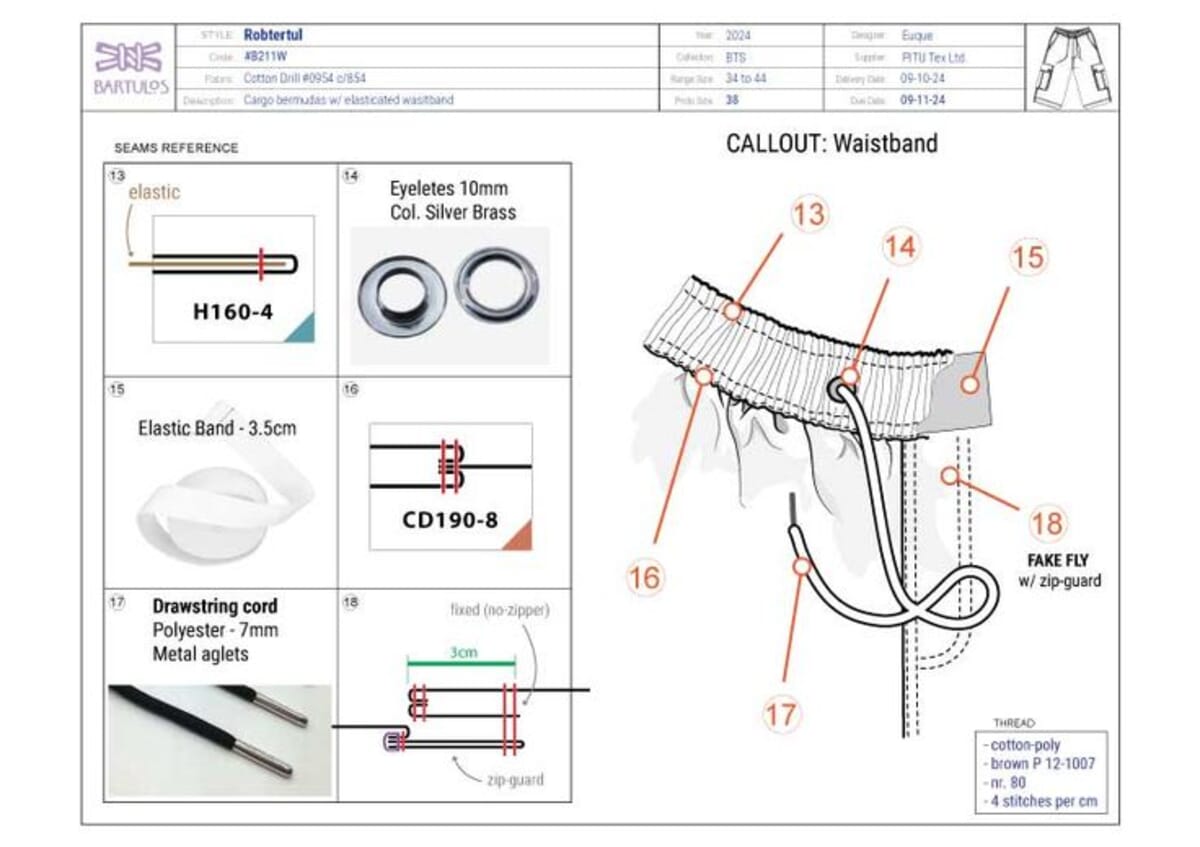
- Construction callouts per seam: seam type, stitch density, allowance.
- Fabric specification: composition, construction, weight in GSM, finish.
- Trims and hardware: zips by brand and length, buttons by size and material, labels, hangtags.
- Colour in Pantone TCX, the textile system, not the coated inks used for print.
- Care and composition labelling; fibre composition labelling is a legal requirement in the EU.
- Packing instructions: polybag, carton quantities, barcode placement.
The element most often missing
Tolerances. Stating a chest measurement of 96 cm means nothing without a tolerance. Is 94 cm acceptable? Is 98 cm? Without a stated tolerance you have no basis to reject a delivery, and every dispute becomes a negotiation rather than a measurement.
How Do You Manage Seasonality in Womenswear?
Womenswear turns faster than menswear and carries more colour, which multiplies both risk and minimum commitments.
Plan backwards from the delivery date. A first order needs three to five months. An autumn/winter delivery therefore starts development in spring, not summer.
Plan around August. Many Portuguese factories close for summer holidays in August, and the weeks before it are congested. A plan that needs August production should be moved rather than negotiated.
Repeat the core, rotate the colour. Adding a colourway to an approved style needs no pattern work and no new fit samples, though it does trigger a new dye lot minimum.
The structure that works at small scale
Two or three carry-over silhouettes that reorder every season with colour changes, plus one or two new styles per season in a narrow size range. Reorders are much faster because pattern and fabric are already approved, against three to five months for anything new.
Brands that refresh an entire range every season need development capacity most do not have, and the calendar rarely survives contact with reality.
Where Should You Produce Womenswear?
Geography decides lead time, minimum, compliance exposure and how easily you can visit. There is no universally correct answer.
Portugal suits knit-led womenswear at moderate volume, delivered into Europe. Portuguese textile and clothing exports were about €5.5 billion in 2025 (RTP / Lusa, provisional INE data), and the northern cluster is strongest in knit and jersey.
Eastern Europe offers tailoring and woven capability with EU access, often at lower labour cost.
Asia offers the lowest unit cost at the highest minimums and longest transit. It suits established volume rather than first runs.
Domestic production gives the shortest feedback loop and usually the highest unit cost.
The decision rule
Choose geography by construction first, then by volume. A knit-led range belongs in a knit cluster. A tailoring range belongs where tailoring capacity exists. Choosing a country before choosing a construction is how brands end up with a factory that subcontracts the actual work.
Conclusion: Sourcing Womenswear Well
The category rewards fit above almost everything else, and fit is decided in grading rather than in sewing. That makes development spend the highest-return money in a first order.
Choose by construction rather than by category label. Validate grading with fit samples at more than one size. Launch narrow on sizes and colours, then extend on data rather than on hope. And confirm what basis your minimum is quoted on before you compare anything.
Talk to our team: Tell us the garment, the size range and the volume. Get in contact; every serious brief gets an answer within 24 hours.
Frequently Asked Questions About Women's Clothing Manufacturers
How do I find a women's clothing manufacturer?
Filter by garment construction rather than by category. Factories specialise in knit or woven and then in specific garment types, so "womenswear manufacturer" is not a capability. Decide whether your product is knit or woven, then look for factories that make that specific garment type.
What is the minimum order for women's clothing?
Across the documented factories in our group the median minimum is 175 units per style. Always confirm whether a minimum applies per style, per colourway or per size and colour combination, since the difference can triple your commitment.
Why is womenswear grading more difficult?
The proportional relationship between bust, waist and hip changes across a size range, so a uniform mathematical grade fits at the sample size and fails toward both extremes. Correct grading needs fit samples at more than one size, which raises first-order development cost.
What does extended sizing cost to produce?
Ranges beyond about six sizes usually need a second base pattern rather than a continued grade, plus additional fit samples and a fabric consumption recalculation. Because minimums often apply per size and colour combination, an eight-size range in three colours becomes 24 separate commitments.
How long does womenswear production take?
Production alone is typically 7 to 10 weeks. A first order adds pattern development, multi-size fit sampling and fabric procurement, which puts realistic first delivery at three to five months. Fitted and tailored garments sit at the upper end. Reorders skip development and return to the production window.
How many fit samples does womenswear need?
At least three: the base size plus one at each end of the range. Womenswear grading is non-proportional, so a single sample validates only the size it was made in. Fitted and tailored product often needs a second round.
Which womenswear categories are hardest to source?
Tailoring, lingerie and swim, structured dresses and fully fashioned knitwear. Capacity for these is much scarcer than for jersey tops, tees and sweatshirts, so shortlists are shorter and first samples more often need a second round.
Can I use one factory for a whole womenswear range?
Rarely. Factories specialise by construction, so a range spanning jersey tops, tailored blazers and swim usually needs three different factories. Expect a multi-factory range as normal rather than a failure.
What does a womenswear tech pack need?
Graded measurements per size with tolerances, technical flats front and back, construction callouts per seam, fabric specification, trims and hardware, Pantone TCX colour, care labelling and packing instructions. Tolerances are the element most often left out, and without them you cannot reject a delivery.
We're a group of 80 documented Portuguese clothing factories, 25 verified, based in Porto and Guimarães. Tell us your product, volume, and timeline. We'll place and manage your production with the right factory in the group, usually replying within 24 hours. Flat fees, no commissions, no upsell.
Get in contact Download the directory (€39)Need a tech pack? Get a factory-ready single-style tech pack for €79. See what's included.
Sources used in this article
- Global Growth Insights, Women Apparel Market report, 2026.
- RTP / Lusa, Portuguese textile and clothing exports 2025 (provisional INE data), 2026.
- PCF quoting and production records, 2024 to 2026, for minimums, lead times and development observations. Our own operational records, not survey data.
Not sourced. Development steps, stage durations and dye-lot observations in this article reflect factory quoting and production we have seen rather than a published dataset. Treat them as indicative, not measured.
Portugal Clothing Factory is a group of documented Portuguese clothing factories in the northern textile cluster (Porto, Guimarães, Braga, Barcelos, Famalicão). We charge flat fees, reply within 24 hours, and place and manage production with the factory in our group built for your product. See how we work or get in contact.
.jpeg)