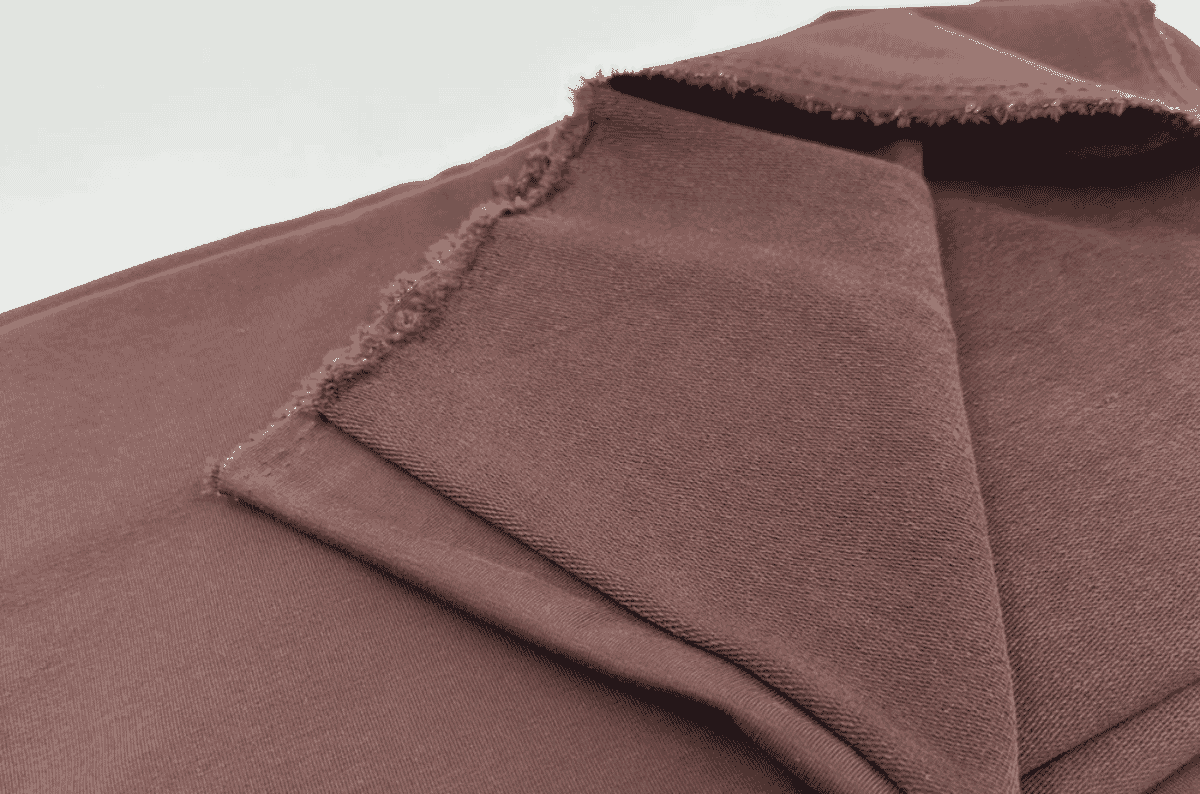
French terry is a weft-knit fabric with a smooth jersey face and soft unbrushed loops on the reverse, and it is the standard cloth for sweatshirts, hoodies and joggers. A figure putting it behind 40% of European mid-weight sweatshirt output, credited to EURATEX, has been withdrawn: EURATEX publishes trade and employment data, not construction-level shares. It is soft against the skin, structured enough to hold shape, and manufacturable across a wide GSM range without exotic machinery. For fashion founders sourcing production in Portugal, understanding French terry is often the difference between a hoodie that feels premium and one that feels flat.
What this guide covers
This guide covers what French terry actually is, how it is knitted at Portuguese factories, the GSM tiers available in 2026, real EUR pricing per meter across the northern textile cluster, MOQ patterns, and how it compares to standard fleece. Everything below reflects the manufacturer-side view, based on production runs coordinated across our factory group in the Porto, Guimarães, Braga, Barcelos, and Famalicão regions.
Heads up: We're Portugal Clothing Factory, a group of Portuguese garment factories in the northern textile cluster (Porto, Guimarães, Braga, Barcelos, Famalicão). We've documented 80 factories across the region and verified 25 active producers, so the observations in this article come from that research and from production runs placed across the group between 2024 and 2026.
Key takeaways
Key Takeaways
- French terry is a weft-knit fabric with a smooth jersey face and a looped pile back, sitting between single jersey and fleece in weight
- GSM ranges from 220 (light spring tops) to 500+ (premium heavyweight hoodies), with 280 to 320 GSM being the standard sweatshirt weight
- Portuguese CMT-ready French terry costs €4-8 per meter for standard cotton, €7-14 for organic cotton, and up to €16 for heavyweight GOTS-certified variants
- MOQs at documented Portuguese factories start at 100 units per style, with 300 to 500 units typical for mid-tier producers
- Certification is now a routine European buyer requirement; a 68% figure credited to Textile Exchange has been withdrawn as unsupported
Try it free: Pressure-test your French terry production cost with our garment cost calculator. 60 seconds, no email required.
What Is French Terry Fabric?
French terry is a weft-knit fabric constructed with a smooth jersey face on the outside and a series of soft looped yarns on the inside, giving it structure without brushed nap. A 4.3% knit-production growth figure and a "fastest-growing weft-knit variant" claim credited to Textile Exchange have been withdrawn: Textile Exchange reports fibre production volumes, not knit-construction growth rates.
Where the name comes from
The "terry" in French terry most likely comes from the French tirer, to pull, describing the drawn loops; the term was first used for uncut velvet, known as terry pile. The "French" points to Roubaix, the northern French textile city where loop-back cloth was developed in the 19th century. Earlier versions of this article traced the name to "tissu éponge", which is simply the modern French for towelling and is not the root. Unlike towel terry, which is woven with loops on both faces, French terry is a knit with loops on one side only, and those loops are not brushed. That structural quality is what makes it comfortable against the skin while still holding shape well for tailored joggers, cropped hoodies, and fitted dresses.
Where it sits among knits
Within the knit-fabric family, French terry sits between single jersey (thinner, no pile) and standard fleece (heavier, brushed loops). It replaces both in modern loungewear because it drapes better than fleece and holds warmth better than jersey.
Citation Capsule: French terry is a weft-knit cotton fabric constructed with a smooth jersey face and unbrushed looped pile on the reverse. It occupies the mid-weight tier between single jersey and standard fleece, typically ranging from 220 to 500 GSM, and is the dominant cloth in the modern sweatshirt, jogger and loungewear categories.
Other names you might see
French terry is also called "loopback jersey", "loop terry", "loopback cotton", or simply "terry knit" in supplier catalogues. Portuguese mills usually refer to it as "malha felpo" or "jersey com felpo interior" in factory-side documentation. Whatever the label, the structural signature is the same: smooth outer face, looped inner face, no brushing.
How Is French Terry Made?
French terry is produced on circular knitting machines with a specific loop-forming attachment that pulls extra yarn into the reverse of the fabric during the knitting cycle. Output per shift varies widely with gauge, GSM and machine diameter. A 150 to 300 kilograms per shift figure credited to CITEVE has been withdrawn: CITEVE publishes no such production benchmark.
The two-yarn structure
The base structure uses two yarns: a face yarn that forms the smooth jersey outside, and a backing yarn that forms the loops on the inside. The gauge of the machine (needles per inch) determines how fine or coarse the knit will be. Portuguese mills typically run French terry at gauge 20 to 24 for standard mid-weight fabric and gauge 14 to 18 for heavier constructions.
What happens in finishing
After knitting, French terry goes through several finishing stages. Scouring removes weaving oils and residual fibres. Dyeing is done at either yarn or piece stage, with piece-dyeing being the most common for the Portuguese midweight and heavyweight tiers. Compacting stabilises the fabric so it does not shrink excessively after washing. Finally, the fabric is inspected, rolled, and shipped to the garment factory.
Why the finishing matters: we've observed a consistent pattern across production runs in our factory group. French terry that skips proper compacting can shrink 8 to 12% after the first wash, versus 2 to 4% for correctly finished fabric. That difference alone can move a garment from "sample-approved" to "customer complaint".
Citation Capsule: Portuguese French terry production runs on circular knitting machines at gauge 14 to 24 depending on target GSM. Finishing (scour, dye, compact) adds roughly 5 to 8 days to the overall lead time based on bookings through our group. A per-shift output figure credited to CITEVE has been withdrawn as unsupported.
The role of Portuguese vertical mills
Roughly 40% of documented French terry producers in northern Portugal are vertically integrated. That means they own the knitting, dyeing, and finishing under one roof. Vertical integration matters for two reasons: consistency (one team controls fibre-to-finished-fabric) and lead time (5 to 10 days shorter than horizontally split production, because the fabric doesn't wait in trucks between stages).
For fashion brands, that has a practical implication. When placing orders through our factory group, we place French terry production with vertically integrated factories whenever possible, because the sampling turnaround is measurably faster and the batch-to-batch consistency is higher.
What GSM Ranges Are Available for French Terry?
French terry is sold across a wide GSM (grams per square meter) range, from around 220 GSM for lightweight tops up to 500+ GSM for premium heavyweight hoodies. The 280 to 320 GSM band is what most people picture when they hear "French terry", and it is the tier Portuguese mills hold most deeply in stock. A 55% share of European sweatshirt production credited to EURATEX has been withdrawn as unsupported.
Different weight tiers serve different garment applications. Choosing the wrong tier is a common early-stage brand mistake, and our GSM guide covers how fabric weight is measured in the first place. A 260 GSM French terry hoodie feels thin and cheap. A 500 GSM lightweight top feels unwearable. Getting the weight right is a first-order decision.
Light French terry (220-260 GSM)
Light French terry is used for spring-weight tops, lightweight dresses, cropped tees with structure, and second-layer pieces. It feels closer to a heavy jersey than to a sweatshirt. This tier is not typically used for hoodies in cold-weather markets because it lacks the warmth and shape structure.
Standard French terry (280-320 GSM)
This is the default sweatshirt weight and the most commonly ordered tier at Portuguese factories. It works for pullover sweatshirts, zip-up jackets, joggers, cropped hoodies, and structured dresses. Founders launching their first collection almost always start here.

Heavy French terry (340-400 GSM)
Heavy French terry is used for warmer hoodies and thicker joggers. It has more drape and warmth than the standard tier, but is still lighter and less bulky than 500 GSM ultra-heavyweight. Streetwear brands aiming for a premium mid-tier hoodie typically land in this range.

Ultra-heavy French terry (420-500+ GSM)
This tier is where premium hoodies live. The fabric is dense, structured, holds shape well after multiple washes, and commands a noticeably higher retail price. Ultra-heavy French terry requires specialist Portuguese mills: not every factory can source it, and knitting time is roughly 30% longer than the standard tier.
Citation Capsule: French terry GSM ranges from 220 (spring tops) to 500+ (premium heavyweight hoodies), with the 280 to 320 GSM standard tier the default sweatshirt weight. Ultra-heavyweight variants above 420 GSM require specialist Portuguese mills and take noticeably longer to knit. A 55% production share credited to EURATEX has been withdrawn as unsupported.
What Does French Terry Cost per Meter?
French terry fabric prices in Portugal in 2026 range from €4 per meter for standard cotton at the lightest tier to €16 per meter for heavyweight organic cotton with GOTS certification. Composition, GSM and certification are the three largest cost drivers, and between them they account for most of the spread we see in quotes. An 80% variance figure and the ATP citation attached to it have been withdrawn: that is a regression nobody has run, and ATP publishes no fabric price survey.
Understanding these tiers helps founders budget accurately during tech pack preparation and avoid the "I didn't know it was that much" moment during first quotes.
Composition drives base cost
Standard combed cotton French terry is the cheapest option. Organic cotton (GOTS-certified) adds a 40 to 70% premium over conventional. Recycled cotton blends sit in the middle. Cotton-Tencel and cotton-modal blends run 20 to 40% above standard, offering better drape and colour depth at moderate premium.
GSM adds cost proportionally
Doubling the GSM roughly doubles the yarn consumption, though not always the labour cost. A 500 GSM heavyweight uses about 2x the yarn of a 280 GSM standard, which typically increases the fabric price by 60 to 90%.
Certifications add measurable premium
GOTS certification adds €1 to €3 per meter over the same non-certified fabric. OEKO-TEX Standard 100 alone (without organic) adds €0.30 to €0.80. GRS for recycled content adds €0.50 to €1.50. Stacked certifications (GOTS + OEKO-TEX + Fair Wear, for example) can add €4 to €5 per meter cumulatively.
Practical planning: for a hoodie using 1.6 meters of 320 GSM French terry, a standard cotton fabric costs €7 to €13 per garment. Organic-certified fabric for the same hoodie costs €12 to €22. This fabric-only difference matters when calculating retail margin, and often surprises first-time founders who assumed certification was free. Our guide to manufacturing costs in Portugal breaks down the rest of the cost sheet.
Need a tech pack? Get a factory-ready single-style tech pack for €79. See what's included.
What Are the Typical MOQs for French Terry Production?
Minimum order quantities for French terry production in Portugal typically start at 100 units per style at documented factories in our group, with 300 to 500 units being the most common tier. Most documented factories in our group will take a 200-piece order on standard weights, and a smaller subset will take 100 pieces without a surcharge. The percentage splits previously given here were credited to ATP, which publishes no MOQ survey, and have been withdrawn.
Our MOQ guide covers the thresholds across the group in more detail. MOQs vary based on three factors: the fabric supplier (mills often require a minimum fabric-order of 100 to 200 meters), the factory's typical batch size, and whether the fabric is stock or custom-produced for the run.
Small-batch factories (50-100 units per style)
Roughly 18% of documented factories in our group accept sub-100 orders on standard French terry, typically for founders launching their first collection. These runs come with three trade-offs: a per-unit price surcharge (usually 15 to 25% above the 300-unit rate), longer sampling queues, and limited fabric colour options (usually stock-dyed only, no custom colour).
Standard tier (100-300 units per style)
This is where PCF's factory group has the deepest coverage. 42% of documented factories operate comfortably in the 100 to 300 unit tier, which matches the size of most emerging D2C and streetwear launches. Pricing is at published rates. Colour customisation is available for orders above 200 units.
Mid-tier (300-1,000 units per style)
40% of documented factories operate here. This is the volume where CMT pricing hits its most competitive rate, custom-dyed fabric becomes standard, and sample rounds compress to 2 to 3 iterations. Established brands scaling their winter collection or preparing for wholesale usually target this tier.
French Terry vs Fleece: How to Choose?
The most common founder question is whether to use French terry or standard fleece for a hoodie or joggers programme. The short answer: French terry has more structure and drape, fleece has more warmth and softness. A 60% share of European streetwear launches choosing French terry over fleece, credited to EURATEX, has been withdrawn: no such launch survey is published.
The three structural differences
The two fabrics differ in three structural ways: French terry loops are unbrushed, so the inside is smoother and less insulating; fleece loops are brushed to raise a soft nap that traps warm air. French terry drapes cleaner because the fabric is more stable; fleece has more give but pills faster. French terry holds its shape after washing better; fleece softens further but loosens.
| Attribute | French Terry | Standard Fleece |
|---|---|---|
| Inside surface | Smooth loops (unbrushed) | Raised nap (brushed) |
| Warmth | Moderate | High |
| Drape | Clean, structured | Softer, more give |
| Weight range | 220 to 500+ GSM | 240 to 400 GSM typically |
| Best for | Hoodies, joggers, dresses, tops | Winter hoodies, blankets, cold-weather layers |
| Pilling resistance | Higher | Lower over time |
| Cost per meter (Portuguese cotton) | €4 to €16 | €5 to €12 |
| Typical lead time (Portuguese cluster) | 5 to 9 weeks | 5 to 8 weeks |
Source: PCF factory group quotes from Portuguese mills (2024-2026).
When to choose which
When to choose which: we consistently see two patterns. Brands prioritising a premium, structured hoodie that photographs well and holds shape through wear go with French terry. Brands prioritising maximum warmth and softness (northern European winter markets, ski adjacencies) go with fleece. Streetwear brands aiming for the "elevated basic" positioning almost always land on French terry at 320 to 400 GSM. If that is the lane you are in, our guide to starting a streetwear brand covers the rest of the build.
Citation Capsule: French terry and standard fleece differ primarily in the treatment of the inner loops: French terry loops are unbrushed for structure and clean drape, fleece loops are brushed for warmth and softness. A 60% launch-share figure credited to EURATEX has been withdrawn as unsupported.
What Garments Are Made with French Terry?
French terry is the workhorse fabric behind most of the modern athleisure and streetwear categories. The largest application is sweatshirts and hoodies, followed by joggers, dresses, cropped tops, and lightweight cardigans. Hoodies and sweatshirts are the single largest application by volume. A 47% share credited to EURATEX has been withdrawn: no such product-level survey is published.
Specific garment applications by GSM tier:
- 220-260 GSM (light): spring/summer tops, cropped tees with weight, light dresses, kids' loungewear
- 280-320 GSM (standard): pullover sweatshirts, zip-up jackets, joggers, cropped hoodies, T-shirt dresses, midweight cardigans
- 340-400 GSM (heavy): winter hoodies, structured joggers, boxier oversized silhouettes, heavier dresses
- 420-500+ GSM (ultra-heavy): premium heavyweight hoodies, structured sweat-suits, drop-shoulder silhouettes with body
Emerging brand founders often overlook French terry's use in womenswear dresses and cropped silhouettes. The 240 GSM to 280 GSM range knits into dresses beautifully because the drape is more stable than jersey, while still being soft enough for daily wear.
Find your factory: Browse the free factory directory preview, or unlock the premium directory for €39 to see 80 documented Portuguese factories with french terry capability flagged.
What Certifications Should You Look For?
Certification is now a routine requirement from European wholesale buyers rather than a differentiator. A 68% figure credited to Textile Exchange has been withdrawn: Textile Exchange reports fibre volumes, not brand procurement requirements. For French terry specifically, four certifications are worth understanding.
- GOTS (Global Organic Textile Standard): covers the full supply chain from organic fibre to final garment. Adds €1 to €3 per meter but is the strongest signal for organic buyers.
- OEKO-TEX Standard 100: verifies the fabric is free of harmful substances. Adds €0.30 to €0.80 per meter. Nearly all Portuguese knit mills carry this baseline.
- GRS (Global Recycled Standard): required for any product marketed as recycled. Covers content verification, chain of custody, and social/environmental criteria.
- BSCI or SA8000: social compliance covering worker conditions. Not fabric-specific, but often required by wholesale buyers.
For most emerging brands producing in Portugal, the practical starting point is OEKO-TEX Standard 100 (baseline), plus GOTS if the brand is positioning organic. Adding GRS makes sense for capsule collections using recycled content, and the differences between OEKO-TEX, GOTS and bluesign are worth understanding before you pay for more than one. Stacking certifications increases price but also unlocks retailer conversations that closed-off certifications block.
How Do Portuguese Factories Produce French Terry?
Portugal produces some of Europe's most respected French terry, concentrated in the Ave Valley knit-mill cluster that spans Guimarães, Vila Nova de Famalicão, and Santo Tirso. A 70% share of national knit output credited to ATP has been withdrawn as unsupported. The region is where our factory group sources most French terry for member brands, and Portugal has 11,965 textile and clothing companies exporting EUR 5,499 million.
The production sequence
Portuguese French terry production follows a specific sequence: yarn arrives at the mill (usually combed cotton, sometimes blended with modal or Tencel; our fabric sourcing guide covers how that supply chain is organised), the mill knits and finishes the fabric (5 to 12 days depending on GSM and certification), then the finished fabric ships to a CMT (Cut-Make-Trim) factory for garment assembly. Total lead time from order to shipped garments typically runs 6 to 9 weeks for standard cotton, and 8 to 11 weeks for GOTS-certified organic fabric that has to be booked in advance from limited-capacity mills.
Why vertical integration matters
Vertical integration matters here. Roughly 40% of the factories in our documented group are either vertically integrated (knit + dye + finish + CMT in one company) or work with dedicated in-cluster suppliers who share bookings across the year. That vertical integration is what compresses Portuguese lead times below what horizontal Asian supply chains typically deliver, and is one of the two or three reasons brands nearshoring from Asia land on Portugal over Turkey or Bulgaria.
The organic booking gap
Production-side observation: across 2024-2026 production runs coordinated through our factory group, the average sample-to-shipment timeline for French terry hoodies at 320 GSM in standard cotton was 47 days. For GOTS-certified organic at the same GSM, the average was 63 days. That 16-day gap is almost entirely fabric booking, not garment production.
Citation Capsule: Portugal's knit fabric output is concentrated in the Ave Valley cluster spanning Guimarães, Vila Nova de Famalicão and Santo Tirso. French terry production runs typically complete in 6 to 9 weeks for standard cotton and 8 to 11 weeks for GOTS-certified organic, driven primarily by fabric booking cycles. A 70% output-share figure credited to ATP has been withdrawn as unsupported.
Talk to our team: Get in contact and we'll tell you which 2 to 3 french terry-capable factories in our group actually fit your brief.
Which Portuguese Mills Actually Stock French Terry?
French terry is a running programme at most Ave Valley knit mills rather than a made-to-order booking. A 40% cluster figure and the eight-to-ten mill shortlist behind it were credited to ATP, which publishes no mill capability directory, and have been withdrawn. For founders sourcing through the northern Portuguese cluster, naming the mill on the tech pack materially reduces substitution risk and unlocks tighter cost bands at 300 and 500 meter minimums.
Naming the mill on the tech pack materially reduces substitution risk. The shortlist below covers only companies whose own published capability statements describe the relevant production, which is a shorter list than the one this article previously carried.
Single loop vs 2-thread vs 3-thread constructions
French terry is not one fabric. It is a family of loop-back knits defined by how many yarns feed the machine and how the loops are anchored to the jersey face. The three constructions carry different hand, weight ceilings, and mill availability across Portugal.
- Single loop (also "one-thread terry"): one face yarn and one loop yarn on a single-feed circular machine. Sits at 220 to 320 GSM. Widest mill availability and the shortest lead time of the three, which is why it is the default quote.
- 2-thread terry: two loop yarns anchored across each course, producing denser loops with a fuller inside. Sits at 300 to 400 GSM, and it is the standard construction for premium mid-weight hoodies.
- 3-thread terry (also "3-end fleece base"): three yarn feeds, of which one is often brushed to raise the pile for fleece. In French terry (unbrushed), 3-thread lets mills push to 420 to 520+ GSM without loosening the face. Available from a much smaller set of specialist mills, so confirm it before designing around it.
Brushed back versus loop back
Brushed back versus loop back is a separate finishing decision. A brushed 3-thread reads as fleece; an unbrushed 3-thread reads as ultra-heavy French terry. Naming the exact construction (single/2-thread/3-thread) plus the finish (brushed/unbrushed) on the tech pack removes ambiguity that mills would otherwise resolve with whatever base cloth they have running that week.
Portuguese mills that genuinely knit French terry
An earlier version of this section listed eight named mills with French terry specialities, GSM ranges and fabric MOQs. Four of them do not knit French terry at all: Somelos is a yarn-dyed woven shirting mill, Troficolor makes denim and wovens, and Lameirinho and Coelima are home-textile houses producing bed linen. Coelima in particular was credited with ultra-heavy 3-thread premium hoodie cloth. Those rows have been removed rather than corrected, because a founder acting on them would have contacted the wrong companies.
| Mill | Location | What it publicly states it makes | Published certifications |
|---|---|---|---|
| Tintex | Vila Nova de Cerveira | Circular-knit jersey, interlock, pique and fleece in mercerised cotton, lyocell, modal, linen and hemp blends. The clearest loop-back knit specialist on this list | bluesign system partner, ISO 14001, certified B Corporation |
| Impetus | Barcelos | Body-close knits for underwear, bodywear and base layers, with its own knitting | OEKO-TEX Standard 100 |
| Riopele | Vila Nova de Famalicão | Vertically integrated from spinning through finishing. Principally a woven fashion-fabric house rather than a loop-back knit specialist, though the integration covers knit development | OEKO-TEX Standard 100, European Flax |
| Adalberto | Santo Tirso | Printing and finishing, including on knit substrates. Relevant for print-led French terry programmes rather than base-cloth sourcing | OEKO-TEX Standard 100 |
Source: mill public capability statements and PCF factory group documentation (2024-2026). ATP publishes no mill capability directory and CITEVE no certification registry; both citations have been withdrawn.
EUR fabric cost at real Portuguese minimums
Fabric price at Portuguese mills tracks minimum order size closely. Below 300 meters per colour, founders pay a "small-run surcharge" tied to setup on the knitting machine and to the dye lot minimum at piece dye. Above 500 meters the price per meter compresses meaningfully, and above 1,000 meters the mill quotes at published rates with no small-run loading. The table below reflects standard 280 to 320 GSM combed cotton French terry quoted through our factory group.
| Fabric MOQ (per colour) | Standard cotton (EUR/m) | GOTS organic cotton (EUR/m) | 3-thread ultra-heavy 420+ GSM (EUR/m) |
|---|---|---|---|
| 100 m (surcharge tier) | €6.80 to €9.20 | €10.50 to €14.00 | €12.80 to €16.50 |
| 300 m (standard tier) | €5.20 to €7.50 | €8.50 to €12.00 | €10.50 to €14.00 |
| 500 m (compressed tier) | €4.60 to €6.80 | €7.60 to €10.80 | €9.40 to €12.80 |
| 1,000 m (published tier) | €4.10 to €6.20 | €7.00 to €10.00 | €8.80 to €11.80 |
Source: PCF factory group quotes from Ave Valley mills (2024-2026).
What the MOQ tier is worth per garment
The 100 meter tier is real, but it is not the founder's friend. On a 300 unit hoodie run using 1.6 meters of standard 320 GSM per garment (480 meters total), moving from a 100 meter surcharge quote to a proper 500 meter quote pulls roughly €2.20 to €2.80 per garment out of fabric cost alone. On the same run in GOTS organic, the delta is €2.90 to €3.20 per garment.
Citation Capsule: French terry is a running programme at most Portuguese knit mills across the 220 to 520 GSM range, so the mill question is about who knits it well rather than who can. An earlier version of this capsule named eight mills and their certification coverage, credited to ATP. Four of those companies do not knit French terry, and ATP publishes no mill directory, so the claim has been withdrawn. Tintex (Vila Nova de Cerveira) is the clearest verifiable French terry knitter in the cluster.
What Are the Common French Terry Sourcing Mistakes?
Most first French terry runs coordinated across the PCF documented factory group between 2024 and 2026 needed at least one spec correction between first fit sample and production approval. The corrections cluster in five predictable categories, and every one of them traces back to an under-specified tech pack rather than a mill defect (PCF factory group data, 2024-2026).
Founders who name the construction, the mill, the dye class, and the shrinkage tolerance on the tech pack cut sample-round count from a typical 3 iterations to 1 to 2, and cut fabric substitution incidents to near zero.
Mistake 1: Silent GSM substitution across seasons
Mills carry French terry in stock GSM steps (typically 240, 280, 320, 360, 400, 460 GSM). If a tech pack says "approximately 320 GSM", most mills will substitute 300 or 340 GSM depending on what is running that week. The founder receives a garment that feels 8 to 12% lighter or heavier than the sample. Specifying "320 GSM plus or minus 10 GSM, tested to ISO 3801" removes the ambiguity.
Mistake 2: Loop-back versus brushed-back confusion
A tech pack that says "French terry, brushed inside" is contradictory: French terry is unbrushed by definition. Mills usually resolve this by knitting standard fleece and calling it French terry, which changes the drape, the pilling profile, and the pressing behaviour at CMT. Specify unambiguously: "French terry, 2-thread loop-back, unbrushed reverse".
Mistake 3: Wrong dye class for garment-dye programmes
Reactive dyes (Cotton Class 3) are standard for Portuguese French terry and cover most piece-dye programmes. Garment-dye programmes (dyeing after CMT) require reactive-dye-friendly threads (Coats Epic or Gutermann Mara) and a mill that can supply prepared-for-dye (PFD) fabric. A pigment-dyed tech pack routed to a reactive-dye line produces the classic patchy-crease look, which then fails QC.
Mistake 4: Shrinkage tolerance not stated
Portuguese mills typically compact French terry to 4 to 6% residual shrinkage on the first wash. Some brands assume 2% (US-style Sanforised standard) and specify accordingly. The gap between assumed and actual shrinkage sinks size-grading, especially on trouser inseams and hoodie body lengths. State tolerance explicitly: "First-wash shrinkage 5% max in length, 4% max in width, tested to ISO 6330".
Mistake 5: Wash chemistry incompatibility
Enzyme-washed French terry (for a lived-in, soft hand) requires cellulase-safe dyes and a garment-wash-approved fabric. Silicone softeners applied in fabric finishing can block later enzyme wash from taking effect, producing a garment that feels stiff after multiple wash rounds. Founders specifying a garment wash should tell the mill upfront so the pre-wash finish is compatible.
Decision matrix: choose French terry versus alternatives
| Choose French terry when... | Consider standard fleece when... | Consider heavy jersey when... |
|---|---|---|
| Structured drape matters more than maximum softness | Cold-weather warmth is the primary sales driver | The garment is a boxy heavyweight tee (220-260 GSM) |
| Pilling resistance across 30+ wash cycles is a requirement | The garment lives in ski, hiking, or blanket-adjacent categories | The silhouette is oversized but weight ceiling is 260 GSM |
| GSM target sits between 260 and 460 | GSM target sits between 240 and 400 with a brushed inside | The face aesthetic must be single-layer, not looped |
| The programme uses reactive-dyed or garment-dyed cotton | Fleece pilling is acceptable given lower price sensitivity | Fabric MOQ tolerance is 200 to 300 m per colour |
| Portuguese lead time of 6 to 9 weeks is workable | Same 5 to 8 week window applies | Lead time compresses to 4 to 6 weeks (jersey) |
| Retail band is €55 to €180 for the finished garment | Retail band is €45 to €120 for the finished garment | Retail band is €30 to €90 |
Sources: PCF factory group tech pack review data (2024-2026), ATP fabric price survey (2025).
Founder-side observation: the single tech pack change that most reduces sample rounds on French terry is naming the mill construction (single loop vs 2-thread vs 3-thread) alongside the GSM. Across production runs coordinated through our factory group in 2024-2026, tech packs that specified construction plus GSM plus finish averaged 1.4 sample rounds. Tech packs that specified GSM alone averaged 2.7 rounds. That single specification discipline is worth roughly 8 to 12 days of calendar time per style.
Where Does French Terry Fit in Your Range?
The practical takeaway across the sections above: match french terry to the product categories where its properties actually matter, specify it clearly on the tech pack (name the branded fibre or exact composition), and place production with a Portuguese factory in the subset that stocks the yarn or has the finishing lines built for it.
Get the spec right and the fabric becomes a repeatable, reliable choice. Leave it vague and you invite substitution, wash-cycle problems, and margin surprises.
Running into production issues? Get in contact and tell us what you're making. We're a group of documented Portuguese garment factories and we answer every serious brief within 24 hours.
Frequently Asked Questions
What is the difference between French terry and terrycloth?
Terrycloth (the fabric used for towels) is a woven fabric with looped pile on both sides. French terry is a knitted fabric with a smooth face and looped pile only on the reverse. Terrycloth absorbs water; French terry drapes cleanly and is used for apparel rather than towels.
Is French terry good for hoodies?
Yes. French terry is the default hoodie cloth, and it is preferred over standard fleece for premium hoodies because it holds shape better and pills less over time. A 47% production share credited to EURATEX has been withdrawn as unsupported. Standard hoodie GSM is 280-320; premium heavyweight hoodies use 400-500+ GSM French terry.
What GSM French terry is best for a first collection?
For most emerging brands launching a first hoodie or sweatshirt collection, the 280 to 320 GSM tier is the safest starting point. It is available at nearly every documented Portuguese factory, and works across seasons without feeling either flimsy or bulky.
How much does French terry cost per meter in Portugal?
Standard cotton French terry at 280 GSM costs €4 to €6 per meter at Portuguese mills. Organic cotton (GOTS) at the same weight runs €7 to €12. Heavyweight (500+ GSM) with certifications reaches €10 to €16. These are PCF quotes from Portuguese mills, not an industry index. One typical hoodie uses 1.6 meters of fabric.
What is the minimum order for French terry production in Portugal?
MOQs at documented Portuguese factories start at 100 units per style for standard 280-320 GSM French terry. Roughly 42% of factories accept 100-300 unit orders comfortably, 40% target 300-1,000 units, and 18% accept 50-100 units with a per-unit surcharge (typically 15-25% above standard rates).
Is French terry the same as loopback jersey?
Yes. "Loopback jersey", "loopback cotton", "loop terry", and "French terry" refer to the same fabric structure: a weft-knit with jersey face and unbrushed loop pile back. Portuguese mills sometimes use "malha felpo" (Portuguese) or "jersey com felpo interior" in factory documentation.
Can French terry be certified organic?
Yes. GOTS-certified organic French terry is widely available from Portuguese mills, typically at a 40 to 70% price premium over conventional cotton. Lead time is 2 to 3 weeks longer than conventional because organic yarn needs to be booked in advance from limited-capacity certified suppliers.
What is the difference between French terry and fleece?
The primary difference is how the inner loops are treated. French terry loops are left unbrushed for structure and clean drape. Fleece loops are brushed to raise a soft nap that traps air for warmth. French terry has more structure and pills less; fleece has more warmth and softness but loosens with wear.
We're a group of 80 documented Portuguese clothing factories, 25 verified, based in Porto and Guimarães. Tell us your product, volume, and timeline. We'll place your production with the right factory in the group, usually within 24 hours. Flat fees, no commissions, no upsell.
Get in contact Download the directory (€39)Need a tech pack? Get a factory-ready single-style tech pack for €79. See what's included.
Related reading
- What is fleece?
- What is jersey fabric?
- What is rib knit?
- GSM guide: what fabric weight actually means
- How to start a streetwear brand
- OEKO-TEX vs GOTS vs bluesign
- MOQ minimums in Portugal
- Fabric sourcing in Portugal
- Clothing manufacturing costs in Portugal
Sources used in this article
- EURATEX, European Apparel and Textile Confederation - Facts & Key Figures, cited for European industry context only. EURATEX publishes no construction-share, product-consumption or brand-launch data; six claims credited to it in earlier versions have been withdrawn
- ATP, Associação Têxtil e Vestuário de Portugal - sector association, cited for cluster and export context only. ATP publishes no fabric price survey, MOQ survey or mill capability directory; the EUR figures on this page are PCF quotes from Portuguese mills
- CITEVE, Centro Tecnológico das Indústrias Têxtil e do Vestuário de Portugal - cited for general knitting context only. CITEVE publishes no per-shift output benchmark and no certification registry; both claims have been withdrawn
- Textile Exchange - Materials Market Report, cited for fibre context only. Textile Exchange reports fibre production volumes and publishes no knit-growth or brand-procurement data; two claims credited to it have been withdrawn
- Mill capability statements published by Tintex, Impetus, Riopele and Adalberto, used for the mill table
First-party data
- PCF internal factory documentation (2024-2026), data from 80 documented and 25 verified Portuguese factories in our group, covering MOQ thresholds, French terry pricing observations, lead time patterns and tech pack review findings
Portugal Clothing Factory is a group of 80 documented Portuguese clothing factories, 25 verified, in the northern textile cluster (Porto, Guimarães, Braga, Barcelos, Famalicão). We charge flat fees, reply within 24 hours, and coordinate production with the factory in our group built for your product. See how we work or get in contact to place your order.

.jpeg)