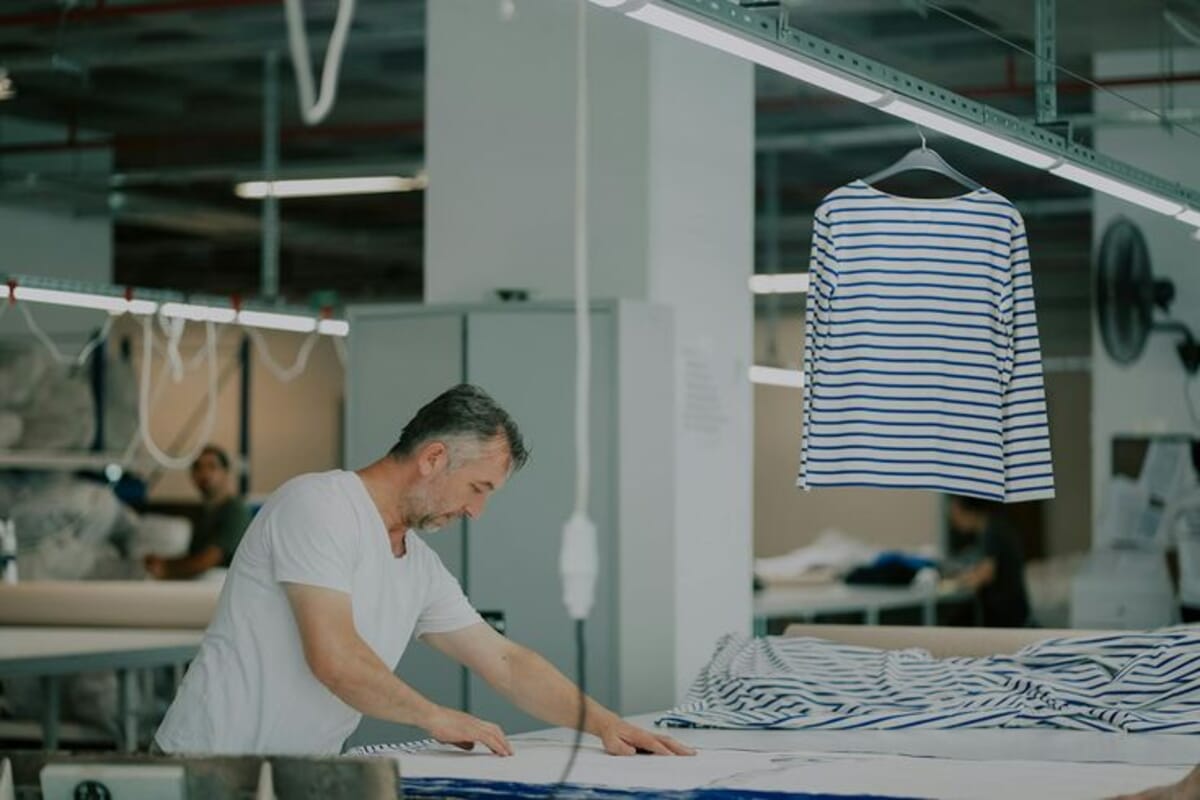
Making clothing in Portugal costs from €3.90 to €116.25 per piece ex-factory in our cost model's reference settings (mid fabric, standard construction), depending on the garment and above all the order size. A T-shirt in mid-range cotton costs €6.00–11.00 per piece at 300–500 units and €9.30–17.05 at 50–100 units.
These figures come from our cost model, built from real production runs across our 80+ partner factories in Portugal between 2024 and 2026. The same model runs our free garment cost calculator. This page publishes the whole model in one place: 12 garments, five order sizes, the fabric and construction multipliers, and the per-piece cost of extras, with a CSV you can download.
Key numbers (PCF cost model, runs 2024–2026)
- T-shirt: €6.00–11.00 per piece at 300–500 units; €4.68–8.58 at 1,000+.
- Hoodie: €14.00–24.00 at 300–500 units; €21.70–37.20 at 50–100.
- Jacket: €35.00–75.00 at 300–500 units, the widest range in the model.
- Small runs cost 55% more per piece than the 300–500 reference, and about twice the 1,000+ price (×1.55 against ×0.78).
- Premium fabric adds 30% (organic, Portuguese mills), luxury fibres add 70%, basic cotton/poly saves 15%.
- All prices are ex-factory (FOB), in EUR, excluding VAT, shipping, duties and sampling.
Heads up: We're Portugal Clothing Factory. Our team places and manages clothing production with selected partner factories in northern Portugal, from 50–100 pieces per style and colour. The numbers below come from our own cost model, and the methodology section explains exactly how it works and what it leaves out.
What Does Each Garment Cost to Make in Portugal?
The table shows the cost per piece for each garment at each of the model's five order sizes. Read across a row to see what quantity does to one garment, and down a column to compare garments at the same volume.
| Garment | 50–100 units | 100–300 units | 300–500 units | 500–1,000 units | 1,000+ units |
|---|---|---|---|---|---|
| T-shirt (jersey/cotton) | €9.30–17.05 | €7.20–13.20 | €6.00–11.00 | €5.28–9.68 | €4.68–8.58 |
| Polo (pique/jersey) | €13.95–23.25 | €10.80–18.00 | €9.00–15.00 | €7.92–13.20 | €7.02–11.70 |
| Hoodie (fleece/french terry) | €21.70–37.20 | €16.80–28.80 | €14.00–24.00 | €12.32–21.12 | €10.92–18.72 |
| Sweatshirt (fleece/terry) | €18.60–31.00 | €14.40–24.00 | €12.00–20.00 | €10.56–17.60 | €9.36–15.60 |
| Shirt (woven) | €23.25–43.40 | €18.00–33.60 | €15.00–28.00 | €13.20–24.64 | €11.70–21.84 |
| Dress (woven/knit) | €27.90–58.90 | €21.60–45.60 | €18.00–38.00 | €15.84–33.44 | €14.04–29.64 |
| Trousers (woven) | €27.90–49.60 | €21.60–38.40 | €18.00–32.00 | €15.84–28.16 | €14.04–24.96 |
| Jeans (denim) | €34.10–62.00 | €26.40–48.00 | €22.00–40.00 | €19.36–35.20 | €17.16–31.20 |
| Jacket (outerwear) | €54.25–116.25 | €42.00–90.00 | €35.00–75.00 | €30.80–66.00 | €27.30–58.50 |
| Activewear (technical knit) | €18.60–37.20 | €14.40–28.80 | €12.00–24.00 | €10.56–21.12 | €9.36–18.72 |
| Underwear (knit) | €7.75–15.50 | €6.00–12.00 | €5.00–10.00 | €4.40–8.80 | €3.90–7.80 |
| Accessory (cap/bag/etc) | €9.30–24.80 | €7.20–19.20 | €6.00–16.00 | €5.28–14.08 | €4.68–12.48 |
Source: PCF's cost model, built from real production runs across our 80+ partner factories in Portugal, 2024 to 2026. EUR per piece, ex-factory (FOB), excluding VAT. Mid fabric (quality cotton blends), standard construction, no extras. Same output as the garment cost calculator with those settings.
The ranges are wide because each one covers many versions of a garment within the same fabric tier and construction level. Use the low end for simple styles and the high end for heavier or more detailed ones, then check your own style in the calculator. For the factories behind these categories, see our guide to the top clothing factories in Portugal.
What Drives the Cost of Each Garment?
The table gives the numbers. This section explains them: for each of the 12 garments, the price at three order sizes, the premium-fabric price, and what pushes a style towards the top or bottom of its range.
T-shirt (jersey/cotton)
€6.00–11.00 per piece at 300–500 units, €9.30–17.05 at 50–100 and €4.68–8.58 at 1,000+. In premium fabric at 300–500 units: €7.80–14.30.
Fabric carries most of the price, because a basic tee is quick to sew: a few seams, a neck rib and two hems. The cost climbs with heavier or better-quality jersey, a garment dye or wash, prints and small details such as a chest pocket or side splits. Extras weigh more on a T-shirt than on any other garment except underwear. Woven labels, care labels, hang tags and a poly bag add €1.40 per piece, which is a large share of a €6 garment. See our t-shirt production page.
Polo (pique/jersey)
€9.00–15.00 per piece at 300–500 units, €13.95–23.25 at 50–100 and €7.02–11.70 at 1,000+. In premium fabric at 300–500 units: €11.70–19.50.
A polo needs more operations than a tee: a buttoned placket, a knitted or fabric collar, sleeve finishing and often side vents. Pique also uses more fabric weight than light jersey, which is why the base range starts €3 higher than the T-shirt. Flat-knit collars with contrast tipping, extra buttons and an embroidered logo all push a polo towards the top of its range. See our polo production page.
Hoodie (fleece/french terry)
€14.00–24.00 per piece at 300–500 units, €21.70–37.20 at 50–100 and €10.92–18.72 at 1,000+. In premium fabric at 300–500 units: €18.20–31.20.
A hoodie uses a lot of fabric per piece, and fleece or French terry is heavier than jersey. The hood is often double-layered, and the kangaroo pocket, rib cuffs and hem, drawcord and eyelets add sewing time. Heavier brushed fleece, garment dyeing and embroidery move a hoodie up fast. In the model a wash or dye treatment adds €2.50 per piece and embroidery €1.80. See our hoodie production page.
Sweatshirt (fleece/terry)
€12.00–20.00 per piece at 300–500 units, €18.60–31.00 at 50–100 and €9.36–15.60 at 1,000+. In premium fabric at 300–500 units: €15.60–26.00.
A sweatshirt is a hoodie without the hood and pocket: less fabric and fewer operations, so its base range sits €2 to €4 lower. The same fleece and French terry choices drive the price. Raglan sleeves, set-in rib panels and contrast trims move it from standard towards complex construction. See our sweatshirt production page.
Shirt (woven)
€15.00–28.00 per piece at 300–500 units, €23.25–43.40 at 50–100 and €11.70–21.84 at 1,000+. In premium fabric at 300–500 units: €19.50–36.40.
A woven shirt has many small pattern pieces: collar and stand, cuffs, yoke, placket and pocket, most of them with interlining. Buttonholes and precise topstitching take time, which is why a shirt costs more to sew than a knit top of similar weight. Checks and stripes that must line up at the seams, French cuffs and fine fabrics are what push shirts towards the top of the range. See our shirt production page.
Dress (woven/knit)
€18.00–38.00 per piece at 300–500 units, €27.90–58.90 at 50–100 and €14.04–29.64 at 1,000+. In premium fabric at 300–500 units: €23.40–49.40.
Dresses have one of the widest ranges in the model (€18–€38 at 300–500 units) because the category runs from a simple jersey dress to a lined woven dress with a zip, darts and a full skirt. Length and fabric volume matter a lot. Linings, invisible zips, gathered or pleated skirts and bias cutting all add sewing time and fabric. See our dress production page.
Trousers (woven)
€18.00–32.00 per piece at 300–500 units, €27.90–49.60 at 50–100 and €14.04–24.96 at 1,000+. In premium fabric at 300–500 units: €23.40–41.60.
Trousers combine a waistband, a fly with a zip or buttons, several pockets and belt loops. Woven fabric, pocket bags and interlining add material cost on top of the shell fabric. Tailored trousers with pressed creases, lined waistbands and hand finishing move into the very complex tier (×1.55).
Jeans (denim)
€22.00–40.00 per piece at 300–500 units, €34.10–62.00 at 50–100 and €17.16–31.20 at 1,000+. In premium fabric at 300–500 units: €28.60–52.00.
Jeans are the most expensive bottoms in the model. Denim is heavy, the five-pocket construction uses heavy thread and specialist machines, and rivets, a shank button and a leather or jacquard patch add trims. Washes matter most for denim: the model adds €2.50 per piece for a wash or dye treatment. Our denim partners often need larger runs than other categories, so check the minimum early. See our jeans production page.
Jacket (outerwear)
€35.00–75.00 per piece at 300–500 units, €54.25–116.25 at 50–100 and €27.30–58.50 at 1,000+. In premium fabric at 300–500 units: €45.50–97.50.
Jackets have the widest range in the model, €35–€75 per piece at 300–500 units, because outerwear runs from an unlined overshirt to a lined, padded or technical jacket. Many panels, zips, linings and interlinings all add time and material. Tailored blazers and structured coats belong in the very complex tier, which multiplies the price by 1.55 before fabric is even considered. See our jacket production page.
Activewear (technical knit)
€12.00–24.00 per piece at 300–500 units, €18.60–37.20 at 50–100 and €9.36–18.72 at 1,000+. In premium fabric at 300–500 units: €15.60–31.20.
Activewear uses technical knits with stretch, and it is sewn with flatlock or coverstitch seams, bonded hems or elastic bands. Those machines and fabrics cost more than standard jersey, which is why its range runs to €24 at 300–500 units. Performance fabrics with recycled content or special finishes usually price in the premium tier (×1.30). See our activewear production page.
Underwear (knit)
€5.00–10.00 per piece at 300–500 units, €7.75–15.50 at 50–100 and €3.90–7.80 at 1,000+. In premium fabric at 300–500 units: €6.50–13.00.
Underwear has the lowest base in the model (€5–€10) because each piece uses little fabric. The work is in fine elastic finishing and small seams rather than in material. As with T-shirts, labels and packaging are a large share of the price per piece, and lace, moulded cups or bonded seams push it up quickly. See our underwear production page.
Accessory (cap/bag/etc)
€6.00–16.00 per piece at 300–500 units, €9.30–24.80 at 50–100 and €4.68–12.48 at 1,000+. In premium fabric at 300–500 units: €7.80–20.80.
"Accessory" covers caps, bags and similar items, so its range is wide relative to its base (€6–€16). A tote bag and a structured six-panel cap are very different jobs. Treat this row as a rough starting point and send us the spec for anything structured or with hardware.
How Do Prices Move With Quantity?
Quantity is the biggest single lever in the model. Every garment uses the same five multipliers, so the effect is identical across categories: the price per piece falls by about half between a 50–100-piece run and a run of 1,000 or more.
The reason is fixed work. Setting up a style, cutting the first lay and getting a sewing line up to speed takes much the same effort whether the order is 80 pieces or 800. On a short run, that work is spread over fewer garments.
Here is what the multipliers mean for the value of a whole order:
| Garment | 50 units | 100 units | 300 units | 1,000 units |
|---|---|---|---|---|
| T-shirt | €465–853 | €720–1,320 | €1,800–3,300 | €4,680–8,580 |
| Hoodie | €1,085–1,860 | €1,680–2,880 | €4,200–7,200 | €10,920–18,720 |
| Shirt | €1,163–2,170 | €1,800–3,360 | €4,500–8,400 | €11,700–21,840 |
| Jeans | €1,705–3,100 | €2,640–4,800 | €6,600–12,000 | €17,160–31,200 |
| Jacket | €2,713–5,813 | €4,200–9,000 | €10,500–22,500 | €27,300–58,500 |
Order value = cost per piece × units, rounded to the euro. Tiers used: 50 units = 50–100 tier, 100 units = 100–300 tier, 300 units = 300–500 tier, 1,000 units = 1,000+ tier. Mid fabric, standard construction, no extras, ex-factory, excluding VAT.
Note the step at 100 units. The calculator's tiers are 50–100 and 100–300, and we priced 100 pieces in the 100–300 tier. Priced in the 50–100 tier, the same 100 T-shirts would cost €930–1,705. In practice the partner factory decides where an order sits. For more on minimums, read our guide to MOQs in Portugal or see our low-MOQ production page.
Citation Capsule Making a T-shirt in Portugal costs €6.00–11.00 per piece ex-factory at 300–500 units, and a hoodie €14.00–24.00, according to Portugal Clothing Factory's cost model, built from real production runs across its 80+ partner factories in Portugal between 2024 and 2026. A 50–100-piece run costs 1.55 times the 300–500 price per piece, and a run of 1,000 or more costs 0.78 times. Prices are in EUR, excluding VAT, shipping and sampling.
How Much Do Fabric, Construction and Extras Add?
After quantity, the model adjusts for fabric and for how complex the garment is to sew. The two multiply, so a premium fabric on a complex style adds 62.5% (×1.30 × 1.25) to the reference price.
Fabric tier
| Fabric tier | What it covers | Multiplier | T-shirt at 300–500 units |
|---|---|---|---|
| Basic | standard cotton/poly | ×0.85 | €5.10–9.35 |
| Mid | quality cotton blends | ×1.00 | €6.00–11.00 |
| Premium | organic, Portuguese mills | ×1.30 | €7.80–14.30 |
| Luxury | tencel, wool, silk | ×1.70 | €10.20–18.70 |
Fabric moves the price by a fixed share at every volume. Two worked examples from the model:
- T-shirt at 1,000+ units: €3.98–7.29 in basic cotton/poly, €4.68–8.58 in mid, €6.08–11.15 in premium and €7.96–14.59 in luxury fibres.
- Hoodie at 50–100 units in premium fabric: €28.21–48.36, about twice the mid-fabric 300–500 price (×1.30 × 1.55 = ×2.015). Small runs in premium fabric are where budgets most often go wrong.
Construction complexity
Construction complexity describes how much sewing work the garment needs relative to a typical example of its type. The four levels are the calculator's own:
- Simple (×0.85): few seams and basic finishing, for example a plain tee with a rib neck or an unlined tote.
- Standard (×1.00): a typical garment of its type. All the headline figures on this page use this level.
- Complex (×1.25): many panels or details, for example a hoodie with panelled sleeves and zipped pockets, or a shirt with checks aligned at every seam.
- Very complex (×1.55): tailoring and structure, for example a lined blazer or a structured coat.
Complexity and fabric multiply. A very complex jacket in luxury fabric at 300–500 units is €92.22–197.62 per piece before extras (×1.55 × 1.70 = ×2.635), against €35–€75 for a standard jacket in mid fabric.
| Construction | What it means | Multiplier | Jacket at 300–500 units |
|---|---|---|---|
| Simple | few seams, basic | ×0.85 | €29.75–63.75 |
| Standard | typical garment | ×1.00 | €35.00–75.00 |
| Complex | many panels, details | ×1.25 | €43.75–93.75 |
| Very complex | tailoring, structure | ×1.55 | €54.25–116.25 |
Extras, added per piece
Extras are flat amounts added after the multipliers, so they matter more on cheap garments. Woven labels, care labels, hang tags and a poly bag add €1.40 per piece: about 23% on a €6 T-shirt, 4% on a €35 jacket.
| Extra | Added per piece |
|---|---|
| Custom woven labels | €0.60 |
| Hang tags | €0.35 |
| Poly bags | €0.15 |
| Eco packaging | €0.80 |
| Embroidery | €1.80 |
| Screen print | €1.40 |
| Wash/dye treatment | €2.50 |
| Care & size labels | €0.30 |
Source: PCF's cost model, built from real production runs across our 80+ partner factories in Portugal, 2024 to 2026. Multipliers and extras are the calculator's own values.
Worked Example: A 300-Piece Hoodie Order
Here is a full calculation for a typical first order: a hoodie in premium fabric (organic cotton fleece from a Portuguese mill), standard construction, with an embroidered logo and a normal label and packaging set. Every number comes from the model.
| Step | Calculation | Per piece |
|---|---|---|
| Base range (hoodie) | Mid fabric, standard, 300–500 units | €14.00–24.00 |
| Premium fabric | ×1.30 | €18.20–31.20 |
| Quantity tier 300–500 | ×1.00 | €18.20–31.20 |
| Standard construction | ×1.00 | €18.20–31.20 |
| Extras (5) | +€3.20 | €21.40–34.40 |
| Order value, 300 pieces | ×300 | €6,420–10,320 |
| Extra in this order | Per piece |
|---|---|
| Custom woven labels | €0.60 |
| Care & size labels | €0.30 |
| Hang tags | €0.35 |
| Poly bags | €0.15 |
| Embroidery | €1.80 |
| Total extras | €3.20 |
Ex-factory, excluding VAT, freight, duties and sampling. The calculator shows order totals at an example quantity per tier (400 pieces for 300–500), so its total line will differ; the price per piece is the same.
Now cut the same order to 100 pieces. The quantity tier moves to 100–300 (×1.20), so the garment part becomes €21.84–37.44 and, with the same €3.20 of extras, the price per piece is €25.04–40.64. The order value falls to €2,504–4,064, but each hoodie costs €3.64–6.24 more.
That is the trade-off every new brand has to make: a smaller first order ties up less cash, while a larger one lowers the price per piece. If you can sell through 300, the per-piece saving is real. If you are not sure, a smaller first run that sells out is usually the better business decision than a cheaper one that sits in stock.
What Does the Price Include, and What Doesn't It?
Every number on this page is a full-package, ex-factory (FOB) price: the fabric at the chosen tier, cutting, sewing, finishing and the factory's margin, at the factory door. It excludes VAT, freight, duties and anything after the goods leave the factory.
- CMT is not split out. The model prices the finished garment. If you supply your own fabric (CMT), the labour share is a part of these figures, not the whole. Our CMT pricing guide covers that model separately.
- Sampling is not included. The model has no sampling line, so we do not publish a sampling figure here. Sample costs depend on the style and the factory and are quoted per project.
- A tech pack comes first. A factory can only quote a binding price from complete specs. Our tech pack service costs €79 per style.
How to Compare These Numbers With a Real Quote
A model range is only useful if you compare it with quotes on the same basis. When a factory price comes in, check these points before you put it next to the numbers on this page:
- Is it full package or CMT? These figures include fabric. A CMT price will look far lower because the fabric is on a separate invoice.
- Is it ex-factory or delivered? These are ex-factory (FOB) prices. A delivered (DDP) price includes freight and duties and should be higher.
- Is it per style and colour? Minimums and price tiers apply per style and colour, so a split order may land in a smaller tier than its total suggests.
- Which trims and packaging are in? Labels, hang tags and bags are extras in this model. Check whether the quote includes them.
- Is sampling separate? It is not in this model. Most quotes list sampling and pattern work as their own lines.
- Is VAT shown? These numbers exclude VAT. EU buyers registered for VAT and buyers outside the EU are treated differently, so ask how the invoice will be issued.
If a quote is well above the model range for the same specification, ask the factory which line drives the difference. Often it is the fabric, a treatment, or a quantity that falls into a smaller tier than you expected.
How to Use the Calculator for Your Own Style
The calculator runs the same model as this page, so you can price your own style in about a minute. It takes five inputs, in this order:
- Garment. Pick the closest of the 12 types. If yours sits between two (an overshirt between shirt and jacket, for example), run both and treat them as the bounds.
- Fabric. Basic for standard cotton or polyester, mid for quality cotton blends, premium for organic or Portuguese-mill fabric, luxury for Tencel, wool or silk.
- Quantity per style and colour. Use the number of pieces in one style and one colour, not the total order. Two colours of 150 are two runs of 150, not one of 300.
- Construction. Simple for few seams, standard for a typical garment, complex for many panels and details, very complex for tailoring and structure.
- Extras. Tick the labels, packaging, decoration and treatments you need. Each adds a fixed amount per piece.
Run it twice: once at the quantity you plan to order and once at the next tier up. The gap between the two tells you what volume is worth to you. You can have the estimate emailed to you, and when you are ready for a real price, send us a brief from the same page.
Methodology: What This Model Is and Isn't
Source. PCF's cost model, built from real production runs across our 80+ partner factories in Portugal, 2024 to 2026. It is the same model that runs our public garment cost calculator, so every number here can be reproduced on that page.
How it works. Each garment has a base cost range per piece, set for mid-range fabric, standard construction and a 300–500-piece run. That range is multiplied by a fabric factor (0.85 to 1.70), a quantity factor (1.55 to 0.78) and a construction factor (0.85 to 1.55). Extras are then added per piece. The headline table uses mid fabric, standard construction and no extras.
What it is not. It is not a price list or a quote. The ranges are planning bands that summarise past runs, and a real quote can fall outside them, for example for very heavy fabrics, certified materials, unusual sizes or tight deadlines. Garments outside the 12 categories (knitwear, swimwear, kidswear, joggers and others) are not modelled yet, so we do not publish figures for them.
Updates. When the model changes, we update the calculator, this page and the CSV together.
Download the Data
The full table is available as a CSV file: 12 garments, five quantity tiers, low and high cost per piece, and order values at 50, 100, 300 and 1,000 units. Download the CSV. Journalists, researchers and educators are welcome to use the data; please cite "Portugal Clothing Factory cost model (production runs 2024–2026)" and link to this page.
Frequently Asked Questions
How much does it cost to make a T-shirt in Portugal?
In PCF's cost model, a T-shirt in mid-range cotton with standard construction costs €6.00–€11.00 per piece ex-factory at 300–500 units, €9.30–€17.05 at 50–100 units and €4.68–€8.58 at 1,000 units or more, excluding VAT and shipping.
How much does it cost to make a hoodie in Portugal?
In PCF's cost model, a fleece or French terry hoodie costs €14–€24 per piece ex-factory at 300–500 units, €21.70–€37.20 at 50–100 units and €10.92–€18.72 at 1,000 units or more, with mid-range fabric and standard construction.
How much cheaper is a larger order?
In the model, the price per piece at 50–100 units is 1.55 times the 300–500 price, and at 1,000+ units it is 0.78 times. So a 1,000-piece run costs about half as much per piece as a 50–100-piece run of the same garment.
Do these prices include fabric, VAT and shipping?
They include fabric at the chosen tier, cutting, sewing and the factory's price at the factory door (FOB). They exclude VAT, shipping, duties and sampling. Labels, packaging, prints and washes are added per piece when you select them.
Is this a quote?
No. It is a planning range from PCF's cost model. A binding price comes from the partner factory after it reviews a complete tech pack with measurements, materials and trims.
What is the minimum order for clothing production in Portugal?
With PCF, production starts from 50–100 pieces per style and colour, decided case by case with the partner factory. Some products, such as denim, can need more.
What does Portugal Clothing Factory do?
Our team places and manages clothing production with selected partner factories in northern Portugal: development, sampling, quality control and communication. The partner factory invoices the production, and our own fee is quoted in writing before any work starts.
Our team places and manages clothing production with selected partner factories in northern Portugal, from 50–100 pieces per style and colour, decided case by case with the partner factory. Tell us your garment, fabric, quantity and timeline; we reply within 24 hours. Fee quoted in writing, no commissions.
Get in contact Run the cost calculatorNeed a tech pack first? Get a factory-ready single-style tech pack for €79. See what's included.
Sources used in this article
- Portugal Clothing Factory, Garment cost calculator: base ranges, fabric, quantity and construction multipliers and extras used for every figure on this page (PCF's cost model, built from real production runs across our 80+ partner factories in Portugal, 2024 to 2026).
Portugal Clothing Factory places and manages clothing production with selected partner factories in the northern Portuguese textile cluster. We quote our fee in writing, reply within 24 hours, and stay involved through sampling, quality control and delivery. See how we work or get in contact.

