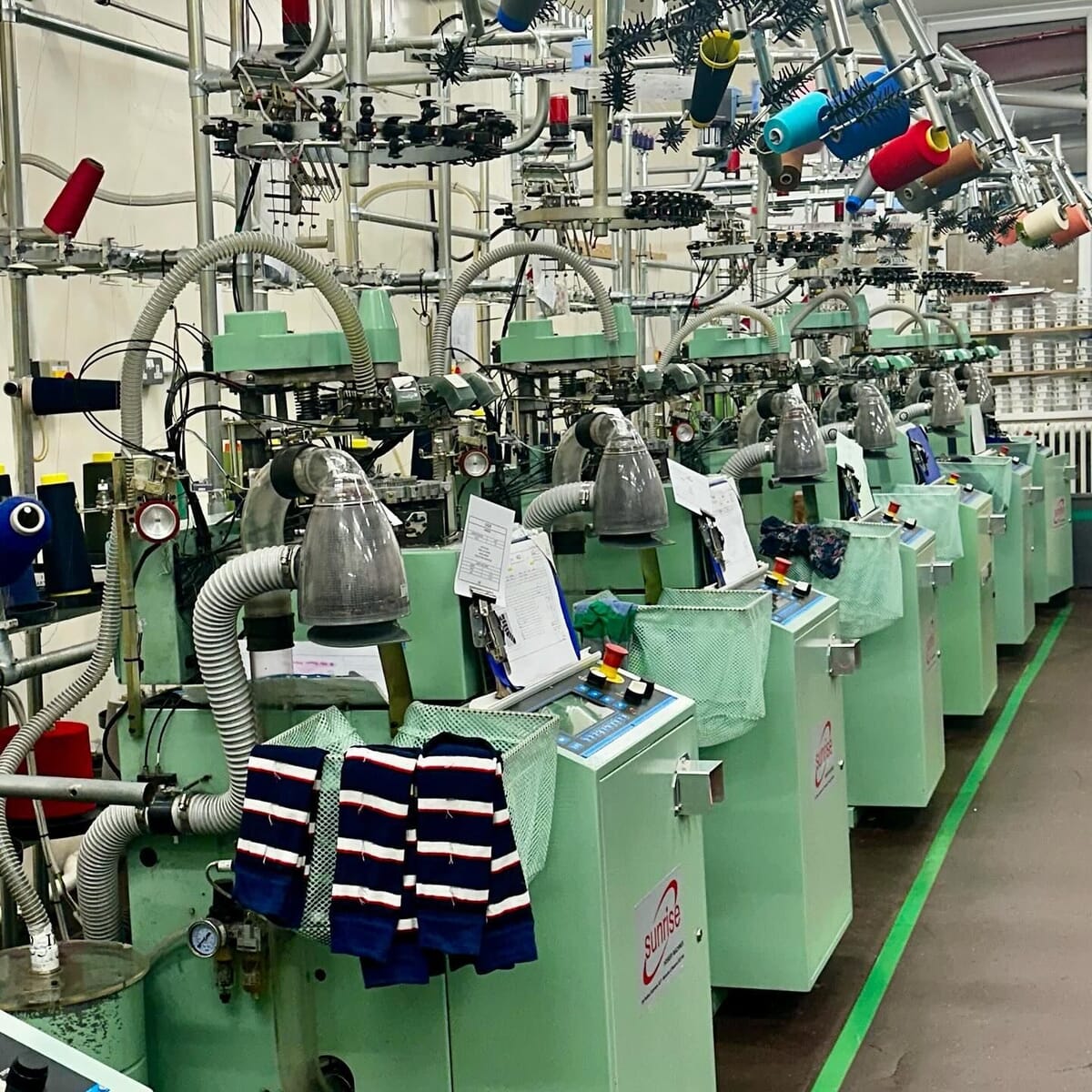
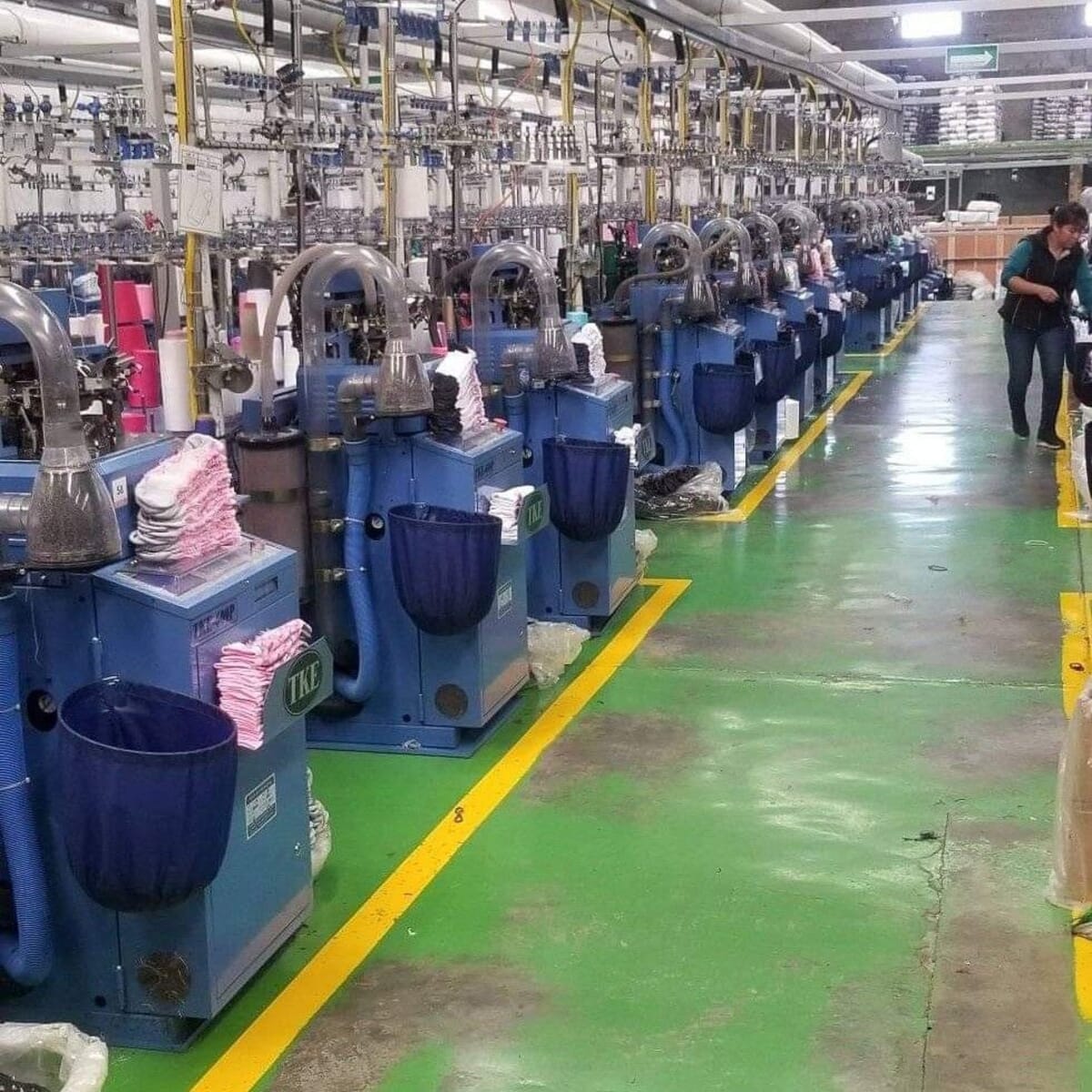
Socks are not made the way the rest of apparel is made. There is no pattern, no marker and no cutting. A sock is knitted in the round on a specialised circular machine, closed at the toe, then washed and shaped on a form. That makes sock production a machine business rather than a labour business, and it means a garment factory is the wrong place to ask about it.
This guide covers how socks are actually produced, what a brand has to specify, what minimums and costs look like, which sock programmes work commercially, how to choose a knitter, and what the trade data says about sock and hosiery production in Portugal. If you already have a sock in mind, our sock manufacturer in Portugal page shows how we take a sock brief.
What to know
- Socks are knitted in the round, not cut and sewn. It is a separate industry.
- Needle count determines fineness and detail, and which machines can run your product.
- Minimums come from machine setup and yarn colour, not from fabric cutting.
- Boarding sets the finished size, and drift across a run is the common complaint.
- Reorders are cheap once the programme exists, because setup is already done.
- Portugal exported $148.9 million of hosiery in 2024, and France, Spain and Germany were the largest buyers (WITS).
How is a sock actually made?
Knitted as a continuous tube on a circular machine, closed at the toe, then wet finished and boarded to shape.
Circular knitting produces the whole geometry
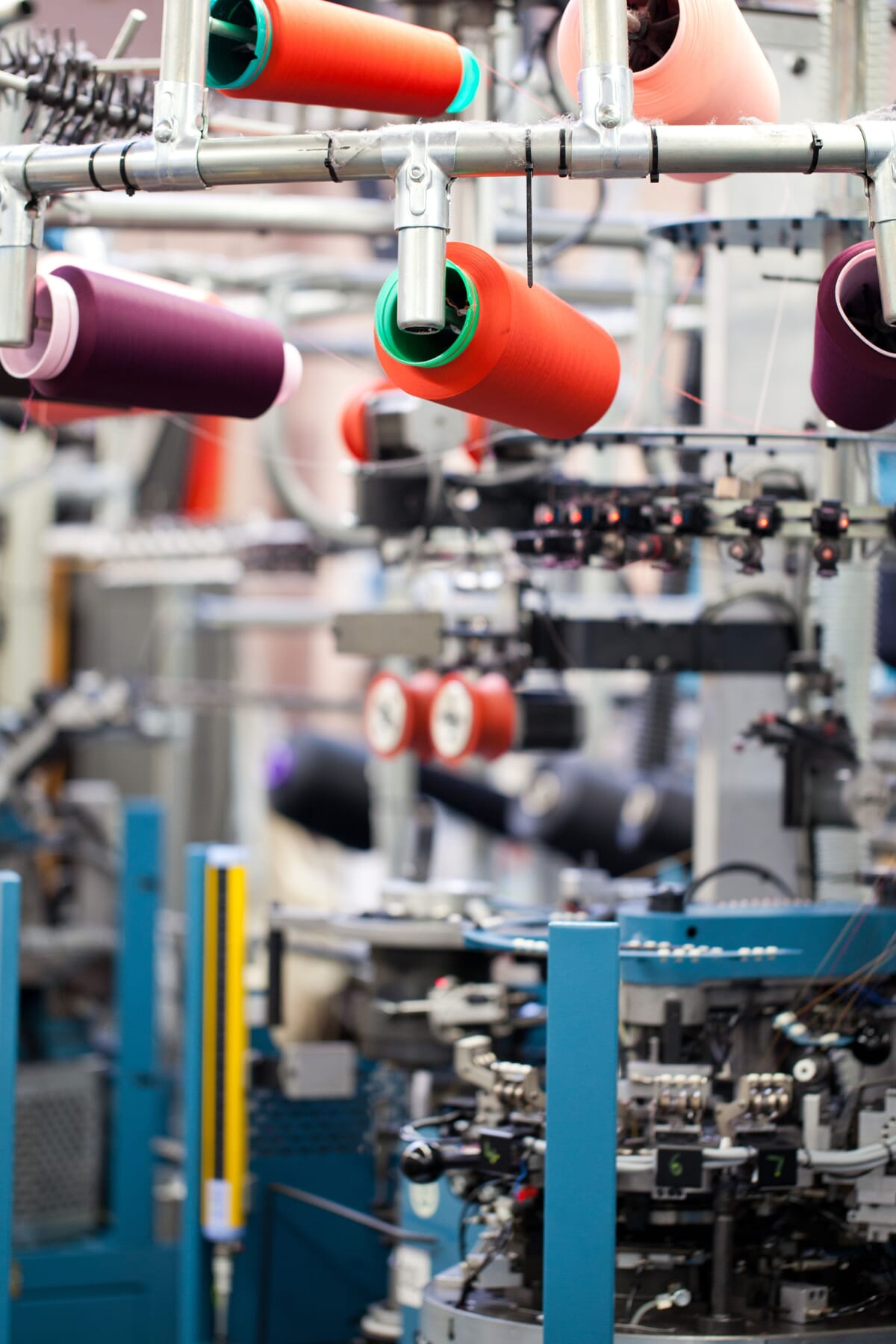
A sock machine knits a continuous tube in the round and forms the cuff ribbing (see our guide to rib knit), the leg, the heel pocket, the foot and the toe entirely through machine programming rather than by cutting and joining separate pieces. The whole shape of the garment emerges from one operation on one machine, which is why the programming and the machine technician rather than any sewing operator are where the skill in this category actually sits.
The toe is closed afterwards
Traditional machines leave the toe open, and it is closed either by a linking operation or automatically by the machine itself. A seamless toe closure produces a flatter, more comfortable join, and a bulky toe seam is something the wearer feels with every step, which makes this worth specifying rather than accepting a default.
Wet finishing and boarding set the shape
Socks are washed and then boarded, meaning pressed onto a foot-shaped form under heat, which fixes the dimensions and the appearance. This stage determines whether a sock holds its size and shape, and it is part of why the same knitting programme can produce noticeably different results at different factories.
Pairing and packing are labour
Pairing, inspecting, labelling, tagging and packing are all hand operations performed after the knitting is complete, and for a branded retail-ready programme they represent a meaningful share of the finished unit cost. Specify the retail presentation early rather than at the end, because it is easy to treat as an afterthought, it affects both the price and the lead time, and adding requirements after a quote is agreed is a legitimate reason for that quote to change.
What is needle count and why does it matter?
It is the number of needles on the cylinder, and it determines how fine the knit is and which machines can make your sock at all.
Fine versus chunky
A higher needle count produces a finer, lighter fabric capable of holding more design detail, while a lower count produces a heavier, chunkier sock. It is one of the first decisions in a sock specification because it sets the character of the product and narrows the set of possible factories immediately.
It constrains the design
An intricate pattern specified without reference to needle count either cannot be knitted as drawn or requires a finer machine at higher cost. Settle the needle count before finalising artwork, because discovering the constraint afterwards means redrawing rather than adjusting.
It drives machine time
Finer gauges take longer to knit, which is a direct cost. Machine time is the main production variable in socks in the way sewing time is in cut-and-sew apparel, so the gauge decision affects the price as much as it affects the appearance.
Pair it with the yarn
Yarn weight and needle count have to be compatible: a chunky yarn cannot be knitted on a fine machine, and a fine yarn on a coarse machine produces a loose, unstable fabric. These two decisions are made together rather than sequentially.
What else has to be specified?
Yarn and blend, sock height, cushioning zones, toe closure, sizing and packaging.
Yarn and blend
Cotton, merino, performance synthetics and blends each behave differently in knitting, in wear and through washing. Yarn choice affects the machine settings, the hand, the durability and the price, and it should be settled with the factory rather than decided in isolation from what they can actually run. For wool socks, our comparison of merino and cashmere explains how the fibre behaves next to skin.
Height and construction
Crew, quarter, ankle and no-show are different constructions with different problems. No-show socks in particular depend on heel grip to stay on the foot, and a brand specifying one without addressing that will receive returns from customers whose socks disappear into their shoes.
Cushioning and zones
Terry cushioning, arch compression, mesh ventilation panels and reinforced heel and toe are all programmable into the knit. Each adds machine time and cost, and each should be specified deliberately rather than requested as a general expectation that the sock be good.
Sizing and packaging
Sock sizing is broader than garment sizing and the stretch absorbs variation, which makes the size run less of a problem than in apparel. Packaging, however, is a real cost: pairing, tagging, header cards and boxes are all labour and materials priced separately from the knitting.
What minimums should you expect?
Driven by machine setup and by yarn colour, which means colours multiply the commitment.
Setup creates the floor
Programming a machine for a new design and threading the required yarn colours takes skilled time during which the machine produces nothing at all, and that fixed cost is then spread across whatever the run produces. This is precisely what creates a minimum in this category, and it is why a very small order costs disproportionately more per pair than a moderate one rather than simply costing less in total.
Each colour is its own setup
Adding a colourway multiplies the commitment rather than splitting it, because each requires its own threading and its own yarn. Reducing the colour count is the most effective lever a brand has for bringing a first sock order into reach.
Yarn carries its own minimum
Where a specific yarn or shade must be dyed rather than bought from stock, the yarn minimum can exceed the factory minimum and becomes the binding constraint. Using colours the factory already stocks is the fastest way to a workable first order. Our guide to minimum orders in Portugal explains how to read the number a factory gives you.
Sizes are comparatively easy
Because sock sizing is broad and the knitted structure stretches to absorb variation, the size run does not fragment an order across many combinations the way an apparel size range inevitably does. This is one of the few respects in which socks are genuinely simpler to plan than cut-and-sew garments, and it means the colour count rather than the size count is what a brand needs to control.
What does sock production cost?
Above offshore per pair, with a narrower gap than in apparel because the process is machine-driven.
The labour differential matters less
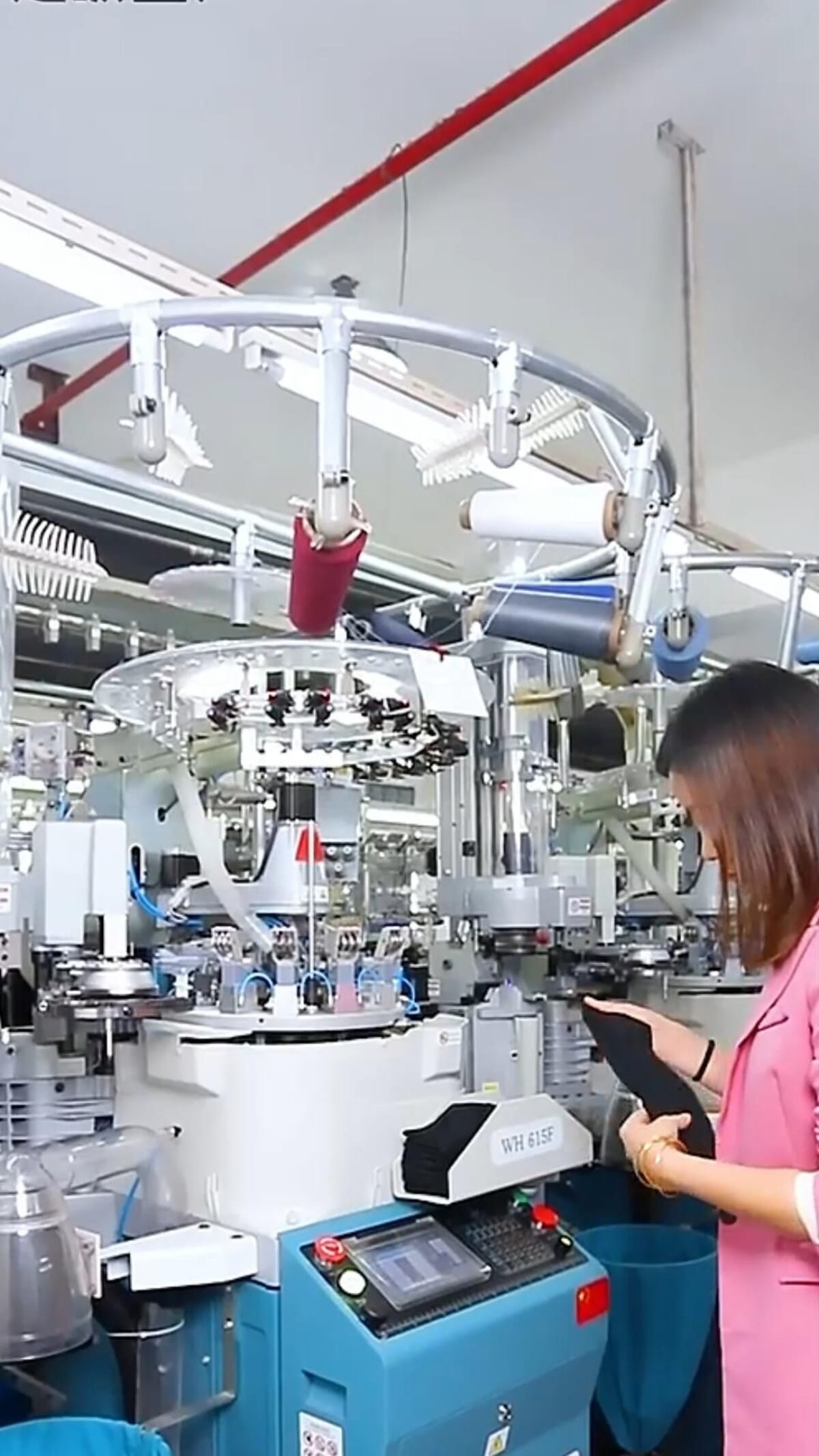
A sock is largely produced by a machine with limited human intervention, so the wage differential that makes offshore cut-and-sew dramatically cheaper applies with much less force here. The premium on domestic or European sock production is real, but it tends to be smaller in proportion than it is on garments.
Complexity drives the price
Needle count, the number of yarn colours in the design, cushioning zones, patterning and the toe closure method all add machine time, and machine time is the production variable that sets the price. A simple two-colour crew sock and a patterned performance sock with multiple cushion zones are genuinely different products with different economics, and comparing quotes between them tells you nothing about the factories.
Finishing and packing add up
Pairing, labelling, tagging and retail packaging are labour, and for a retail-ready programme they can represent a significant share of the unit cost. A brand costing only the knitting has costed part of the product.
Reorders are cheap
Because there is no pattern to develop, no marker and no cutting, a repeat order is close to pure machine time once the programme exists. The first order carries the setup and every subsequent one benefits from it, which makes the category unusually rewarding to reorder.
How do you choose a sock factory?
On machine type and needle count first, then on finishing and consistency.
Ask what machines they run
Ask specifically about needle counts, machine makes and how many machines of each type they hold, because that determines both what they can make and whether your order runs as a normal job or waits for one machine to become free. A factory whose machines genuinely suit your product will produce it well, while one adapting what it has will compromise somewhere, usually in the fineness of the knit or the detail of the pattern.
Ask about boarding and finishing
Boarding quality determines whether socks hold shape and size consistently across a run. Ask how they board and ask to see production rather than samples, because sample socks are frequently finished more carefully than a production batch.
Ask for worn references
Socks fail in wearing and washing rather than on arrival. Ask what comparable products the factory produces and, where possible, obtain examples that have been worn and laundered rather than only new samples straight from a bag.
Check consistency across a run
A frequent sock quality problem is variation within a batch: size drift, colour variation between machines and inconsistent cushioning. Ask how that is controlled and inspect across several cartons rather than from the top of the first one. Our guide to quality control in Portuguese clothing production shows what a final inspection should cover.
Can socks be made fully domestically?
More readily than most apparel, because spinning capability still exists.
Yarn availability is the difference
Unlike many technical apparel fabrics, cotton and wool yarns are still spun in Europe, which means a sock knitted regionally from regionally spun yarn is an achievable chain rather than an aspiration. In Portugal alone, GEE counted 999 companies in fibres, yarns and fabrics in 2022. For brands making origin claims, that makes socks easier to substantiate than many garments.
Ask about the spinner specifically
A factory that knits domestically may be running imported yarn and will answer a question about domestic knitting without volunteering it. Ask about the spinner by name and whether that applies to the specific lot being produced for you.
Verify at each production run
Factories buy yarn from more than one spinner and allocate by run, and for commercial customers the distinction is immaterial so it goes unmentioned. A claim that depends on yarn origin needs confirming at each order rather than once at the start.
Keep the evidence with the order
Ask each party for a statement identifying the lot, the producer and the date, and file it against the production run. Reconstructing a fibre claim retrospectively is difficult once material has been consumed.
Why produce socks in Portugal?
An established hosiery export industry, yarn in the same region, and short road links into European markets.
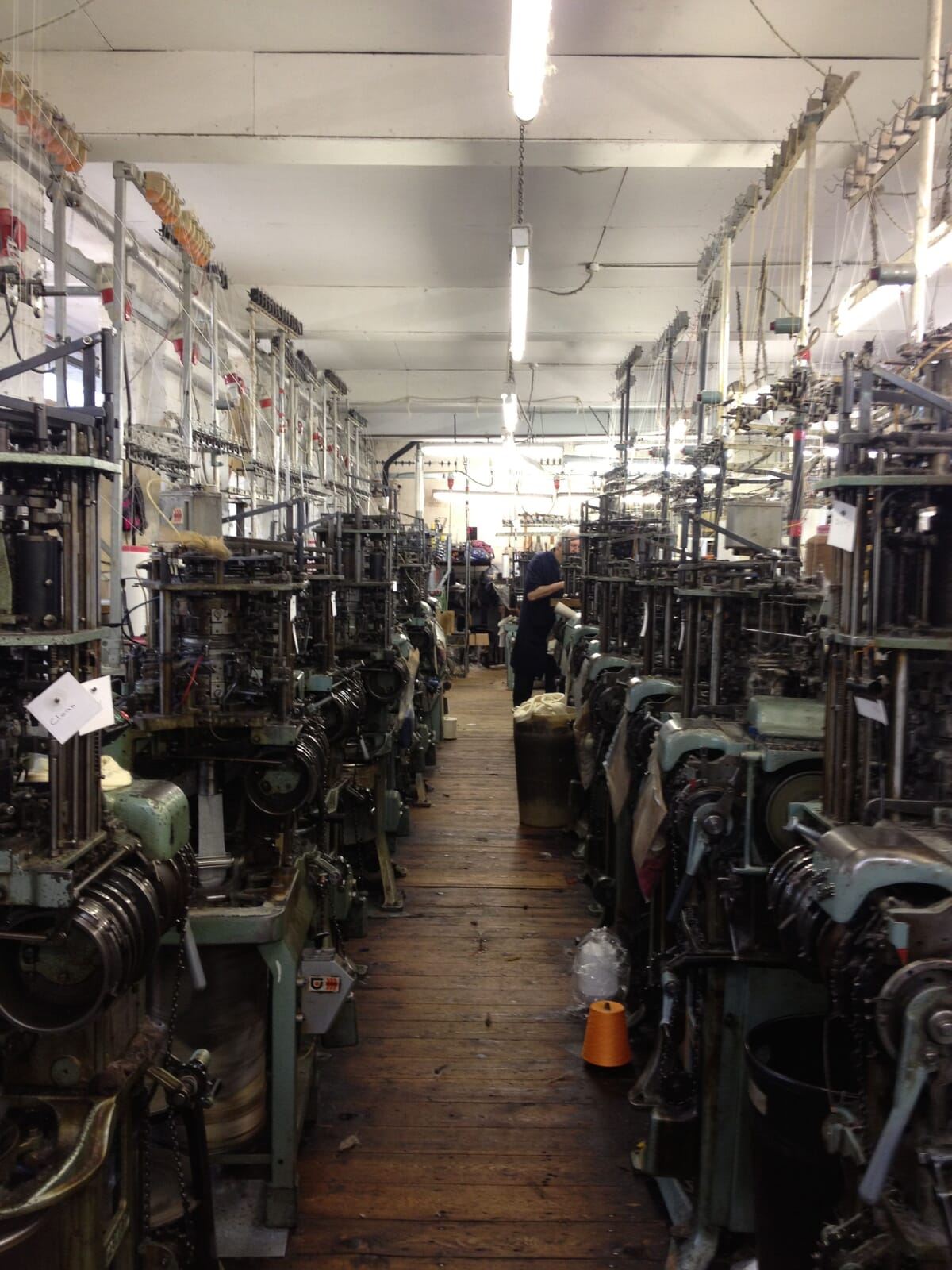
Hosiery is an established regional industry
Portugal exported $148.9 million of hosiery in 2024 according to WITS, so sock and hosiery knitting is an established export industry rather than a sideline of garment making. The trade data section below shows how that figure has moved since 2019 and where the goods went.
Yarn sits in the same region
GEE notes that Portugal's textile and clothing companies sit mostly in the North, concentrated in the Ave and Cávado regions. Spinning, dyeing and finishing are close to the knitters, which shortens the chain, simplifies documentation and makes a substantially regional product achievable.
Lead times suit reordering
Because reorders are largely machine time and goods travel by road to most EU customers with no customs declaration inside the single market, restocking a selling colour is fast. In a category that sells steadily rather than seasonally, that matters more than it does in fashion.
Small programmes are possible
Sock minimums are set per style and colourway, so a first programme with few colours and stock yarn shades can stay modest. We quote the sock minimum in writing for each brief rather than publishing one number, because needle count, yarn and colourways move it.
What does the trade data say about Portuguese socks?
Steady value, fewer kilos, and a market that is mostly next door. Socks and other hosiery are traded under HS heading 6115. According to WITS, which publishes UN Comtrade data, Portugal exported $148.9 million of HS 6115 goods in 2024, weighing 10.1 million kg.
The value has stayed in a fairly narrow band: $147.8 million in 2019, a dip to $127.4 million in 2020, a peak of $164.2 million in 2022, then $152.7 million in 2023 and $148.9 million in 2024. The weight tells a different story. Shipments fell from 14.7 million kg in 2019 to 10.1 million kg in 2024, a drop of about 31%.
Put the two together and the average export value works out at about $10.03 per kg in 2019 and about $14.70 per kg in 2024. Treat that as a direction, not a price list. The figures are in current US dollars, so inflation and the euro to dollar rate play a part, and HS 6115 also covers tights and stockings. Still, it is consistent with what you see on the ground: fewer basic, heavy multipacks and more programmes where the pair carries more value.
The buyers are close by. In 2024 France took $27.1 million, Spain $18.9 million, Germany $17.8 million, the Netherlands $16.7 million and the United Kingdom $13.7 million. Those five took about 63% of the total. The UK figure has fallen each year since 2019, when it was the largest destination at $28.3 million.
For a brand, the useful reading is simple. Portuguese sock knitting competes on value and speed into Europe, not on the lowest price per pair. Our page on the Portuguese textile industry in numbers gives a wider view of the sector.
What mistakes do brands make with socks?
Approaching garment factories, designing beyond the needle count, ignoring yarn and skipping wear testing.
Asking a clothing factory
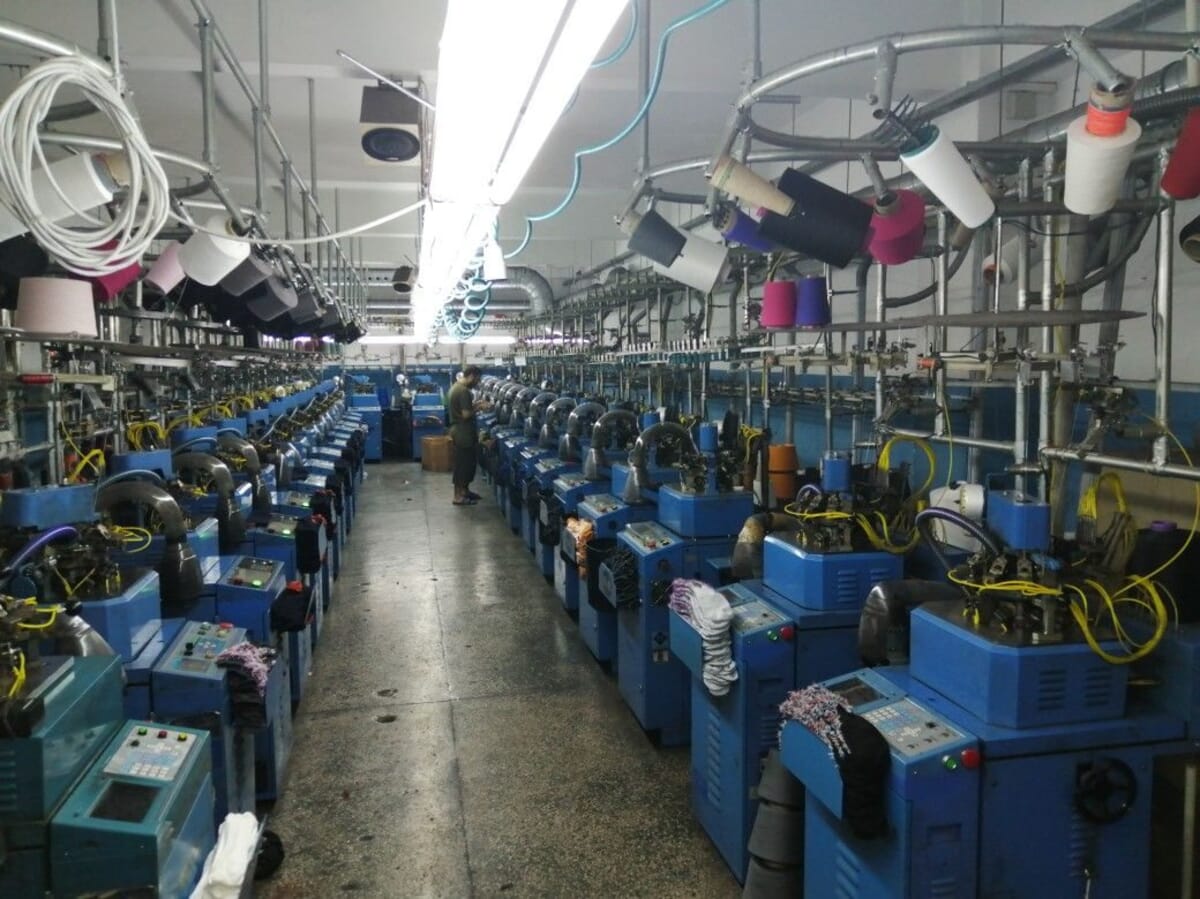
Sock manufacturing is a separate industry with separate equipment, separate technicians and separate supply relationships. Time spent asking cut-and-sew factories about socks produces a referral at best, and the referral is the useful part of the conversation.
Designing before settling the gauge
An intricate design specified without reference to needle count either cannot be knitted or requires a finer and more expensive machine. Decide the gauge with the factory before artwork is finished rather than after.
Leaving yarn to the factory
Yarn determines hand, durability, shrinkage and price, and brands frequently leave it unspecified and then find the result unsatisfying without being able to explain why. Engage with it as a decision rather than a detail.
Not wear testing
A sock that looks entirely correct straight from the bag can slip at the heel in a shoe, thin at the toe within weeks or lose its cuff elasticity after a handful of washes. These are the complaints that actually drive returns and stop repeat purchase, not one of them appears on a visual inspection, and every one of them is cheap to find during a fortnight of wearing before a production quantity is committed. Our guide to ordering a clothing sample covers how to run sample rounds.
What sock programmes work commercially?
Performance, outdoor, workwear and branded merchandise. Commodity multipacks competing on shelf price do not.
Performance socks carry a premium
Cushion zones, arch compression, ventilation panels and targeted reinforcement are all knittable features that customers will genuinely pay more for, and performance socks sell on function rather than on price. That combination gives a domestic or European programme the margin it needs to work, which makes it a strong fit for regional production.
Outdoor and workwear reorder reliably
Heavier constructions in merino and wool blends, sold through outdoor and workwear channels, carry price points that comfortably absorb European production costs. These customers also value durability and origin, both of which a regional programme can credibly claim, and they repurchase the same product rather than shopping on price each season.
Branded and merchandise programmes need speed
Corporate, team, event and brand-merchandise socks are bought on design and turnaround rather than on unit price, and short lead times are a genuine advantage. A programme needing a specific colourway delivered in weeks is one that long-haul production struggles to serve. Our merch manufacturer page covers branded programmes beyond socks.
Commodity multipacks do not work
Basic white multipacks sold on price through mass retail are where the offshore advantage is largest and the European premium hardest to recover. A brand whose entire proposition is cost per pair should be honest that this is not the category where regional production competes.
Working with Portugal Clothing Factory
Our team places and manages clothing production with factories in our group in the northern Portuguese textile cluster, and that includes factories that knit socks. Socks sit in a different part of the industry from garments, so we place a sock brief with a knitter whose machines, needle counts and yarns suit it, and you approve a sample on your own feet before production. The sock manufacturer in Portugal page lists the styles brands brief us most.
Across our group, minimums are usually 50 to 100 pieces per style and colour; for socks we quote the minimum per brief, because needle count, yarn and colourways move it. We agree our fee in writing, take no commission on production, and the partner factory invoices the production.
Get in contact with the item, the quantity and the timeline. Our team replies within 24 hours.
Frequently asked questions
How are socks manufactured?
Knitted in the round on a specialised circular machine that forms the cuff, leg, heel, foot and toe through programming, then toe-closed, washed and boarded onto a foot-shaped form to set the final dimensions.
What is needle count in socks?
The number of needles on the machine cylinder, which determines how fine the knit is and how much design detail is possible. It also decides which machines can produce your sock at all, which is why it is one of the first specifications to settle.
What minimums should I expect for socks?
Minimums come from machine setup and yarn colour rather than from fabric cutting. Each colourway is its own setup, so reducing colour count is the most effective way to bring a first order into reach. We quote the sock minimum in writing for each brief.
Are socks cheaper to produce than garments?
Per unit they are a different economic proposition. Because the process is machine-driven rather than labour-intensive, the gap between European and offshore production tends to be narrower in proportion than it is for cut-and-sew apparel.
Can I reorder socks quickly?
Yes, and this is a genuine advantage of the category. With no pattern, marker or cutting, a repeat order is largely machine time once the programme exists, so the first order carries the setup and later ones benefit from it.
What should I specify before asking for a quote?
Needle count, yarn and blend, sock height, cushioning zones, toe closure method, size range and packaging. A factory cannot price a sock without those.
How much hosiery does Portugal export?
According to WITS (UN Comtrade data), Portugal exported $148.9 million of hosiery under HS 6115 in 2024, weighing 10.1 million kg. France, Spain and Germany were the largest destinations.
Our team places and manages clothing production with factories in our group in northern Portugal, usually from 50 to 100 pieces per style and colour, with sock minimums quoted per brief. Tell us your product, yarn, volume and timeline, and we reply within 24 hours. Fee agreed in writing, no commissions.
Send your brief Portugal factory directory (€49)No tech pack yet? We prepare one style, factory-ready, for €79. What it includes.
Sources
- WITS (World Bank), UN Comtrade data: Portugal exports of HS 6115 hosiery by partner, 2019, 2020, 2021, 2022, 2023, 2024.
- GEE, Estudos Setoriais 2030: Indústria Têxtil e do Vestuário (2024) (PDF): companies in fibres, yarns and fabrics, 2022 data, and regional concentration.
Portugal Clothing Factory places and manages clothing production with factories in our group in the northern Portuguese textile cluster. We agree our fee in writing, reply within 24 hours, and stay involved through sampling, quality control and delivery. See how we work or get in contact.