Sport clothing is the category where the gap between a general garment factory and a specialist is widest. The fabrics behave differently, the seams are constructed differently, and the machinery is not interchangeable.
The global activewear market was projected at roughly $373 billion in 2026, growing at 8.57% annually (Fortune Business Insights, 2026). That growth has pulled a lot of generalist factories into claiming sportswear capability. This guide explains how to tell the difference, what technical production actually requires, and what it costs.
Heads up: We're Portugal Clothing Factory, a group of 80 documented Portuguese clothing factories, 25 verified in person. Capability counts, minimums and lead times come from that group. Market figures come from published sources, named inline.
Key Takeaways
- The global activewear market is projected at ~$373 billion in 2026, growing 8.57% annually (Fortune Business Insights, 2026).
- Sportswear needs flatlock or coverstitch seams and elastane-compatible machinery, not standard lockstitch lines.
- Only 4 of 80 factories in our documented Portuguese group specialise in sportswear. Specialism is genuinely scarce.
- Performance claims require testing. Untested claims are a legal exposure, not a marketing choice.
What Makes a Sport Clothing Manufacturer Different?
Three things, and all of them are equipment rather than skill. Specialism is scarce: only 4 of the 80 factories we document specialise in sportswear.
Seam construction. Flatlock and coverstitch seams sit flat against skin. That stops chafing. Both need dedicated machines, so a factory running standard lockstitch lines cannot make them. Operator skill does not close that gap.
Elastane handling. Sportswear fabric carries 8-20% elastane. It stretches under the needle. It curls at the edges. Factories that handle it well have adjusted their cutting tables and tension settings, and many use vacuum cutting beds.
Bonded and taped construction. Premium pieces swap stitching for heat-bonded seams and taped edges. That needs bonding equipment. Most garment factories do not own any.
In our documented group of 80 Portuguese factories, 4 specialise in sportswear. That scarcity is normal across Europe, and it is why "we can do activewear" from a generalist deserves a follow-up question about machinery.
Citation Capsule: Sport clothing manufacturing differs from general garment production primarily through equipment rather than labour skill. Flatlock and coverstitch seams require dedicated machines, elastane content of 8-20% demands adjusted cutting and tension handling, and bonded seam construction requires heat-bonding equipment absent from most garment factories. In one documented group of 80 Portuguese factories, only 4 specialise in sportswear.
What Fabrics Do Sport Clothing Manufacturers Use?
Performance fabric is mostly synthetic. Polyester alone is 59 percent of global fibre production (Textile Exchange, 2025), and its share inside sportswear runs higher. Buyers want wicking, fast drying and shape recovery. Cotton delivers none of them well.
Polyester dominates. It wicks, dries fast and recovers shape. It also holds colour through sublimation printing. Polyester is 59% of all global fibre production (Textile Exchange, 2025), and its share inside sportswear runs higher.
Nylon costs more, feels smoother and resists abrasion better. It is the standard for premium leggings and outerwear shells.
Elastane, Lycra or Spandex by brand, is blended at 8-20% to provide stretch and recovery. Below 8% the garment does not move with the body. Above 20% it loses shape.
Merino wool occupies the natural-fibre end for base layers, odour resistance and temperature regulation, at a significant price premium.
| Fabric | Typical use | GSM range |
|---|---|---|
| Poly/elastane jersey | Leggings, tops | 190-280 |
| Nylon/elastane | Premium leggings, shells | 200-260 |
| Poly mesh | Panels, linings, ventilation | 100-150 |
| Poly/elastane scuba | Structured pieces | 280-350 |
| Merino jersey | Base layers | 150-200 |
Recycled polyester is increasingly requested, though recycled materials still accounted for only 7.6% of the overall fibre market in 2024 (Textile Exchange, 2025).
Try it free: Model your landed cost in the garment cost calculator before you brief a factory. 60 seconds, no email required.
What Minimum Order Do Sport Clothing Manufacturers Require?
Across our documented group the median minimum is 175 units per style, and sportswear specialists sit at or slightly above that rather than below.
The reason is fabric again. Performance fabrics are rarely held in stock in the colour you want. Custom dye lots for synthetic fabric carry their own minimums, and technical fabrics are more often made to order than natural ones.
Size range compounds this. A legging in five sizes and three colours is fifteen combinations, and minimums apply per combination more often than brands expect. Ask explicitly whether the minimum is per style, per colourway or per size run.
Citation Capsule: Sportswear minimum orders sit at or above the general apparel median of 175 units per style, because performance fabrics are typically made to order rather than held in stock. Custom dye lots for synthetic fabric carry separate minimums, and brands should confirm whether a stated minimum applies per style, per colourway or per size combination before comparing quotes.
What Testing Do Performance Claims Require?
Make a performance claim and you need test data behind it. In the EU that is a compliance question, not a marketing preference. Independent laboratories run the tests, not the factory.
The common tests are moisture management and wicking rate, pilling resistance, colour fastness to perspiration and washing, and dimensional stability after repeated laundering. Add UPF rating if you claim sun protection.
Budget for it as a separate line on a first order.
One claim causes most of the trouble: antibacterial or odour control. Worded carelessly, it can fall under EU biocidal product regulation. Get that language checked before it reaches a label.
Find your factory: Producing technical sportswear in Europe? Get in contact and we'll route your brief to the sportswear factories in the group.
What Does Sport Clothing Production Cost?
Sportswear costs more per unit than equivalent basics. A basic jersey tee runs 8 to 12 sewing operations; a panelled legging with a bonded waistband runs 25 to 40. The reasons are structural, not negotiable.
Technical fabric costs more per metre than cotton jersey. Elastane raises fabric price and slows cutting. Flatlock seams take longer than lockstitch. Panelled construction, the norm in performance pieces, multiplies operations.
A basic jersey tee runs 8 to 12 sewing operations. A panelled legging with a bonded waistband can run 25 to 40. Since operations drive labour cost, that difference shows up directly in the quote.
Always confirm the quote basis. CMT is cut, make and trim only, and you supply the fabric. FOB includes fabric and delivery to port. Comparing one against the other causes most sportswear quoting confusion, because fabric takes a bigger share of cost here than in basics.
Need a tech pack? Get a factory-ready single-style tech pack with seam and fabric specification for €79. See what's included.
How Do You Vet a Sport Clothing Manufacturer?
Four questions separate specialists from generalists claiming the category. With only 4 sportswear specialists in a group of 80 factories, most of the market answering your email is the second kind.
Which seam machines do you own? A specialist answers immediately, with machine types and counts. A generalist deflects: "we can source that".
Show me a performance piece you have produced. Ask for a physical sample, not a photograph. Seam quality on stretch fabric is visible and tactile.
What elastane percentages have you run? Anyone who has genuinely produced sportswear knows their working range.
Who does your testing? A specialist has an existing laboratory relationship. A generalist has never needed one.
Then check certificates by number. Across our documented group, 5 factories hold OEKO-TEX Standard 100 and 2 hold GRS. That second one matters if you use recycled polyester and want to claim it.
Talk to a real person: Not sure whether a factory genuinely has sportswear capability? Get in contact and tell us what you're making.
How Do You Write a Tech Pack for Sportswear?
Sportswear specifications carry four things a basics tech pack does not, and omitting them guarantees a wrong first sample.
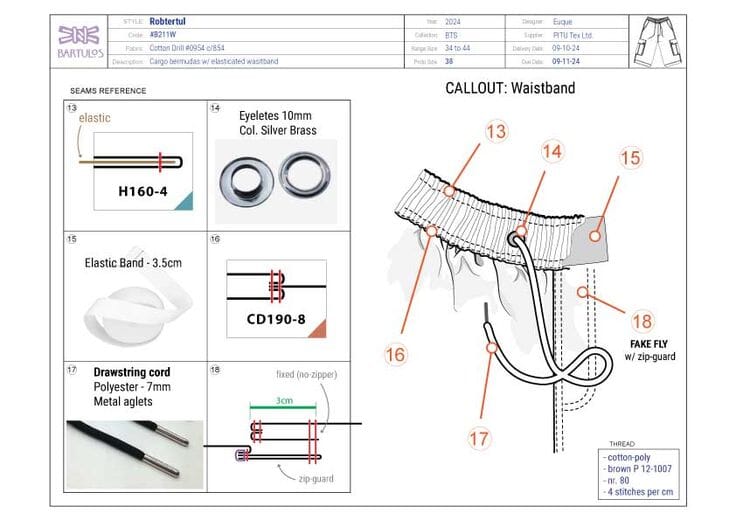
Seam type per seam. Not "flatlock" globally. Specify per seam: flatlock at the side, coverstitch at the hem, bartack at stress points. Different seams have different stretch and different costs.
Elastane percentage and recovery. State the blend and the required recovery after extension. A fabric that stretches but does not recover produces a garment that bags at the knee.
Panel diagram. Performance garments are panelled. The tech pack needs a diagram showing every panel and where each seam runs.
Trim specification. Elastic width and tension, drawcord type, tipping, reflective placement. These are the details that separate a sample that looks right from one that performs.
What a factory does with it
A specialist reads the seam callouts and quotes the operations. A generalist quotes a number and discovers the machines later. The tech pack is therefore also a filter: send it to five factories and the quality of the questions you get back tells you who is real.
Citation Capsule: Sportswear technical packages require four elements absent from basics specifications: seam type designated per individual seam rather than globally, elastane percentage with required recovery after extension, a panel diagram showing every panel and seam line, and trim specification covering elastic width and tension, drawcord and reflective placement.
What Certifications Matter in Sportswear?
Three, and they answer different buyer questions.
OEKO-TEX Standard 100 certifies the finished article contains no harmful substances. It is the baseline European retail buyers ask for. Five of the 80 factories we document hold it.
GRS verifies recycled content plus environmental and social processing. It matters because recycled polyester is now a standard request in activewear, and an unverified claim is a legal exposure. Two factories in the group hold it.
bluesign covers chemical inputs across the production process. It is common in technical outdoor and less common in general activewear.
The claim that causes trouble
Antibacterial and odour control. Depending on wording, these can fall under EU biocidal product regulation, which is a different and much heavier compliance regime than a textile standard. Have the language reviewed before it reaches a label or a product page.
How Do You Price a Sportswear Order?
Work backwards from the operation count, not forwards from a per-metre fabric price.
A basic jersey tee runs 8 to 12 sewing operations. A panelled legging with a bonded waistband runs 25 to 40. Labour scales with operations, so a legging costs two to four times a tee to sew before fabric enters the calculation.
Then add the sportswear-specific lines: technical fabric at a higher per-metre cost, slower cutting because elastane moves, laboratory testing on the first order, and often a second sample round because fit tolerance is tighter.
The number to ask for
Cost per operation. A factory that knows its own cost per operation can explain any quote it gives you, and can tell you which construction changes would actually reduce price. One that cannot is guessing, and the guess will be revised upward after sampling.
What Machinery Does Sportswear Actually Need?
Six machine types, and a factory either owns them or it does not. This is the fastest way to qualify a supplier, because equipment cannot be improvised.
Flatlock. Joins panels with a flat seam that sits against skin without a ridge. Essential for anything worn next to the body under exertion.
Coverstitch. Finishes hems and necklines on stretch fabric without cracking. A lockstitch hem on elastane will break.
Overlock with differential feed. Handles stretch fabric without waving the seam. Standard overlock without differential feed produces rippled edges.
Bartack. Reinforces stress points at pocket corners, drawcord exits and waistband joins.
Elastic attachment. Applies elastic at controlled tension. Doing it by hand produces inconsistent waistbands across a run.
Heat bonding and seam taping. For seamless construction. Genuinely rare, and expensive to install.
The question that filters the market
"How many flatlock and coverstitch machines do you have, and what brands?" A specialist answers with numbers and manufacturers. A generalist says they can arrange it, which means subcontracting, which means you lose control of the thing that defines the product.
Only 4 of the 80 factories we document specialise in sportswear. That scarcity is normal across Europe and it means your shortlist will be short.
Citation Capsule: Sportswear production requires six specific machine types: flatlock for flat next-to-skin seams, coverstitch for stretch hems, overlock with differential feed to prevent seam waving, bartack for stress points, controlled-tension elastic attachment, and heat bonding for seamless construction. Equipment cannot be improvised, making machine inventory the fastest supplier qualification test.
How Long Does a Sportswear Order Take?
Longer than basics, and the difference sits in sampling rather than production.
| Stage | Sportswear | Basic tee |
|---|---|---|
| Pattern and grading | 3-4 weeks | 2-3 weeks |
| Fit samples | 6-10 weeks, 2-3 rounds | 3-4 weeks, 1 round |
| Fabric procurement | 4-8 weeks | 2-6 weeks |
| Laboratory testing | 2-3 weeks | not required |
| Production | 7-10 weeks | 7-10 weeks |
| Realistic first order | 4-6 months | 3-5 months |
Production itself is the same. It is everything before production that differs.
Why sampling takes longer
Fit tolerance on compression garments is measured in millimetres, not centimetres. A legging that is 1cm large at the waist is a returned legging. That precision requires more rounds, and each round is an international shipment in both directions.
Brands that budget one sample round on performance product almost always need two. Plan for it rather than discovering it in week nine.
What Sizes and Fits Should a Sportswear Range Launch With?
Narrow, and narrower than feels comfortable. Every size and colour combination is a separate minimum, and sportswear minimums sit at or above the general apparel median of 175 units per style.
Four sizes in one or two colours is the realistic first order. Eight sizes in three colours is 24 combinations, and minimums frequently apply per combination rather than per style.
Why grading matters more here
Compression garments have almost no fit tolerance. A straight mathematical grade, adding the same increment to every measurement at every size, fits at the sample size and fails toward both extremes. Correct grading needs fit samples at more than one size.
That costs money in development and saves it in returns. Returns on badly graded activewear routinely exceed 30%, which destroys the economics of the whole order.
Expand on data, not on hope
Launch narrow, sell through, then extend the range on the sizes that actually moved. Extending a validated range is straightforward. Guessing at eight sizes upfront and discovering that three of them never sell is how a first order turns into dead stock.
Conclusion: Choosing a Sport Clothing Manufacturer
Sportswear rewards specialism more than almost any other category. The equipment gap is real. Good intentions do not bridge it, and the first sample shows the difference.
Filter on machinery before price. Ask for physical samples of comparable products. Budget for testing on the first order. Treat performance claims as regulated statements, not copy.
If you are producing in Europe and need genuine technical capability, we can point your brief at the factories in the group actually equipped for it.
Find your factory: Tell us the product, the fabric and the volume. Get in contact, every serious brief gets an answer within 24 hours.
Frequently Asked Questions
What is a sport clothing manufacturer?
A sport clothing manufacturer produces performance apparel using equipment general garment factories typically lack: flatlock and coverstitch machines for flat seams, elastane-compatible cutting, and often heat-bonding for taped construction. The distinction is equipment rather than labour skill.
What is the minimum order for sportswear manufacturing?
Sportswear minimums sit at or above the general apparel median of 175 units per style, because technical fabrics are usually made to order rather than held in stock. Confirm whether the minimum applies per style, per colourway or per size combination before comparing quotes.
What fabric is used for sportswear?
Polyester dominates for wicking and fast drying, blended with 8-20% elastane for stretch and recovery. Nylon blends serve premium leggings and shells. Polyester holds 59% of global fibre production overall (Textile Exchange, 2025), with a higher share within sportswear.
Why does sportswear cost more to manufacture?
Technical fabric costs more per metre, elastane slows cutting, and flatlock seams take longer than lockstitch. Panelled construction multiplies operations: a basic tee runs 8 to 12 sewing operations against 25 to 40 for a panelled legging with a bonded waistband.
Do I need testing for performance claims?
Yes. Moisture management, pilling, colour fastness to perspiration, dimensional stability and UPF claims all require independent laboratory testing. In the EU, antibacterial and odour-control claims may fall under biocidal product regulation depending on wording, so have the language reviewed before it reaches a label.
How many sizes should a sportswear range launch with?
Four sizes in one or two colours. Minimums frequently apply per size and colour combination rather than per style, so eight sizes in three colours becomes 24 separate commitments against a median minimum of 175 units per style.
What machines does a sportswear factory need?
Flatlock, coverstitch, overlock with differential feed, bartack, controlled-tension elastic attachment, and heat bonding for seamless construction. Ask how many of each the factory owns and which brands. Equipment cannot be improvised, so this is the fastest qualification test.
Do I need laboratory testing for sportswear?
Yes, if you make any performance claim. Moisture management, pilling, colour fastness to perspiration, dimensional stability and UPF all require independent laboratory testing, billed separately from the factory quote. Budget two to three weeks on a first order.
We're a group of 80 documented Portuguese clothing factories, 25 verified, based in Porto and Guimarães. Tell us your product, volume, and timeline. We'll route your production to the right factory in the group, usually within 24 hours. Flat fees, no commissions, no upsell.
Get in contact Download the directory (€39)Need a tech pack? Get a factory-ready single-style tech pack for €79. See what's included.
Sources
- Fortune Business Insights, Activewear Market, 2026
- Textile Exchange, Materials Market Report 2025
- Portugal Clothing Factory group documentation, 80 Portuguese factories, 2024-2026
Portugal Clothing Factory is a group of 80 documented Portuguese clothing factories, 25 verified, in the northern textile cluster (Porto, Guimarães, Braga, Barcelos, Famalicão). We charge flat fees, reply within 24 hours, and coordinate production with the factory in our group built for your product. See how we work or get in contact to place your order.