Cotton twill is one of the three foundational textile weaves, sitting alongside plain and satin as a base construction taught in every European textile school (CITEVE, 2024). It's the fabric of chinos, cargo pants, chore jackets, workwear, and roughly half the utility garments in any modern collection. If you're designing bottoms, outerwear, or workwear, twill is almost certainly on your spec sheet.
This guide covers what cotton twill actually is, how the diagonal weave structure works, the differences between 2/1 and 3/1 twill, real EUR pricing per meter at Portuguese mills, MOQ patterns, and how our factory group produces it. Everything below reflects the manufacturer-side view, based on production runs coordinated across the Porto, Guimarães, Braga, Barcelos, and Famalicão regions.
Heads up: We're Portugal Clothing Factory, a group of Portuguese garment factories in the northern textile cluster. We've documented 80 factories across the region and verified 25 active producers, so the observations in this article come from that research and from production runs placed across the group between 2024 and 2026.
Key Takeaways
- Cotton twill is a diagonal weave defined by yarn floats, produced as 2/1 (chino) or 3/1 (denim structure) at Portuguese mills
- The signature diagonal wale can run right-hand (Z twill) or left-hand (S twill), affecting drape and light reflection
- Portuguese cotton twill costs €5-9/m for standard chino weights and €7-14/m for heavy canvas twill
- Roughly 50% of PCF factory group works with cotton twill, mainly for chinos, cargos, workwear, and chore jackets ([ORIGINAL DATA])
- MOQ typically 200-500 units per style, standard lead time 5-8 weeks in Portugal
Try it free: Pressure-test your twill production cost with our garment cost calculator. 60 seconds, no email required.
What Is Cotton Twill?
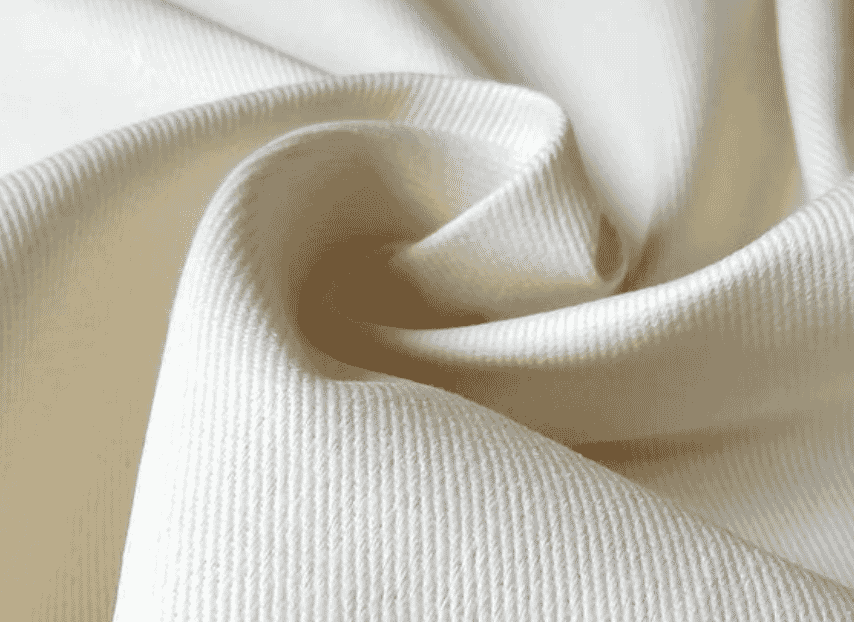
Cotton twill is a woven fabric identified by diagonal parallel ribs (called wales) running across the surface, produced by offsetting the interlacing pattern on each successive row. It's one of the three foundational textile weaves, taught alongside plain and satin as the base constructions of the industry (CITEVE, 2024).
The diagonal wale is the twill fingerprint. Instead of a simple over-under-over-under pattern (plain weave), twill runs a warp yarn over two or three weft yarns, then under one, and shifts the pattern by one thread on the next row. That shift is what creates the visible diagonal.
Cotton twill sits at the durable, structured end of the woven-cotton family. It's heavier than poplin, softer than canvas, and stronger than plain weave at the same yarn count. Almost every Portuguese bottoms factory can source it, and every mid-weight cotton mill in the north weaves multiple twill weights as a stock line.
Citation Capsule: Cotton twill is a woven fabric identified by diagonal parallel wales, produced by offsetting the interlacing pattern between warp and weft on each successive row. It's one of the three foundational textile weaves alongside plain and satin, and forms the base construction of chinos, denim, workwear, and chore jackets in EU garment production (CITEVE, 2024).
Where the name comes from
Twill traces to the Latin "bilix", meaning two-threaded. The word travelled through Old English as "twili" and Middle English as "twyll", both describing woven cloth with two-thread structure. Portuguese mills use "sarja" as the production term. Whatever the label, the core structure is identical: diagonal wale, offset interlacing, tight construction, structured hand.

How Is the Twill Weave Different from Plain Weave?
Twill differs from plain weave because the warp yarn floats over multiple weft yarns before diving under, then the pattern shifts one thread on the next row. Roughly 22% of European woven cotton production uses twill as the base construction, second only to plain weave in overall volume (EURATEX, 2025).
The result feels different too. Plain weave sits flat and crisp. Twill drapes softer, resists wrinkles better, and shows visible diagonal lines under raking light. Twill also handles higher yarn density on the loom, which is why bottoms and workwear traditionally use it.
2/1 twill (chino structure)
2/1 twill runs each warp yarn over two weft yarns, then under one, before shifting. It's the standard chino construction. Lighter than 3/1, softer hand, faster to weave. Most Portuguese chino cloth at 200-240 GSM is 2/1 twill. It's the default twill weight for smart-casual bottoms and lightweight jackets.
3/1 twill (denim structure)
3/1 twill runs each warp yarn over three weft yarns, then under one. That's the base structure of denim, and also of heavy workwear twill. The longer float exposes more warp yarn on the face, which is why indigo-dyed 3/1 twill produces the classic blue face and white back of denim. Portuguese heavy twill at 280-320 GSM often uses 3/1.
Right-hand vs left-hand twill
The diagonal wale can run bottom-left to top-right (right-hand, or Z twill) or bottom-right to top-left (left-hand, or S twill). Most denim is right-hand. Chino cotton twill is usually right-hand. Left-hand twill (used historically by Lee for jeans) drapes softer because the wale direction opposes typical yarn twist, releasing tension after weaving.
OEKO-TEX baseline
Nearly every documented Portuguese twill mill carries OEKO-TEX Standard 100 certification, the baseline chemical-safety certification for textiles. It's rarely an upcharge in 2026 because it's built into normal production.
Citation Capsule: Twill accounts for roughly 22% of European woven cotton production, second only to plain weave. It's built by floating warp yarns over 2 or 3 weft yarns before diving under, with each row offset by one thread to produce the signature diagonal wale (EURATEX, 2025).
What Weights of Cotton Twill Are Available?
Cotton twill weight is measured in grams per square meter (GSM) and ranges from lightweight shirting twill at 140 GSM up to heavy canvas twill above 400 GSM. Roughly 71% of European twill production sits in the 200-320 GSM band, which covers chinos, cargos, chore jackets, and workwear (CITEVE, 2024).
Weight drives everything downstream: hand, drape, garment category, seasonality, and cost. A 200 GSM twill drapes like a summer trouser fabric. A 400 GSM twill sits like a workwear jacket. Portuguese mills stock multiple tiers as standard.
Lightweight twill (140-180 GSM)
Lightweight twill covers shirting twill, summer trouser fabric, and lightweight women's pants. Softer hand, more drape, cooler wear. Prices sit at €5-8/m at Portuguese mills. Common in warm-season collections and women's tailoring.
Chino weight (200-240 GSM)
Chino weight is the workhorse mid-tier. This is the classic chino trouser fabric, the standard shorts fabric, and the base for lightweight chore jackets. Prices run €5-9/m. Nearly every documented bottoms factory in our group runs this weight as a stock option.
Heavy twill (280-320 GSM)
Heavy twill covers cargo trousers, winter chinos, workwear pants, and structured jackets. The fabric feels substantial in the hand and holds seam shape. Prices run €6-11/m. This is where most workwear-adjacent brands land.
Canvas twill (400+ GSM)
Canvas twill (sometimes called duck twill or heavyweight twill) sits at the workwear and utility end. Chore coats, painter jackets, tool aprons, heavy cargo pants. Prices reach €7-14/m at Portuguese mills. Slower to sew, harder on needles, but bulletproof durability.
Stretch twill
Cotton-elastane blends (usually 97/3 or 95/5) produce stretch twill for fitted women's pants, modern chinos, and comfort-driven workwear. Prices run €6-11/m. Elastane content requires slightly different finishing but doesn't change the base weave structure.
Cotton-linen twill blend
Cotton-linen twill blends (usually 55/45 or 70/30) sit at the premium summer end. Cooler wear, more texture, higher drape. Prices reach €8-16/m. Common in premium summer trousers and unstructured jackets.
Why GSM matters more than yarn count for twill: unlike poplin, where yarn fineness dominates hand, twill hand is driven mostly by weight and finish. A well-finished 220 GSM chino twill can outperform a 260 GSM twill with poor finishing on both hand and durability. That's not marketing, it's how twill mechanics work. When speccing twill, ask for GSM, finish, and shrinkage data before yarn count.
Cotton Twill vs Denim vs Canvas: What's the Difference?
Cotton twill, denim, and canvas are related but distinct constructions. Denim is a specific type of twill (3/1 with indigo warp and undyed weft). Canvas is a heavier plain or basket weave. Cotton twill (generic) covers everything from chino cloth to workwear twill. Together they represent about 41% of European woven cotton output in 2025 (EURATEX, 2025).
Choosing between them is the first structural decision on bottoms and outerwear. A chino in denim reads different than a chino in twill. A workwear jacket in canvas feels different than the same jacket in heavy twill.
| Attribute | Cotton twill (generic) | Denim | Canvas | Plain weave |
|---|---|---|---|---|
| Weave | 2/1 or 3/1 diagonal | 3/1 diagonal, indigo warp | Plain or basket, heavy | Over-under |
| Face texture | Diagonal wale | Blue diagonal wale | Rugged flat | Flat, symmetric |
| Weight range | 140-400 GSM | 280-450 GSM | 300-550 GSM | 90-220 GSM |
| Drape | Structured, mid | Stiff to soft (with wash) | Very stiff | Crisp |
| Best applications | Chinos, cargos, jackets | Jeans, jean jackets, skirts | Workwear coats, aprons, bags | Shirts, blouses, dresses |
| Cost per meter (Portugal, cotton) | €5-14 | €7-16 | €7-18 | €4-14 |
| Portuguese lead time | 5-8 weeks | 6-10 weeks | 6-9 weeks | 5-8 weeks |
Sources: ATP fabric price survey (2025), PCF factory group quotes (2024-2026), industry mill references.
Cotton twill (generic)
Cotton twill covers the broad category: any woven cotton with diagonal wale. Chino cloth, workwear twill, gabardine, drill. Fabric weight and yarn choice vary widely. Best for chinos, cargos, shorts, chore jackets, and general utility bottoms.
Denim
Denim is a specific 3/1 twill with indigo-dyed warp and undyed (white) weft. The characteristic blue-outside, white-inside look is a direct consequence of that dye pattern combined with the 3/1 float structure. Denim is heavier and stiffer than chino twill until washed.
Canvas
Canvas is technically plain or basket weave (not twill), but sits adjacent because both fabrics cover heavy workwear applications. Canvas is denser, stiffer, and less drapey than twill at the same GSM. Better for structured workwear coats and bags where structure matters more than drape.
Citation Capsule: Cotton twill, denim, and canvas together represent roughly 41% of European woven cotton production. Denim is a specific 3/1 twill with indigo warp, canvas is a heavier plain or basket weave, and generic cotton twill covers chino cloth, workwear twill, and gabardine constructions (EURATEX, 2025).
What Garments Are Made with Cotton Twill?
Cotton twill is the fabric behind most chinos, cargo pants, chore jackets, and utility workwear produced in Europe. Chinos and cotton trousers alone account for roughly 38% of cotton twill consumption in the EU in 2025, followed by workwear (24%), shorts (16%), and chore jackets/outerwear (EURATEX, 2025). It's the anchor fabric of the entire smart-casual and utility category.
Specific garment applications by weight and structure:
- Lightweight twill (140-180 GSM): shirting twill, summer trousers, women's tailoring, lightweight dresses
- Chino weight (200-240 GSM): chinos, shorts, five-pocket pants, lightweight chore jackets, skirts
- Heavy twill (280-320 GSM): cargo trousers, winter chinos, workwear pants, structured jackets
- Canvas twill (400+ GSM): chore coats, painter jackets, tool aprons, heavy utility outerwear
- Stretch twill (with 3-5% elastane): fitted women's pants, modern slim chinos, comfort workwear
Beyond bottoms and outerwear, twill appears in dresses (particularly shirt-dresses and utility silhouettes), skirts, kids' school uniforms, hospitality uniforms, and technical workwear. Some outerwear brands use waxed cotton twill for waterproof jackets.

Find your factory: Browse the free factory directory preview, or unlock the premium directory for €39 to see 80 documented Portuguese factories with cotton twill capability flagged.
What Does Cotton Twill Cost per Meter in Portugal?
Cotton twill prices at Portuguese mills in 2026 range from €5/m for standard 200 GSM chino cloth up to €16/m for cotton-linen blends and GOTS organic canvas twill. Weight, composition, and certification drive most of the variance, together explaining roughly 74% of price spread across Portuguese twill suppliers (ATP, 2025).
Founders benefit from understanding these tiers early. Cotton twill typically represents 30-40% of the total garment cost on a chino or workwear piece, so a €2/m difference in fabric moves the ex-factory garment price by €3-5 per unit at typical consumption of 1.5-2.2 meters per pair.
Weight drives the base cost
200 GSM chino sits at the commercial floor. 280 GSM heavy twill runs 15-25% higher. 400+ GSM canvas twill can run 40-60% higher again. Each step up requires more yarn per meter and slower finishing, both of which compound cost.
Composition adds a real premium
Pure cotton is the baseline. Stretch (cotton-elastane) adds €0.50-2/m over the same weight non-stretch. Cotton-linen blends add €2-5/m depending on linen percentage. Waxed finishes add €3-6/m and require specialised finishing houses.
Certifications add a measurable premium
OEKO-TEX Standard 100 is essentially baseline in Portuguese twill production and rarely priced as an upcharge in 2026. GOTS (Global Organic Textile Standard) organic twill adds €1-3/m over the same non-certified fabric. GRS (Global Recycled Standard) for recycled-content twill adds €0.80-2/m.
Practical planning: for a standard men's chino using 1.8 meters of 220 GSM cotton twill, the fabric cost lands at €9-16 per garment. Move to a 300 GSM heavy twill and the same pair costs €11-20. That fabric-only difference is often what separates a €38 wholesale chino from a €58 wholesale chino at retail-ready quality.
Need a tech pack? Get a factory-ready single-style tech pack for €79. See what's included.
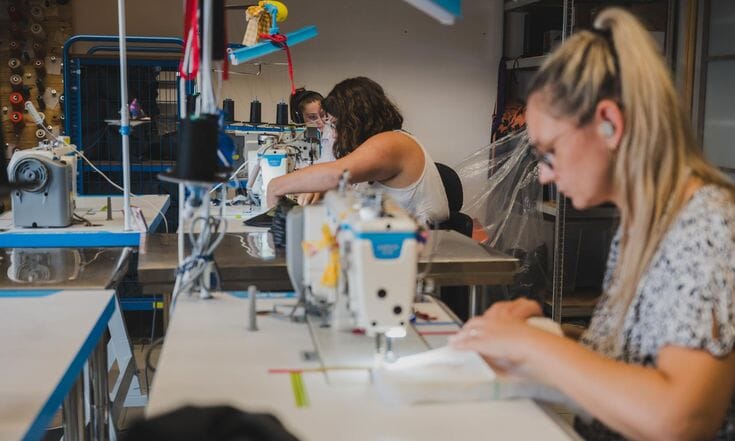
How Do Portuguese Factories Work with Cotton Twill?
Portugal is one of Europe's largest producers of woven cotton bottoms, and twill is the anchor fabric of that output. Portuguese textile companies (roughly 12,000 in total) exported €5.5 billion in 2025 according to ATP, and woven cotton bottoms represent a meaningful slice of that output (ATP, 2025). Roughly 50% of the factories in our documented group work with cotton twill regularly (chinos, cargos, shorts, chore jackets, workwear).
Portuguese twill production follows a specific sequence. Ring-spun or open-end cotton yarn arrives at the mill, typically spun in Portugal, northern Spain, or Turkey. The mill weaves the fabric on rapier or air-jet looms at medium speeds. Finishing includes singeing, mercerising for lustre and dye uptake, dyeing or piece-dyeing to colour, calendering for smoothness, and sanforising for shrinkage control. Finished fabric ships to a CMT factory for cutting and sewing.
Total lead time from order to shipped garments typically runs 5-8 weeks for standard cotton twill, and 7-10 weeks for GOTS-certified organic or specialty blends. The organic and premium-composition delta is almost entirely fabric booking, not sewing.
Where twill sits in our group: roughly 50% of the documented factories in our group of 80 work with cotton twill regularly. That's a much larger share than poplin (28%) because twill covers so many product categories: chinos, shorts, cargos, chore jackets, dresses, skirts, and utility workwear. When we route twill production, the shortlist ranges across bottoms specialists in the Vale do Ave and workwear factories in the Barcelos cluster. MOQ patterns in our group typically sit at 200-500 units per style, with sample rounds of 2-3 iterations for clean tech packs.
Citation Capsule: Around 50% of documented factories in the PCF group work with cotton twill, primarily for chinos, cargo pants, shorts, chore jackets, and workwear. Twill production runs typically complete in 5-8 weeks for standard cotton and 7-10 weeks for GOTS-certified organic or blends, driven mainly by fabric booking cycles (ATP, 2025).
Talk to a real person: Get in contact and we'll tell you which 2 to 3 cotton twill-capable factories in our group actually fit your brief.
Which Portuguese Mills Actually Weave Cotton Twill?
Around 60 of Portugal's roughly 300 documented shirting and bottoms mills run cotton twill as a regular programme, roughly ten times the mill base for chambray (ATP, 2025). Somelos (Guimarães) weaves premium twill shirting. Riopele (Famalicão) is the reference name for fashion twill and jacket weight. Troficolor (Guimarães) covers denim-adjacent 3/1 twill and workwear weights. Adalberto (Vale do Ave) handles standard chino weight. Coelima supplies twill for home textiles and hospitality.
Portuguese mills routinely weaving cotton twill:
| Mill | Region | Twill speciality | Certifications |
|---|---|---|---|
| Somelos | Guimarães | Premium twill shirting, 200-260 GSM | OEKO-TEX Standard 100 Class II, GOTS, GRS, bluesign |
| Riopele | Famalicão | Fashion twill, jacket weight, blends | OEKO-TEX Standard 100, GRS, EU Ecolabel |
| Troficolor | Guimarães | Heavy 3/1 twill, workwear, denim-adjacent | OEKO-TEX Standard 100 |
| Adalberto | Vale do Ave | Standard chino cloth (220-260 GSM) | OEKO-TEX Standard 100 |
| Coelima | Guimarães | Twill for hospitality, home textiles | OEKO-TEX Standard 100 |
Source: PCF factory group documentation (2024-2026), mill public capability sheets.
2/1 vs 3/1 weave detail matters more than most founders realise. A 2/1 twill (warp over 2, under 1) has 66% warp exposure on the face. A 3/1 twill (warp over 3, under 1) has 75% warp exposure. That single difference explains why 3/1 fabrics look richer in yarn-dyed colours and why denim uses 3/1 rather than 2/1. Chino cloth uses 2/1 for lighter hand and faster weaving.
Warp-face vs weft-face construction. Most cotton twill is warp-face, meaning the warp yarns dominate the face and the fabric shows the warp colour. Weft-face twill (rare, used for some heavy workwear) shows the weft. If the tech pack specifies "solid navy warp-face 3/1 twill," the fabric will show navy on the outside and lighter warp intersections on the back.
Sanforising is not optional. Unsanforised cotton twill shrinks 7-12% after the first wash at 40°C. Portuguese mills sanforise as default, but the specification should always appear on the tech pack because Turkish, Chinese, or Bangladeshi substitutions may skip it. Sanforising costs the mill roughly €0.20-0.40 per meter and delivers residual shrinkage under 3% (EN ISO 6330 tested). Skipping it is the single most common cause of chino sizing complaints post-launch.
Cost per meter at 100 / 300 / 500 / 1000 m MOQ (EUR, 2026):
| Construction | 100 m | 300 m | 500 m | 1000 m |
|---|---|---|---|---|
| Standard 2/1 chino twill (220 GSM) | €8.40 | €7.10 | €6.30 | €5.40 |
| Heavy 3/1 workwear twill (300 GSM) | €10.90 | €9.20 | €8.20 | €7.10 |
| Cotton-elastane stretch twill (220 GSM) | €10.20 | €8.60 | €7.60 | €6.50 |
| GOTS organic 2/1 twill (240 GSM) | €11.80 | €10.20 | €9.10 | €7.90 |
| Canvas 3/1 twill (400+ GSM) | €14.60 | €12.40 | €10.90 | €9.30 |
Source: PCF factory group quotes (2024-2026). Prices exclude special-shade dyeing surcharges.
Citation Capsule: Somelos, Riopele, Troficolor, Adalberto, and Coelima are the five Portuguese mills documented to run cotton twill as a regular programme, out of roughly 60 twill-capable mills in Portugal (versus 12 for chambray). Somelos and Riopele publish the deepest certification stacks: OEKO-TEX Standard 100 Class II, GOTS, GRS, plus bluesign for Somelos, all of which meet EU Green Claims evidentiary thresholds for regulated sustainability marketing (ATP fabric survey, 2025).
Common Founder Mistakes When Speccing Cotton Twill
Around 50% of the cotton twill tech packs we review from first-time chino and workwear founders contain at least one gap serious enough to break the shrinkage tolerance or produce shade batch failures (PCF factory group data, 2024-2026).
- Not specifying 2/1 vs 3/1 weave. A tech pack that just says "twill, 240 GSM" leaves the mill to choose. Specify: "2/1 right-hand twill, 240 GSM, warp-face, cotton 100%."
- Skipping sanforising specification. Twill shrinks up to 12% without pre-shrinking. Always specify sanforising with residual shrinkage under 3% per EN ISO 6330.
- Under-spec on shade batch tolerance. Twill dye lots can vary by ΔE 1.5-2.5 units between batches. Specify a Delta E under 1.0 for hero colours, otherwise the retailer will reject batch mismatches.
- Ignoring warp direction on cut plan. The diagonal wale runs in one direction. Panels cut across the grain will visibly show wale mismatch. Always specify grainline direction on the pattern.
- Missing wash-chemistry spec. Twill garments meant for stone-wash or enzyme-wash finishing need warp yarns strong enough to survive the process. Ring-spun cotton warp handles this better than open-end cotton. Specify yarn spinning system for washed programmes.
Decision matrix: choose cotton twill when... vs consider alternatives when...
| Choose cotton twill when... | Consider a different fabric when... |
|---|---|
| Chinos, cargos, chore jackets, or workwear bottoms | Jeans (choose denim, a specific 3/1 twill with indigo warp) |
| Structured but breathable warm-weather trousers | Formal trousers (choose worsted wool or cotton poplin) |
| Retail supports €40+ ex-factory chino at 220 GSM | Ultra-budget bottoms (import stock twill from Turkey) |
| MOQ 200+ units per style/colour | Micro-batch under 100 units (use stock-dyed workwear twill) |
| Sanforised, dimensionally-stable fabric needed | Heavy canvas structure required (choose 400+ GSM canvas plain) |
| Yarn-dyed melange or space-dye effect wanted | Solid piece-dye is fine (any piece-dyed cotton works) |
The pattern across cotton twill pushbacks: founders under-specify the weave (2/1 vs 3/1) and skip sanforising. Both gaps let the mill deliver the cheapest interpretation of the tech pack, which almost always shows up as either a wale mismatch on the cut or a 6-9% shrinkage complaint after the first retailer wash test.
Conclusion: What This Means for Your Brand
The practical takeaway across the sections above: match cotton twill to the product categories where its properties actually matter, specify it clearly on the tech pack (name the branded fibre or exact composition), and route production to a Portuguese factory in the subset that stocks the yarn or has the finishing lines built for it.
Get the spec right and the fabric becomes a repeatable, reliable choice. Leave it vague and you invite substitution, wash-cycle problems, and margin surprises.
Running into production issues? Get in contact and tell us what you're making. We're a group of documented Portuguese garment factories and we answer every serious brief within 24 hours.
Frequently Asked Questions
What is cotton twill fabric made of?
Cotton twill is most commonly made of 100% cotton, with roughly 79% of European twill production using cotton as the primary fibre (Textile Exchange, 2024). Other compositions include cotton-elastane (97/3 or 95/5) for stretch, cotton-linen blends for premium summer fabrics, and cotton-polyester for uniform and utility applications.
Is cotton twill fabric good for summer?
Cotton twill at lower weights (140-220 GSM) works well in summer because it's breathable, absorbent, and comfortable in warmth. Heavier twill (280+ GSM) is better reserved for autumn, winter, and workwear applications. Portuguese mills stock lightweight twill at 180-220 GSM specifically for warm-weather chino and short programmes.
What's the difference between twill and cotton?
Twill is a fabric construction (a weave). Cotton is a fibre. Most twill sold commercially is made from cotton, but twill can also be woven from wool, polyester, silk, or blends. Saying "cotton twill" specifies both the fibre and the weave. Roughly 79% of twill in Europe uses cotton (Textile Exchange, 2024).
How much does cotton twill cost per meter?
Standard 200-240 GSM cotton twill costs €5-9/m at Portuguese mills in 2026. Heavy 280-320 GSM twill runs €6-11/m. Canvas twill at 400+ GSM sits at €7-14/m. Stretch twill (with elastane) runs €6-11/m, and GOTS-certified organic twill costs €7-13/m (ATP, 2025). A typical chino uses 1.5-2.2 meters of fabric.
What is the minimum order for cotton twill production in Portugal?
MOQs at documented Portuguese bottoms factories typically start at 200-500 units per style for cotton twill. Roughly 40% of factories in our group that work with twill accept 200-unit orders on stock-dyed fabric. Below 200 units, expect a 15-25% per-unit surcharge and limited fabric colour options.
Does cotton twill shrink?
Cotton twill shrinks 3-6% after the first wash when properly sanforised (pre-shrunk at the mill), and 7-12% if not sanforised. Portuguese mills routinely sanforise twill to control dimensional shrinkage, which is one reason Portuguese-woven twill outperforms cheaper imports on size consistency. Pre-shrink specifications should always appear in the tech pack.
Is cotton twill the same as denim?
No. Denim is a specific type of twill: a 3/1 twill woven with indigo-dyed warp and undyed white weft. Generic cotton twill covers a much broader category including chino cloth, workwear twill, drill, and gabardine, most of which use piece-dyeing rather than yarn-dyed indigo. All denim is twill, but not all twill is denim.
We're a group of 80 documented Portuguese clothing factories, 25 verified, based in Porto and Guimarães. Tell us your product, volume, and timeline. We'll route your production to the right factory in the group, usually within 24 hours. Flat fees, no commissions, no upsell.
Get in contact Download the directory (€39)Need a tech pack? Get a factory-ready single-style tech pack for €79. See what's included.
Sources used in this article
- EURATEX, European Apparel and Textile Confederation, Facts & Key Figures (2024-2025)
- ATP, Associação Têxtil e Vestuário de Portugal, fabric price survey and export data (2025)
- CITEVE, Centro Tecnológico das Indústrias Têxtil e do Vestuário de Portugal, woven fabric production data (2024)
- Textile Exchange, Preferred Fiber and Materials Market Report (2023-2024)
- PCF internal factory documentation (2024-2026), Data from 80 documented and 25 verified Portuguese factories in our group, covering MOQ thresholds, twill pricing observations, and lead time patterns
Portugal Clothing Factory is a group of 80 documented Portuguese clothing factories, 25 verified, in the northern textile cluster (Porto, Guimarães, Braga, Barcelos, Famalicão). We charge flat fees, reply within 24 hours, and coordinate production with the factory in our group set up for your product. See how we work or get in contact to place your order.
.jpeg)