Workwear wholesale means buying work clothing and uniforms in bulk, either as stock garments from a distributor's catalogue or as custom garments made to your specification by a factory. Most buyers start with stock and add a logo. It's a big, regulated market: Europe's workwear market is worth around €3.4 billion and is growing at about 4.3% a year, according to the EU's CBI market study (updated September 2026).
This guide covers how the two buying models work, what drives the price, what to check, which safety standards apply, and when to switch to your own garments.
Heads up: We're Portugal Clothing Factory, a group of 80 documented clothing factories in northern Portugal. We don't sell stock workwear from a catalogue. Where stock is the better buy, we say so.
Key Takeaways
- Two models, different jobs. Stock wholesale gives speed and small quantities. Custom production gives your own fabric, fit and features, at higher minimums.
- The market is large and regulated. EU workwear imports reached €3.4 billion and about 156 million units in 2024 (CBI).
- Not all workwear is PPE. Hi-vis, flame-resistant and rain garments need CE marking under EU Regulation 2016/425. Chef jackets and service uniforms don't.
- Durability is testable. Ask for industrial-laundry, colour fastness and seam data rather than a promise.
- Reorders decide the program. Check that the same garment, colour and size range will still exist next year.
Try it free: Estimate a custom garment's cost with our garment cost calculator. No email required.
What is workwear wholesale?
Workwear wholesale is the bulk supply of work clothing to businesses, mostly through specialist distributors. The CBI study notes that "workwear in Europe is mainly sold through specialist distributors", many with strong online channels, while some brands sell direct for large orders (CBI, 2026).
The category is wider than most people think. CBI's definition covers jackets, trousers, overalls, bib-and-brace overalls and ensembles worn in construction, manufacturing, utilities, logistics, healthcare, hospitality and public services. Men's workwear makes up 84.7% of the market's value and women's 15.3%. Synthetic fibres account for about three quarters of products, cotton for about a quarter.
In practice, "workwear wholesale" means catalogue garments in bulk, catalogue garments with a logo, or garments built to your own spec. The first two are stock wholesale. The third is custom production.
Stock wholesale or custom-made: which fits your order?
Stock wholesale fits small or urgent orders, and custom production fits larger, repeat programs where fit, fabric or branding matter. Stock garments already exist in a warehouse, so you can order a few pieces per size. Custom garments are cut from fabric bought for your order, so minimums apply per style and colour.
| Factor | Stock wholesale (blank + decoration) | Custom production (factory-made) |
|---|---|---|
| Garment | Catalogue body, fixed fabric and colours | Your pattern, fabric, colours and features |
| Minimum order | Low; often a few pieces per size | Per style and colour; set by fabric and the sewing line |
| Speed | Fast when sizes are in stock | Sampling, then bulk production |
| Branding | Embroidery, print or transfer added after | Branding can be built in: labels, trims, colourways |
| Certification | Already done by the garment maker, if it's PPE | Your responsibility as the brand placing it on the market |
| Continuity risk | The catalogue can drop or change a line | You own the spec and can repeat it |
Source: Portugal Clothing Factory editorial comparison; certification duties per EU Regulation 2016/425.
The certification row is the one buyers miss. When you buy a certified stock jacket, its maker has already carried out the conformity assessment. When you commission your own design and put your name on it, you're treated as the manufacturer under the PPE Regulation, so testing and paperwork become yours. For a fuller look at the trade-off, see our guides to cut-and-sew vs blanks and private label vs custom manufacturing.
Citation capsule Workwear wholesale runs on two models. Stock wholesale ships catalogue garments, often decorated with a logo, in small quantities. Custom production builds garments to the buyer's own specification at higher minimums. Europe's workwear market is worth about €3.4 billion and is sold mainly through specialist distributors (CBI, 2026).
How do workwear price tiers and volume breaks work?
Wholesale price lists drop the unit price as quantity rises, and decoration adds one-off set-up costs that are spread across the order. That's why the same polo can look cheap at 500 pieces and expensive at 20. Volume matters to the whole market: EU imports of workwear came to about 156 million units in 2024 (CBI).
We won't quote prices, because they vary too much by garment and decorator. These are the levers that move the number:
- Quantity per style. Distributors set tiers by quantity of one item. Mixing ten styles at ten pieces each rarely reaches a break.
- Decoration set-up. Embroidery needs a stitch file to be digitised once. Screen print needs a screen per colour. Both are fixed costs per design.
- Logo positions. Each position is a separate run.
- Fabric and certification. In custom work, certified fabric and testing are often the biggest single costs.
For custom production, the logic changes. The price depends on fabric, construction and labour minutes, and the minimum is set by the fabric mill as much as by the factory. Our guides to clothing manufacturing costs and minimum order quantities break those down.
What should you check before buying workwear in bulk?
Check the fabric, the seams and how the garment survives washing, in that order. CBI lists the features European buyers expect: reinforced knees, elbows and seat, multiple pockets, "high durability for industrial laundering" and colour-fast fabrics that keep their look after repeated washing (CBI, 2026).
Fabric weight and composition
Ask for the fabric weight in grams per square metre and the exact fibre blend, not "heavy-duty". Two trousers that look alike can differ a lot in weight, weave and wear. Our GSM guide explains how weight relates to use.
Poly-cotton or 100% cotton?
Poly-cotton blends are the default for a reason. Polyester adds strength, holds colour and dries fast, and it copes better with frequent commercial washing. Cotton is more comfortable in heat and is needed for some flame-related uses, since melting fibres are a hazard near sparks. Many ranges use "reverse" blends with more cotton on the skin side. Ask which blend the garment uses and why.
Reinforcement: bar-tacks and triple stitching
Look at the stress points. Bar-tacks (dense zig-zag stitches) should sit at pocket corners, belt loops and fly ends. Main seams on trousers and overalls are often triple-stitched. Knee pad pockets, double-layer seats and gussets show the garment was designed for movement.
Industrial-laundry durability
If your garments go to an industrial laundry or a rental service, ask for test results under ISO 15797. This standard sets out eight washing procedures and two drying procedures that simulate industrial laundering, and it's used to assess dimensional stability, colour, creasing, seam puckering and pilling (ISO 15797:2017). Home-wash care labels don't tell you how a garment behaves at a commercial laundry.
Colour fastness
Corporate colours are part of the brand, so fading matters. Ask for colour fastness results to washing and light, and agree a reference shade. For hi-vis, colour isn't just cosmetic: the fluorescent background material is tested for colour and luminance after exposure and washing (Centexbel). See our quality control guide.
Citation capsule Durable workwear is judged on measurable properties, not appearance. ISO 15797:2017 defines eight washing and two drying procedures that simulate industrial laundering, used to test dimensional stability, colour, creasing, seam puckering and pilling. Buyers should ask for these results, plus fabric weight, blend and colour fastness data.
Which safety standards apply to workwear?
Only garments that protect against a hazard count as PPE, and those must carry CE marking under EU Regulation 2016/425. CBI is clear that kitchen jackets, scrubs and service uniforms are occupational apparel, not PPE, so they don't need CE marking, though they still must meet chemical rules such as REACH (CBI, 2026).
The Regulation sorts PPE into three risk categories (Annex I) with a set conformity procedure for each (Article 19):
| Category | Risk level | Examples | Conformity procedure |
|---|---|---|---|
| Category I | Minimal risks | Superficial mechanical injury, contact with surfaces up to 50 °C, non-extreme weather | Internal production control (module A); the maker self-declares |
| Category II | Risks not in I or III | High-visibility garments, most certified construction and logistics workwear | EU type-examination by a notified body (module B), then conformity to type (module C) |
| Category III | Death or irreversible harm | Heat of 100 °C or more, electric shock, hazardous substances; flame-resistant garments | Module B plus ongoing checks (module C2) or production quality assurance (module D) |
Source: Regulation (EU) 2016/425, Annex I and Article 19; category examples for garments from CBI, 2026.
These are the product standards buyers meet most:
- EN ISO 13688 (general requirements). The base standard for all protective clothing. It covers labelling, construction, care, sizing, and limits on harmful substances and pH (Wenaas summary).
- EN ISO 20471 (high visibility). Three classes by minimum material area. Class 3 needs at least 0.80 m² of fluorescent background and 0.20 m² of retroreflective material; Class 1 needs 0.14 m² and 0.10 m² (Centexbel).
- EN ISO 11612 (heat and flame). Letter codes A to F for flame spread, convective, radiant and contact heat, and molten metal splash. Every garment needs A1 or A2 plus at least one other code (HAVEP).
- EN ISO 11611 (welding). Class 1 for lower-risk welding with less spatter, Class 2 for heavier processes, overhead work and confined spaces (Kübler).
- EN 343 (rain). Two ratings, waterproofness and breathability, each in classes 1 to 4. An X means the finished garment wasn't put through the optional rain tower test (Wenaas summary).
Selling into Great Britain? The UK government has extended recognition of CE marking indefinitely, so businesses can use either CE or UKCA marking on PPE placed on the GB market (GOV.UK). Products for the EU still need CE marking.
Who pays matters for budgeting. Under EU Directive 89/656/EEC, employers must provide the appropriate PPE free of charge (EU-OSHA). In Great Britain, since 6 April 2022 that duty also covers limb (b) workers, and the HSE says plainly that you can't charge workers for PPE they need (HSE).
Citation capsule Under EU Regulation 2016/425, high-visibility workwear is usually Category II PPE and needs EU type-examination by a notified body before CE marking. Flame-resistant garments fall under Category III, which adds ongoing production checks. Chef jackets, scrubs and service uniforms aren't PPE and don't need CE marking.
Decoration: embroidery, heat transfer and screen print
Embroidery suits most cotton and poly-cotton workwear, heat transfer suits technical and certified garments, and screen print suits large runs of simple designs. On PPE, also check whether the decoration affects the certification.
| Method | Best for | Watch out for |
|---|---|---|
| Embroidery | Polos, softshells, twill jackets and trousers; logos that must last | Needle holes in waterproof membranes; small text loses detail |
| Heat transfer | Hi-vis, rainwear, flame-resistant garments (with compatible transfers) | Transfer must suit the fabric and the wash process |
| Screen print | Large runs of tees and sweats with few colours | One screen per colour, so small runs cost more per piece |
Source: Portugal Clothing Factory editorial comparison.
Two cautions for certified garments. On hi-vis, minimum fluorescent and reflective areas are part of the class, so a large logo placed over the background can matter. Ask the supplier whether the decorated garment still meets its class. On flame-resistant garments, thread, transfers and badges need to be compatible with the certification, so follow the garment maker's guidance. See also screen printing vs DTG.
Sizing programs and reorder continuity
A workwear program lives or dies on reorders. New staff join, garments wear out and standards change, which CBI names as the drivers of steady demand (CBI, 2026). So the question isn't only "does this fit now?" but "can I get the same garment in the same size next year?"
Stock wholesale uses a stock-service model: the distributor keeps core lines on the shelf and you reorder single sizes. It works until the brand drops a colour or changes a pattern.
Custom production is make-to-order. You hold the spec, pattern and approved shade, and the factory repeats them. There are no single-piece reorders, so plan a buffer stock by size. Either way, set up:
- Fit trials. Try garments on real staff while kneeling, reaching and lifting.
- A size curve. Record how many of each size you actually issue, then order to that curve.
- A golden sample. Keep one approved garment per style as the reference for every reorder.
How long does bulk workwear take?
Stock orders take as long as stock, decoration and shipping allow, while custom orders need sampling and bulk production first. Fabric is usually the long pole in custom work, especially certified fabric. Public buyers add tender time on top, since EU rules require open tenders for many of them (CBI, 2026).
With stock, confirm stock by size before approving artwork, since one missing size can hold up the order. With custom, allow for a sample round, approval, testing and bulk. For Category II or III PPE, type-examination is part of the timeline. See our guides to production lead times and ordering a sample.
When should you move from wholesale stock to custom production?
Move to custom when stock garments stop fitting your people, your brand or your reorder plan. These are the usual signs:
- Volume per style is steady. You order the same garments in quantities large enough to justify a fabric order.
- Fit complaints keep coming. Catalogue blocks don't suit your team or the way they work.
- You need your own colour or features. A brand colour, a specific pocket layout, a tool loop in the right place.
- Lines keep changing. Your distributor's catalogue changes faster than your uniform should.
There's also a middle path. Some brands start with full-package production of one or two core styles and keep buying stock for the rest. See CMT vs full-package production for which suits a first run.
Planning a custom range? Send us your brief with the garment, fabric and quantity, and our team will place and manage your production with the factory in our group built for it.
Custom workwear production in Portugal with PCF
Portugal is a smaller workwear supplier than the big volume hubs, but it's a growing one inside the EU. CBI ranks Portugal ninth among the top 10 intra-EU exporters of workwear to the EU market, with €71 million in 2024 and average yearly growth of 7.3% (CBI, 2026). Portugal's wider textile and clothing exports reached €5.499 billion in 2025, according to ATP and INE data reported by RTP.
Heavy fabric needs the right factory
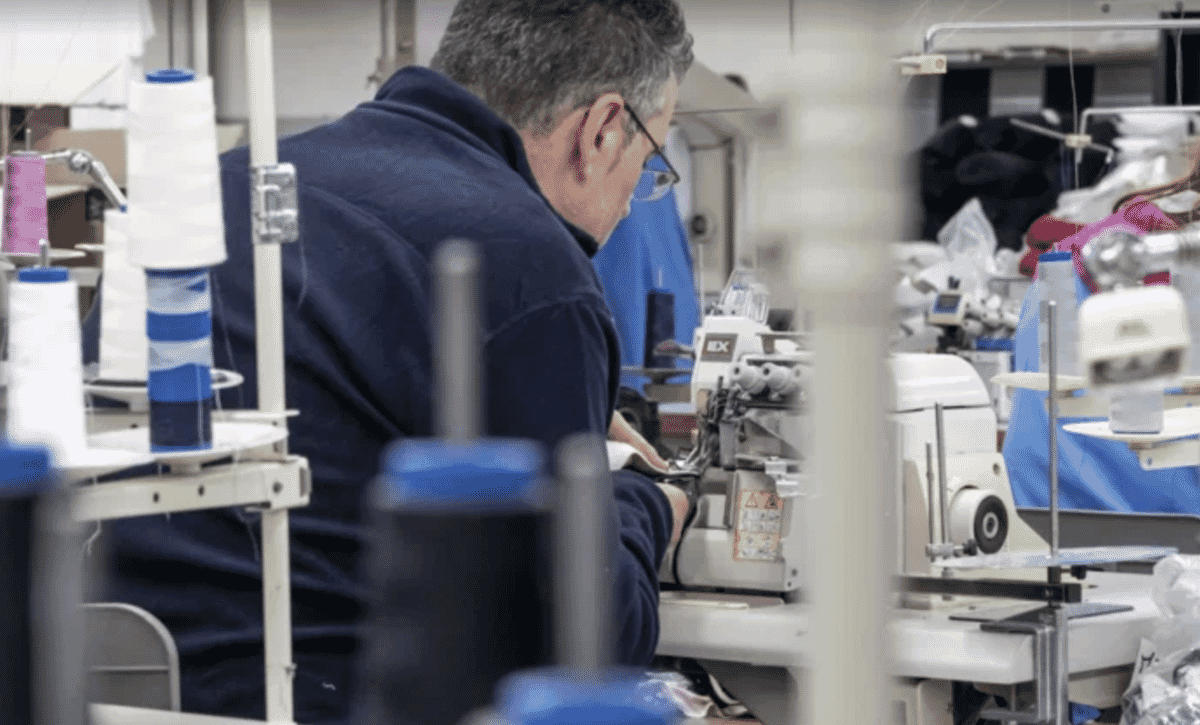
Canvas, heavy twill and reinforced construction need heavy-duty machines, the right needles and heavier thread. That's why our team places your production with the factory in our group built for that product, not with whichever line is free.
How working with PCF works
PCF is a group of 80 documented clothing factories in northern Portugal, around Porto and Guimarães. You send a brief, and our team places and manages your production with the factory in our group built for it, from 100 units per style. We stay involved through sampling, production and delivery, so you have one point of contact. Our fee is quoted in writing before any work starts, and the factory bills you directly for production.
Repeat supply and EU compliance
Uniform programs are judged on whether the same garment can be supplied identically over years. A stable factory relationship inside the EU helps with that. Where garments carry protective claims, producing inside the EU also keeps testing, certification and labelling within one regulatory framework.
For staff programmes, our uniform and workwear manufacturing page sets out how it works. Your logo is embroidered or printed as part of the same order, and we keep your patterns and specs so reorders for new staff start from the approved spec. For hi-vis and flame-resistant pieces, the certificate for the exact fabric and garment is shared with your quote, before you order.
Frequently Asked Questions About Workwear Wholesale
What does workwear wholesale mean?
Workwear wholesale is buying work clothing and uniforms in bulk for a business. Most of it is stock garments from specialist distributors, often decorated with a logo. The rest is custom-made by factories to the buyer's specification. Europe's workwear market is worth around €3.4 billion (CBI, 2026).
Is it cheaper to buy stock workwear or have it custom-made?
For small or mixed orders, stock workwear is usually cheaper, because there's no fabric minimum or sampling. Custom production becomes worth it when volume per style is steady and you need your own fit, colour or features. Decoration set-up costs and certification also change the maths, so compare a full quote.
Does all workwear need CE marking?
No. Only garments that protect against a hazard, such as hi-vis, flame-resistant or rain protective clothing, are PPE under EU Regulation 2016/425 and need CE marking. CBI notes that kitchen jackets, scrubs and service uniforms are occupational apparel, not PPE, though they must still meet chemical rules such as REACH.
What is the difference between hi-vis Class 1, 2 and 3?
Under EN ISO 20471, the class depends on the minimum area of fluorescent and reflective material. Class 3 needs at least 0.80 m² of background and 0.20 m² of retroreflective material. Class 2 needs 0.50 m² and 0.13 m², and Class 1 needs 0.14 m² and 0.10 m² (Centexbel).
Can I embroider a logo on hi-vis or flame-resistant workwear?
Often, but check first. On hi-vis, a large logo over the fluorescent background can affect whether the garment still meets its class. On flame-resistant garments, thread, transfers and badges need to be compatible with the certification. Heat transfers made for these fabrics are the usual choice. Follow the garment maker's guidance.
We're a group of 80 documented Portuguese clothing factories in northern Portugal, around Porto and Guimarães. Tell us your product, volume and timeline. Our team places your production with the factory in our group built for it and stays with you from sample to delivery.
Get in contact Download the directory (€39)Need a tech pack? Get a factory-ready single-style tech pack for €79. See what's included.
Sources used in this article
- CBI (Netherlands Ministry of Foreign Affairs), The European market potential for workwear, updated September 2026, based on Eurostat data.
- Regulation (EU) 2016/425 on personal protective equipment, EUR-Lex; Annex I risk categories and Article 19 conformity procedures.
- GOV.UK, Regulation 2016/425 and the PPE (Enforcement) Regulations 2018: Great Britain.
- EU-OSHA, Directive 89/656/EEC, use of personal protective equipment.
- HSE, Personal Protective Equipment at Work (Amendment) Regulations 2022.
- ISO 15797:2017, industrial washing and finishing procedures for testing of workwear.
- Centexbel, high-visibility clothing according to EN ISO 20471:2013+A1:2016.
- Wenaas, EN ISO 13688:2013 protective clothing, general requirements.
- HAVEP, EN ISO 11612 performance codes.
- Kübler, EN ISO 11611 welding protection classes.
- Wenaas, EN 343:2019 protective clothing against rain.
- RTP / Lusa, Portuguese textile and clothing exports in 2025 (ATP and INE data).
Portugal Clothing Factory is a group of 80 documented clothing factories in northern Portugal, around Porto and Guimarães. Our team places your production with the factory in our group built for your product and stays involved from sample to delivery. See how we work or get in contact.