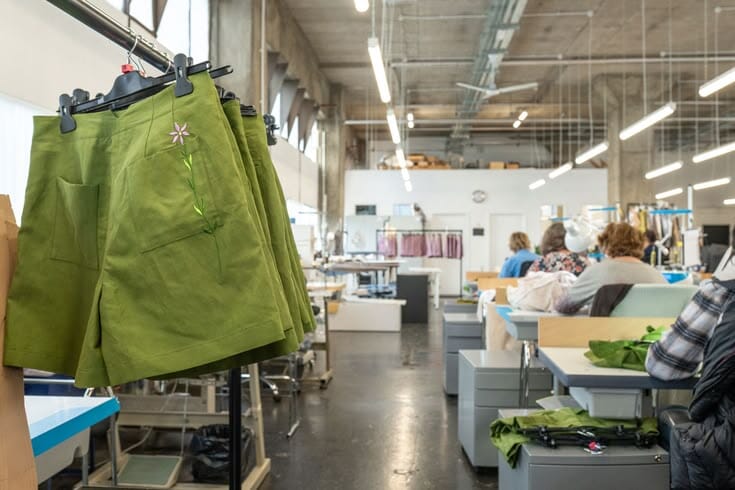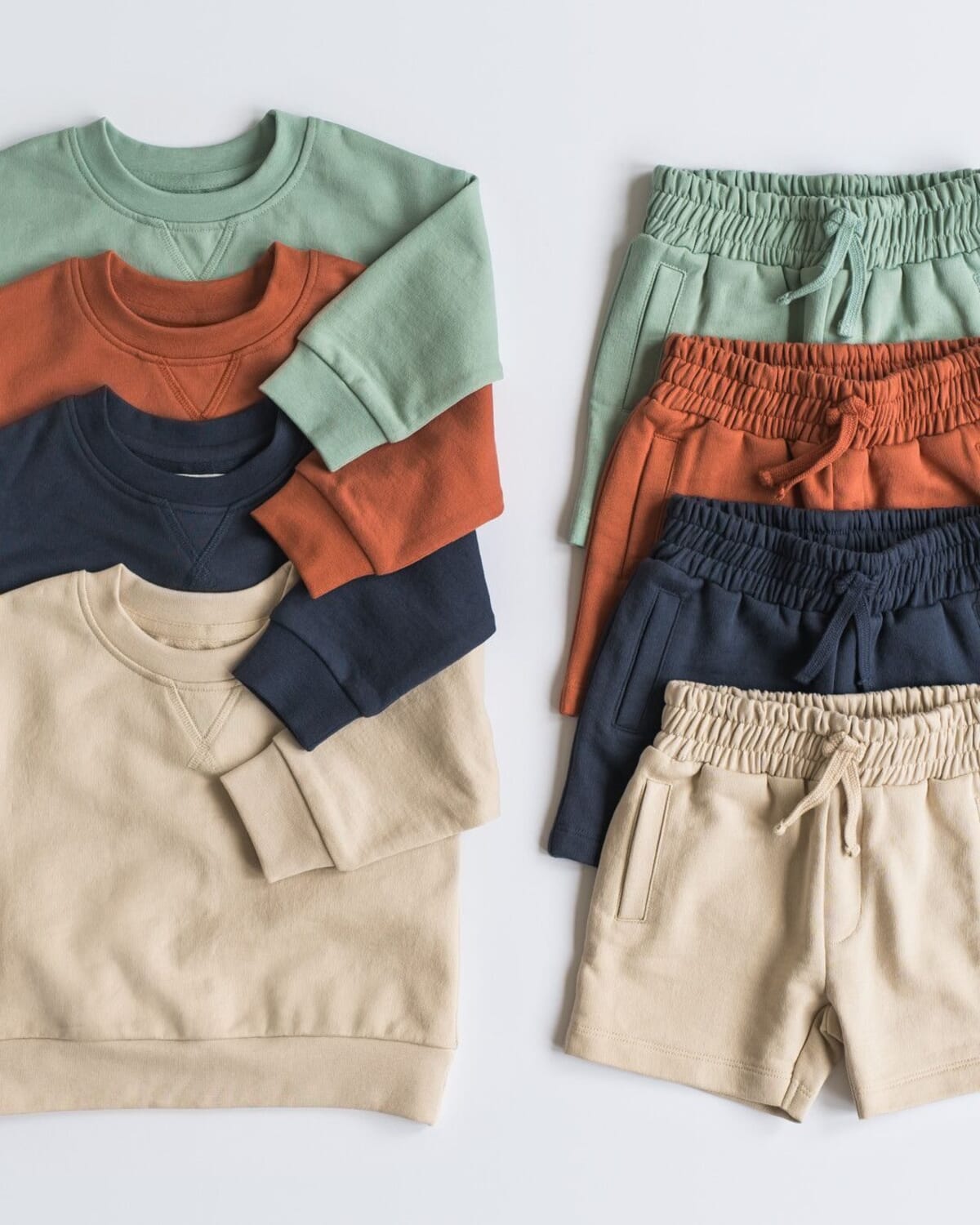
Childrenswear is the one apparel category where a design decision can be a safety matter rather than a commercial one. Cords, small parts, nightwear flammability and chemical content are all covered by rules or standards, and a factory that produces adult clothing well may have little experience of the ones that govern garments for children.
This guide covers the European rules a children's clothing manufacturer has to work to, what changes if you sell in the UK or the US, why sizing is harder than adult grading, which fabrics and constructions suit the category, how minimums behave across a long size range, and what the trade data says about babywear made in Portugal. For our production page, see kidswear manufacturer in Portugal.
What to know
- Cords and drawstrings are covered by EN 14682, which applies up to the age of 14 years. Under 7, cords in the hood or neck area are prohibited.
- Since 13 December 2024 the General Product Safety Regulation (EU) 2023/988 is the safety net for children's clothing sold in the EU.
- Children's nightwear has its own burning-behaviour standard in Europe (EN 14878) and federal flammability standards in the US.
- Chemicals: REACH Annex XVII entry 72 limits substances such as formaldehyde in clothing, and babywear usually needs the strictest OEKO-TEX class.
- Portugal exported $59.2 million of knitted cotton babies' garments in 2024 (WITS). Use a factory that has produced childrenswear before.
What safety rules govern children's clothing in Europe?
A general safety duty, one harmonised standard for cords and drawstrings, a nightwear standard and chemical limits, and they shape the design rather than the paperwork. None of this is a box to tick at the end. A hooded top drawn with a neck drawstring for a four-year-old cannot be made compliant at sampling; it has to be redrawn.
The General Product Safety Regulation
Clothing for children has no CE marking directive of its own. In the EU it falls under the General Product Safety Regulation (EU) 2023/988, which repeals the General Product Safety Directive 2001/95/EC and has applied in EU Member States since 13 December 2024. For a product to be placed on the EU market there must be a responsible economic operator in place, and online marketplaces have their own duties, including registering with the Safety Gate Portal and keeping internal processes for product safety.
Safety Gate is also the EU rapid alert system for dangerous non-food products, which lets the Commission and national authorities share information on dangerous products found on the market. Children's clothing with dangerous cords or drawstrings is a type of product that appears there. For a brand, the practical point is simple: the product you place on the market has to be safe, and showing that it meets the relevant European standard is the normal way to demonstrate it.
EN 14682: cords and drawstrings
The standard that matters most for everyday childrenswear is EN 14682:2014, Safety of children's clothing, Cords and drawstrings on children's clothing, Specifications. It sets requirements for cords and drawstrings on children's clothing, including disguise costumes and ski apparel, up to the age of 14 years.
It is a harmonised standard, cited in the Official Journal under the old directive 2001/95/EC and listed against Regulation 2023/988, and it replaced EN 14682:2007. The 2007 edition was the one the Commission assessed in Decision 2011/196/EU of 29 March 2011, which found it compliant with the general safety requirement and published its reference. A revision draft, prEN 14682, was published in April 2023, but the project was deleted on 29 January 2025, so the 2014 edition is still the one to build to.
The requirements are stricter for younger children. Under 7 years of age (up to 134 cm in height), drawstrings, functional cords and decorative cords in the hood or neck area are prohibited. Beyond hoods and necklines, the standard deals with decorative and functional cords, belts, sashes, toggles, fixed and flat loops, zip pullers, adjusting tabs, shoulder straps, lower hems, elastic cords, sleeves, halter necks and garments that finish at the ankle.
Some items are outside its scope, among them bibs, nappies and soother holders, footwear, gloves, hats, bonnets and scarves, braces, religious clothing, theatrical costumes, and bags and purses. The standard itself recommends an individual risk assessment on every garment, because it cannot cover every hazard a design might create.
The commercial consequence is that cords are a design decision. For a toddler hoodie the answer is no hood cord at all; for an older child's jacket the cord has to meet the length and position rules for that age band. Put the intended age range and the clause you are building to in the tech pack, so the factory sews to the rule and not to a sketch.
Small parts and mechanical safety
For buttons, poppers, appliques and other parts that a child could pull off and swallow, the reference document is CEN/TR 16792:2014, a technical report that gives recommendations for the design and manufacture of safe children's clothing in relation to mechanical hazards. It also covers packaging and display, and it applies to accessories such as bonnets, hats, gloves, scarves and socks.
A technical report is guidance, not a harmonised standard, but it is what test laboratories and retailers lean on. In practice that means attachment strength is tested rather than assumed: a popper is only as safe as the way it is set into the fabric, so specify the component, the reinforcement behind it and the attachment method together.
Children's nightwear and flammability
Nightwear is the part of the category with its own fire rules. EN 14878:2007 specifies requirements for the burning behaviour of children's nightwear and nightwear fabrics when tested in accordance with EN 1103 but without the washing procedure, and it was confirmed again in October 2024.
The UK has gone further for decades with the Nightwear (Safety) Regulations 1985, which set requirements for children's nightwear and labelling rules for pyjamas, babies' garments and bath robes. Their first schedule defines children's nightwear by maximum measurements, for example a nightdress up to a chest of 91 cm and a length of 122 cm.
If pyjamas, nightdresses or dressing gowns are in your range, decide the market first and choose fabric and fit with the nightwear rules in front of you. A loose, brushed cotton nightdress and a close-fitting cotton pyjama set are treated very differently, and retrofitting compliance onto a finished design is rarely possible.
Chemical content: REACH entry 72
Chemical limits apply to all clothing, children's included. Since 1 November 2020, entry 72 of REACH Annex XVII has banned placing clothing, related accessories and footwear on the market when they contain any of the carcinogenic, mutagenic or reprotoxic substances listed in its Appendix 12 at or above the set concentrations. Formaldehyde, for example, is limited to 75 mg/kg, with a temporary 300 mg/kg derogation for jackets, coats and upholstery that ended on 1 November 2023.
On top of the legal floor, babywear buyers usually ask for OEKO-TEX STANDARD 100 in Product Class 1, which covers products for babies and children up to 3 years and has the strictest requirements and limit values. Our OEKO-TEX Standard 100 guide explains the classes, and this guide compares it with GOTS and bluesign.
Labelling
Fibre composition labelling across the EU follows Regulation (EU) No 1007/2011 on textile fibre names and related labelling and marking of the fibre composition of textile products. Care labelling has to describe what the garment can really survive, and childrenswear is washed hard and often. A care instruction the fabric fails is a return you caused yourself.
What changes if you sell in the UK or the US?
The design principles are the same; the documents and some limits differ. A range built for Europe is a good start for both markets, but check each rule before you ship.
The UK
For the UK, the Nightwear (Safety) Regulations 1985 above are UK law, and if the same style also sells in the EU, design its cords to EN 14682 from the start. Brands selling there should treat nightwear labelling as a separate line in the spec, because the regulations prescribe the wording on pyjamas, babies' garments and robes.
The US
In the US, children's upper outerwear in sizes 2T to 16 with drawstrings that do not conform to ASTM F1816-97 is on the Consumer Product Safety Commission's substantial product hazard list. The hood and neck drawstring prohibition applies up to size 12, and the rule treats girls' and boys' size Large as size 12 and Extra-Large as size 16.
Children's sleepwear has two federal flammability standards: 16 CFR part 1615 for sizes 0 through 6X and 16 CFR part 1616 for sizes 7 through 14. For sizes up to 6X, sleepwear means items such as nightgowns, pajamas and robes worn primarily for sleeping, with exceptions for diapers and underwear, infant garments sized nine months or smaller, and tight-fitting garments.
If the US is a target market, tell us at the brief stage. It changes the drawstring decisions on outerwear, and for sleepwear it can change the fabric and fit of the whole style.
Why is children's sizing harder than adult sizing?
Because bodies change shape as well as size, and one size chart spans years of growth rather than a range of adult builds.
Age and height rather than measurements
Childrenswear is labelled by age, height or both, and the link between those and real body measurements varies widely between individual children. A size chart is a statement about an average that many of your customers will not fit exactly, which makes published garment measurements more important here than in adult ranges. Parents buying online use them to choose between two sizes.
Proportions change, not just dimensions
A two-year-old and a ten-year-old are not the same shape scaled up: head-to-body ratio, torso length and limb proportion all shift with age. Grading a range by uniform increments produces garments that fit in the middle of the range and badly at both ends. Baby, toddler and older children's blocks are usually developed separately for that reason, and the head opening on a toddler top is a design problem in its own right.
The range spans more sizes
A range that covers several age bands has many more sizes than an adult equivalent, which multiplies both the grading work and the number of pieces needed to stock it properly. It is one of the biggest practical differences when you plan a first childrenswear order.
Growth makes fit forgiving and unforgiving at once
Parents buy with some room for growth, so a slightly generous fit is tolerated, and they return anything tight, short in the body or restrictive at the shoulder. Knowing which way the tolerance runs is worth more than false precision in a size chart. Fit-test on children in the target age band, moving, sitting and being dressed, not only on a stand.
What fabrics suit childrenswear?
Soft, durable, washable and tested. Comfort and wash performance come before almost everything else in this category.
Softness against skin
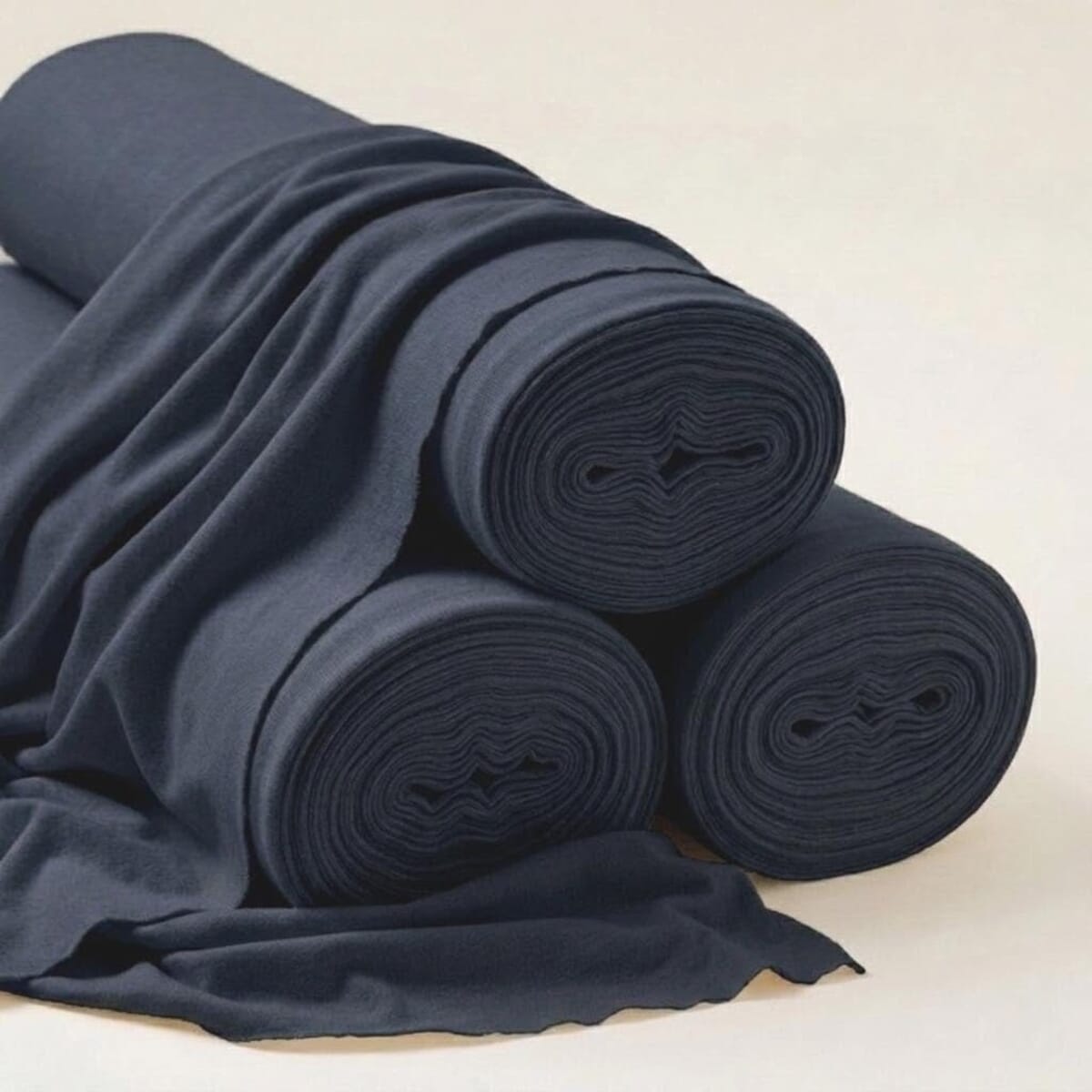
Children react to scratchy fabric, stiff seams and irritating labels quickly and visibly, and a garment that is uncomfortable will not be worn however good it looks. Soft cotton knits such as single jersey and interlock, rib for cuffs and necklines, brushed constructions and French terry for sweatshirts are the foundation of the category for practical reasons. Our guide to cotton fabric for apparel covers the qualities to ask for.
Wash durability is the real test
Children's clothing is washed often and hard. A fabric that pills, fades or loses its shape within weeks fails in exactly the way a parent notices and remembers. Wash-test the production fabric, not only the development sample, for colour fastness, pilling and dimensional change before you commit to bulk, and keep the reports with the order.
Stretch helps
A degree of stretch in a knit accommodates movement, growth and dressing a child who is not cooperating. It also widens the effective fit range of each size, which helps in a category where sizing is imprecise. Rib cuffs and waistbands do much of this work on sweatshirts and joggers.
Certification is often expected
Independent harmful-substance certification is widely held in childrenswear and is often a condition of retail listing. If you intend to sell wholesale, establish it at fabric selection; it is far harder to retrofit once a range exists. For organic claims, the fabric and every processing stage need GOTS certification, not only the yarn.
What construction details matter?
Flat seams, secure trims, easy dressing and labels that do not irritate.
Seams against skin
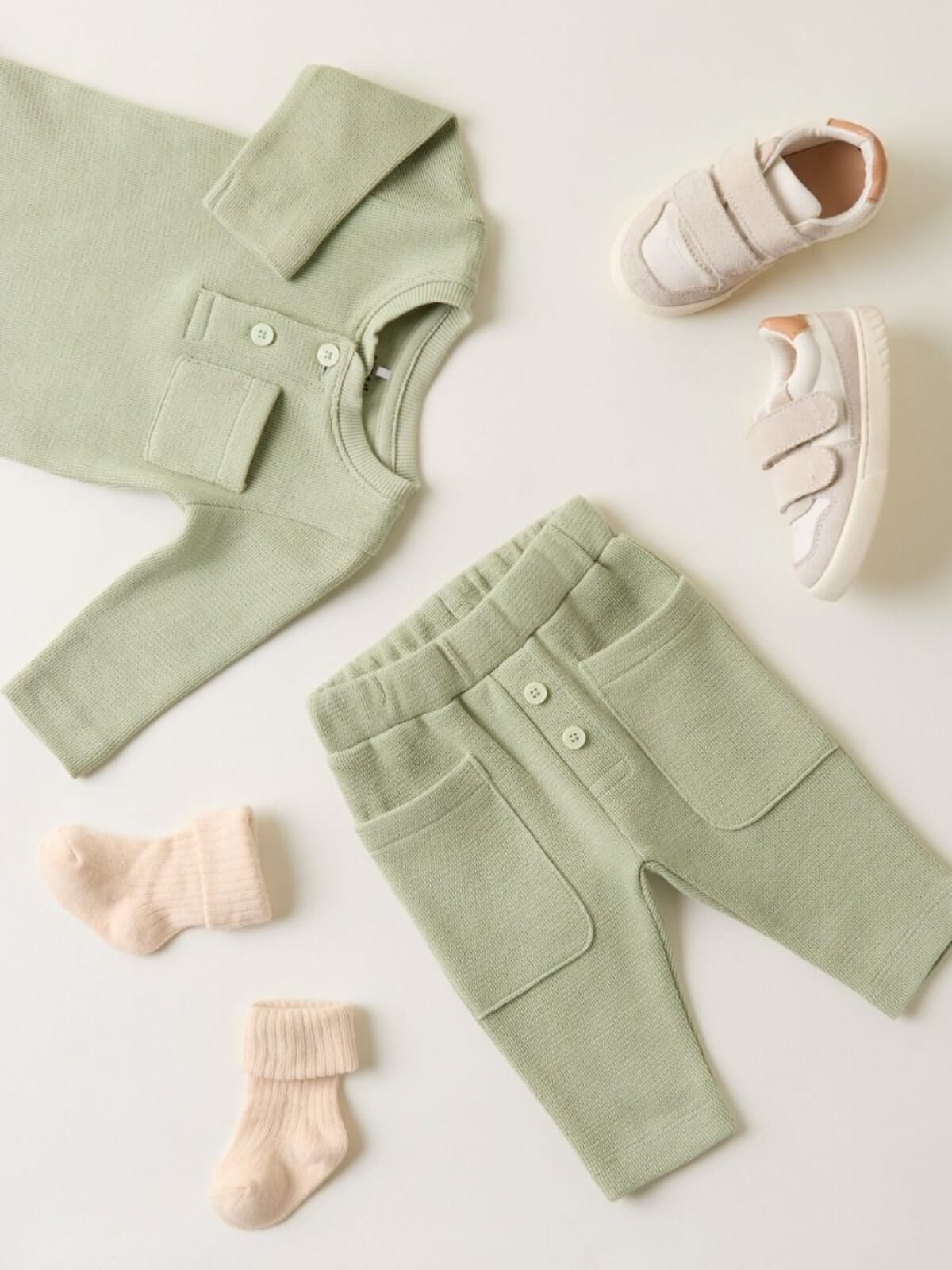
Flat, low-bulk seams matter more in childrenswear because children are less tolerant of irritation and less able to say what is wrong. Flatlock and coverstitch construction, and careful thought about where seams sit, do much of the work in whether a garment gets worn.
Openings that make dressing possible
Envelope necklines on babywear, shoulder poppers, generous head openings and front fastenings all exist because dressing a small child is a practical problem. A garment that cannot be got onto a toddler quickly is a garment parents stop reaching for.
Trims have to survive testing
Poppers, buttons and appliques need attachment strength suited to the category, which affects how they are applied as well as which ones are chosen. Specify the attachment method alongside the component, because this is where compliance and construction meet. Decorative trims that could come away, such as loose beads or sequins, are best left out of garments for the youngest age bands.
Labels are a comfort decision
A stiff woven label at the back neck is a common reason a child refuses a garment. Printed neck labels, heat transfers or a side-seam position are standard solutions in childrenswear and are worth specifying on purpose rather than defaulting to an adult convention.
What are realistic minimums in childrenswear?
Set per style and per colour as always, with the size range multiplying the quantity you need to stock properly.
Minimums attach per style and colour
As in every category, a factory quotes a minimum per style and per colourway. Across the factories in our group, minimums for cut and sew are usually 50 to 100 pieces per style and colour, confirmed per brief, because the size range, fabric and trims all move the number. That figure reflects the fixed cost of setting up a style, and it applies however many sizes the quantity is then split across. Our guide to minimum orders in Portugal explains how to read the number a factory gives you.
The size split is the real constraint
A hundred pieces spread across eight age sizes leaves about a dozen garments per size. That sells out unevenly, looks thin in stock and leaves you unable to serve the customers who wanted the sizes that went first. Childrenswear brands often need a larger total order than an adult equivalent simply to hold a credible depth in each size, and that arithmetic is better done before the order is placed than when the stock arrives.
Narrow the age range to start
Covering fewer age bands on a first range concentrates the same quantity into a workable depth per size. Proving a product across three sizes is better evidence, and better business, than spreading it thinly across eight. Our low MOQ clothing manufacturer page covers small first runs.
Colours multiply as usual
Each colourway is a separate fabric commitment and a separate setup, and in a category already stretched across many sizes the effect compounds quickly. Two colours across a narrow age range is a sensible shape for a first childrenswear order.
What should be in the tech pack?
Everything an adult tech pack contains, plus the safety detail that governs the category. Before you ask for a quote, have these settled:
- Age range and market: the age band each size is for, and whether the style is for the EU, the UK, the US or all three. This decides which cord, nightwear and labelling rules apply.
- Cords and drawstrings: position, length, ends and the age range, or a clear note that there are none. Where the rules preclude a cord, draw the alternative (elastic, a fixed tab, a popper).
- Trims and attachment: each button, popper or applique, how it is attached, and the reinforcement behind it.
- Fabric: composition, weight and construction, the certification you need (for babywear, usually OEKO-TEX Product Class 1), and the wash, pilling and colour fastness tests you expect.
- Size chart: real garment measurements per size alongside the age or height label, the sample size, and the points that stay fixed between sizes.
- Labels: fibre content, care instructions suited to the real fabric, the neck label method and position.
- Quantity and colours: pieces per style and colour, the size split, and the delivery date you are working back from.
If you do not have a tech pack yet, our tech pack service builds a factory-ready one for a single style, and our guide to ordering a clothing sample covers how to run fit rounds.
How do you choose a childrenswear factory?
By whether it has produced the category before, which is a compliance question as much as a technical one.
Ask what childrenswear it has made
A factory that regularly produces childrenswear already knows the cord rules, attachment testing and construction conventions of the category. One that has never made it will follow your specification exactly, which is only safe if the specification is complete, and first specifications in this category often are not, because the author did not know what to include.
Ask about testing
Factories that make this category use testing laboratories regularly and can tell you what will be needed and when. Ask which tests they arrange for EN 14682, attachment strength and chemicals, and when in the schedule they happen. Remember that certificates and test reports come from independent laboratories and certificate holders, so ask to see the documents for your fabric and your garment.
Check the machinery for knits
Most childrenswear is knitted, which means flatlock and coverstitch capacity rather than general woven capacity. Confirm it is present in enough quantity to run a production line, not only to sew a sample.
Ask how they handle small sizes
Very small garments are fiddly to sew, and the operations do not scale down in proportion from adult work. A factory experienced in the category handles that as routine; one adapting from adult production may find it slower and more expensive than expected. Ask to see garments from the smallest sizes they have produced, and plan final inspection across sizes, as our guide to quality control in Portuguese clothing production explains.
What does the trade data say about babywear from Portugal?
A steady export line in knitted cotton babywear, sold mostly to neighbouring European markets. Customs data has a separate heading for babies' garments, so it gives a clearer picture of this part of the category than of older children's clothing, which is mixed in with adult lines.
According to WITS, which publishes UN Comtrade data, Portugal exported $59.2 million of babies' garments and clothing accessories of cotton, knitted or crocheted (HS 611120) in 2024. The value has moved between $59.2 million (2024) and $78.9 million (2021) since 2019, when it was $60.3 million.
By weight, Portugal shipped 1,553,570 kg of this line in 2019 and 1,424,890 kg in 2023, so the average export value rose from about $38.80 to about $48.32 per kg. Treat that as a direction, not a price list: the figures are export values in current US dollars, and the line mixes bodysuits, sleepsuits, sets and accessories.
Spain took $17.08 million in 2024, about 29% of the total, followed by Italy ($12.29 million), France ($10.68 million), the Netherlands ($4.91 million) and the United Kingdom ($3.65 million).
Two other customs lines complete the picture. Woven cotton babies' garments (HS 620920) came to $20.2 million in 2024, and Portugal's knitted synthetic babywear (HS 611130) came to $12.0 million in 2024. Together the three lines add up to about $91.4 million.
For a brand, the reading is simple. Portuguese babywear is built on knitted cotton and sold mainly within Europe, which is where most of the production knowledge in the region sits. Knitting, dyeing, finishing and sewing are close together in the north of the country, and a European brand selling into the EU works to one set of safety and chemical rules. Our page on the Portuguese textile industry in numbers gives a wider view of the sector.
What mistakes do brands make in childrenswear?
Designing before reading the safety rules, spreading a first order too thin, and treating it as small adult clothing.
Designing the cord in first
A hooded top drawn with a neck drawstring and sent to a factory produces a compliance problem discovered at sampling rather than at design. The rules are published, and reading them before drawing is the cheapest possible fix.
Splitting a first order across too many sizes
A hundred pieces across eight age bands leaves about a dozen garments per size, which sells out unevenly and looks unconvincing. Narrowing the age range concentrates the same quantity into a stockable depth.
Assuming adult grading transfers
Children's proportions shift with age rather than scaling, so a range graded by uniform increments fits the middle and fails the extremes. This needs proper grading work, not an adaptation of an adult block.
Forgetting which market the garment is for
A style built for the EU can still fail in the US on drawstrings or sleepwear flammability, and UK nightwear needs its own labels. Decide the markets before the first sample, not when a retailer asks for the test report.
Under-testing the fabric
Frequent, hot washing exposes pilling, fading and shape loss quickly, and parents notice. Wash-test the production fabric before committing, because durability is a large part of what a parent is paying for.
How do you plan a childrenswear range?
Around a narrow age band, a few core garments, and repeat purchase driven by growth rather than by season.
Growth drives the repeat purchase
Children outgrow clothing on a schedule unrelated to fashion seasons, so a parent who liked a garment comes back for the next size up rather than for something new. That rewards brands that keep a core product available continuously rather than replacing the range each season, and it makes reliable restocking more valuable than a big seasonal drop.
Core garments before collections
A small number of well-made essentials that parents buy again in successive sizes is a stronger starting position than a broad seasonal range. It also concentrates the production quantity into fewer styles, which solves the depth problem a wide childrenswear range creates. Our guide to small batch clothing production in Portugal shows how to plan a first small run.
Decide the age band deliberately
Babywear, toddler and older children's clothing are different products, with different construction conventions, different safety rules (the under-7 cord rule is one example) and different buying behaviour. Attempting all three in a first range multiplies the development work and spreads the order across so many sizes that none of them stocks properly.
Plan the size-up path
If a customer's child outgrows your largest size and you have nothing above it, you lose the customer at the moment they were most loyal. Knowing where your range ends, and whether you intend to extend it, is a commercial decision worth making early.
Working with Portugal Clothing Factory
Our team places and manages clothing production with factories in our group in the northern Portuguese textile cluster, including partner factories that make kidswear in jersey, fleece, knitwear and wovens. For childrenswear the first useful questions are which factory has produced the category before and whether your design clears the safety rules for the age band and market, because both decide whether the rest is worth discussing. We place the brief with a factory that runs that kind of work and stay involved through sampling, testing and delivery. Testing and certificates come from independent laboratories and the certificate holders, never from us. The kidswear manufacturer in Portugal page covers the kidswear briefs we take.
Across our group, minimums are usually 50 to 100 pieces per style and colour, quoted per brief. We agree our fee in writing, take no commission on production, and the partner factory invoices the production.
Get in contact with the item, the age range, the market, the quantity and the timeline. Our team replies within 24 hours.
Frequently asked questions
What safety rules apply to children's clothing in the EU?
The General Product Safety Regulation (EU) 2023/988, which has applied since 13 December 2024; EN 14682 for cords and drawstrings up to 14 years; EN 14878 for the burning behaviour of children's nightwear; and REACH Annex XVII chemical limits, including entry 72 for clothing.
Why can't children's hoodies have neck drawstrings?
Cords at the neck present a strangulation risk. Under EN 14682, drawstrings, functional cords and decorative cords in the hood or neck area are prohibited on garments for children under 7 years (up to 134 cm), and older age bands have limits on length and position.
Is EN 14682 still the current standard?
Yes. EN 14682:2014 is the published edition and a harmonised standard. A revision draft, prEN 14682, was published in 2023, but the project was deleted in January 2025.
Do US rules on children's drawstrings differ?
Yes. Children's upper outerwear in sizes 2T to 16 with drawstrings that do not conform to ASTM F1816-97 is on the CPSC substantial product hazard list, and the hood and neck drawstring ban applies up to size 12.
How is children's clothing sized?
By age, height or both. Because children vary widely against those averages, publishing real garment measurements alongside age labels helps parents choose and reduces returns.
What minimums should I expect for childrenswear?
Minimums attach per style and per colourway. Across our group they are usually 50 to 100 pieces per style and colour, quoted per brief. The size range is the real constraint, because that quantity split across many age bands leaves few pieces per size.
Which OEKO-TEX class does babywear need?
Product Class 1, which covers products for babies and children up to 3 years and has the strictest requirements and limit values.
Can any clothing factory make childrenswear?
Many can sew it, but the ones that have produced it before know the cord rules, attachment testing and construction conventions without being told. That experience matters in a category governed by safety standards.
Our team places and manages clothing production with factories in our group in northern Portugal, usually from 50 to 100 pieces per style and colour. Tell us your product, fabric, volume and timeline, and we reply within 24 hours. Fee agreed in writing, no commissions.
Send your brief Portugal factory directory (€49)No tech pack yet? We prepare one style, factory-ready, for €79. What it includes.
Sources
- EN 14682:2014, Safety of children's clothing, Cords and drawstrings on children's clothing, Specifications: scope, exclusions and status; revision project prEN 14682: status (Genorma).
- ProductIP, Dangerous drawstrings and cords (age bands and covered features of EN 14682).
- Commission Decision 2011/196/EU of 29 March 2011 on EN 14682:2007 (legislation.gov.uk).
- Office for Product Safety and Standards (GOV.UK), EU Regulation 2023/988 on General Product Safety: detailed guidance; European Commission, Product safety and Safety Gate.
- CEN/TR 16792:2014, mechanical safety of children's clothing (Genorma).
- EN 14878:2007, burning behaviour of children's nightwear (Genorma).
- The Nightwear (Safety) Regulations 1985 (legislation.gov.uk).
- eCFR: 16 CFR part 1120, substantial product hazard list; 16 CFR part 1615, children's sleepwear sizes 0 through 6X; 16 CFR part 1616, sizes 7 through 14.
- Commission Regulation (EU) 2018/1513, Annex, adding entry 72 to REACH Annex XVII (legislation.gov.uk).
- OEKO-TEX STANDARD 100, product classes.
- Regulation (EU) No 1007/2011 on textile fibre names and labelling (legislation.gov.uk).
- WITS (World Bank), UN Comtrade data: Portugal exports of HS 611120 by partner, 2019, 2020, 2021, 2022, 2023, 2024; HS 620920, 2024; HS 611130, 2024.
Portugal Clothing Factory places and manages clothing production with factories in our group in the northern Portuguese textile cluster. We agree our fee in writing, reply within 24 hours, and stay involved through sampling, quality control and delivery. See how we work or get in contact.