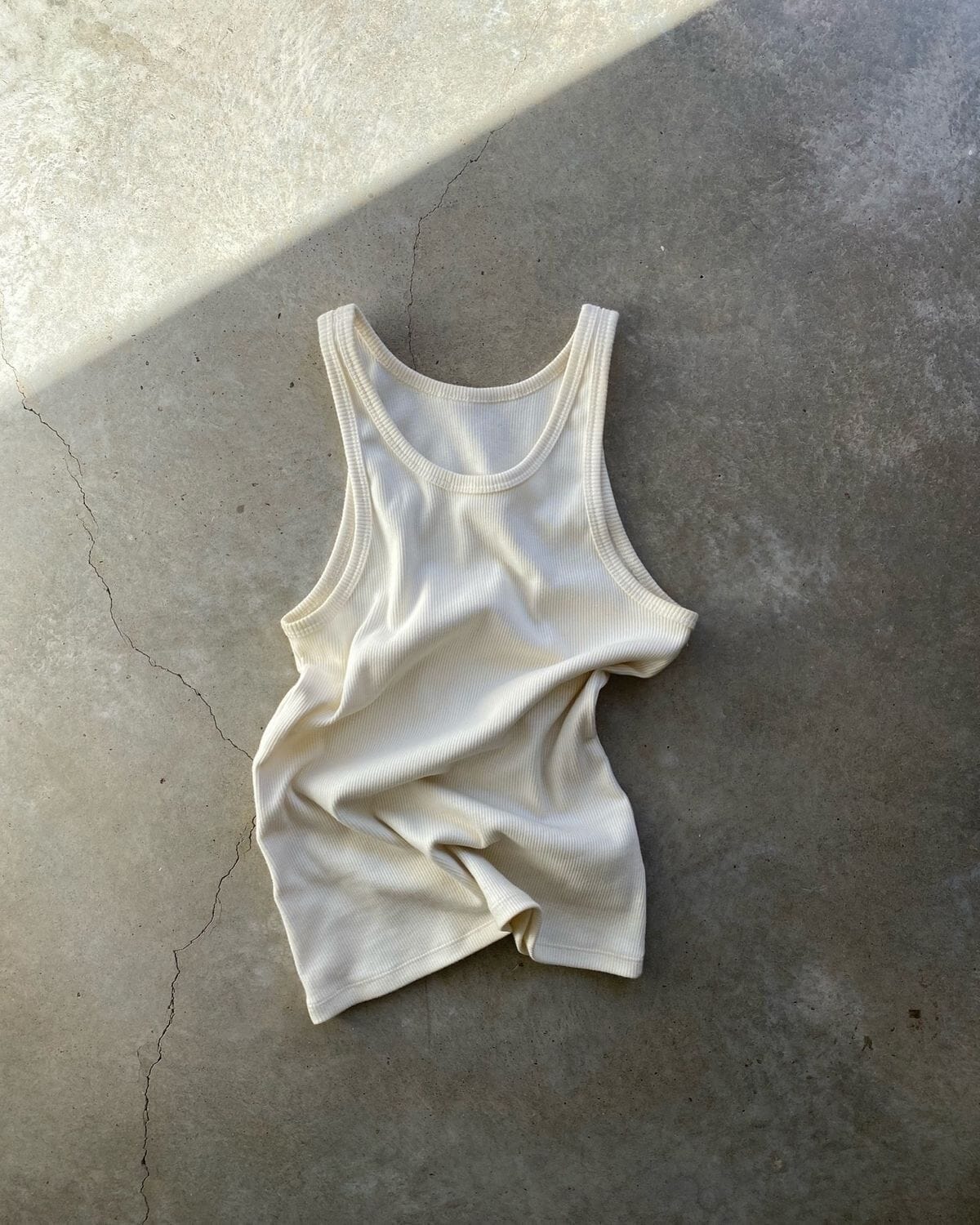
A tank top has fewer operations than almost any other garment in a range, and that is exactly why it is easy to get wrong. With no sleeves, collar or pockets to look at, the eye goes straight to three things: the fabric, the armholes and the neckline. If the rib is too thin, the binding ripples or the side seam swings to the front after the first wash, there is nothing else on the garment to distract from it.
This guide is for brands that want their own tank top made to their own pattern, not a printed stock blank. It covers the choice between rib and jersey, the ways to finish an armhole and a neck, the silhouettes and what each one asks of the pattern, side seams versus tubular bodies, spirality (the twist that moves side seams), the laboratory tests to name in a brief, what the official trade data says about this product group in Portugal, and how to plan a small first order. If you also make t-shirts, our custom t-shirt manufacturing guide covers the shared decisions; this page stays on what is specific to tanks.
What to know
- The armhole is the garment. Decide bound, banded or turned-and-stitched before sampling, and write the finished width and the stitch on the tech pack.
- Rib and jersey behave differently. Rib grips the body and recovers; single jersey drapes but curls at cut edges and is more prone to twist.
- Spirality moves side seams. Name a spirality test (ISO 16322-1 for weft-knitted jersey garments, or ISO 16322-2 for the fabric) with a pass mark.
- Test after washing, not before: dimensional change (ISO 5077 with ISO 6330 wash procedures), colourfastness to washing (ISO 105-C06) and to perspiration (ISO 105-E04).
- A first run can be small. Our minimums are 50 to 100 pieces per style and colour, and we can be flexible; fewer colours and a weighted size run keep it sensible.
Why is a tank top harder to make than it looks?
Because every edge is on show. A t-shirt hides its body seams under the arm and its hem at the hip, and a sleeve frames the shoulder. A tank top has two long curved armholes and a deep neckline, all cut on stretch fabric, all finished with a strip of fabric or a fold that has to lie flat around a curve. That is the hardest thing a knit sewing line does routinely, and on a tank it is most of the garment.
Curves on stretch fabric
An armhole on a tank is a deep curve that changes direction under the arm. When a binding or band is sewn around it, the binding has to be slightly shorter than the edge it covers so that it pulls the curve in and sits flat against the body. Too little tension and the edge gapes or waves; too much and it puckers or twists the strap. The right ratio depends on the fabric, the binding and the depth of the curve, which is why it is settled on the sample and then written down, not left to each operator on the line.
The fabric does all the work
With so little construction, almost everything the customer notices comes from the cloth: its hand, its opacity, how it recovers after being stretched over the shoulder, how the colour holds after washing and sweat. A tank in a thin, loosely knitted fabric looks cheap however well it is sewn. A tank in a good rib, cleanly bound, looks considered even in a plain colour. Spend the development time on the fabric and the edges.
Little cloth per piece
A tank uses less fabric than a t-shirt of the same size, so a knitting or dyeing minimum turns into a large number of finished garments. That is good news for a first order: the fabric minimum is rarely what stops a tank programme. Trims, labels, a custom colour or a specialist yarn are more likely to set the quantity.
Rib or jersey: which fabric should a tank top use?
Most tank tops are made from one of three knitted structures. The choice decides the fit, how the edges behave and how much the garment twists, so make it first and test it before anything else.
| Fabric | How it behaves | Typical tank use |
|---|---|---|
| Single jersey | Smooth face, drapes, stretches mostly across the width; cut edges curl | Relaxed and boxy tanks, muscle tanks, printed tanks |
| 1x1 rib | Same on both faces, strong crosswise stretch and recovery, edges lie flat | Fitted womenswear tanks, classic ribbed vests, bindings |
| 2x2 rib | More pronounced ribs, more grip and bulk than 1x1 | Statement ribbed tanks, heavier fitted styles |
| Interlock | Double knit, smooth on both faces, stable, does not curl | Clean, structured tanks; lined or reversible styles |
Construction behaviour as commonly described for weft-knitted fabrics; confirm the hand and weight on a swatch from the actual mill.
When to choose rib
Rib is the natural fabric for a fitted tank. Its alternating ribs pull inward, so the garment hugs the body and returns to shape after being pulled over the head. It also lies flat at a cut edge, which makes bindings and turned edges easier to sew neatly. The trade-off is that rib narrows a lot in finishing and grows in length when worn, so the pattern must be made for the finished rib, not for a jersey version of the same style. Our guide to rib knit explains the variants in more detail.
When to choose jersey
Single jersey suits relaxed tanks, muscle tanks with a dropped armhole and anything that carries a large print, because its smooth face takes print well. It is lighter and drapes more, but it curls at a cut edge and is the structure most prone to spirality, so the finish and the fabric source matter more. Our guide to jersey fabric covers how it is knitted.
Weight, composition and stretch
State the finished fabric weight in grams per square metre with a tolerance, the full fibre composition and whether the fabric includes elastane. A small elastane content improves recovery in rib and keeps a fitted tank from bagging at the hem, but it changes how the fabric is dyed and finished and it must appear on the label. For weight ranges and how GSM is measured, see our GSM guide. Ask the mill for a swatch from current stock, not an archive card, and approve colour on that fabric.
Tubular or open-width fabric
Circular knitting machines produce a tube. The mill can finish and deliver it as a tube, or slit it open and finish it flat. Open-width fabric is cut like any other cloth, with side seams. Tubular fabric can be cut so that the body has no side seams at all, which is the classic construction of a plain ribbed vest. Each option has consequences for fit, sizing and twist, covered below.
How should the armholes and neck be finished?
There are four common ways to finish a tank edge. Each looks and wears differently, uses different machines and suits different fabrics. Name the one you want, with a photo of the edge itself, not of the whole garment.
| Finish | What it is | Look and wear | Write on the tech pack |
|---|---|---|---|
| Bound | A strip of rib or self-fabric folded over the raw edge and stitched through, usually with a coverstitch | Narrow, clean, stable; the classic ribbed vest edge | Finished binding width, binding fabric, stitch type and stitch colour |
| Banded | A folded band sewn to the edge with an overlock seam, then often topstitched | Wider, sporty, slightly heavier | Band width, seam allowance, whether topstitched and how far from the seam |
| Turned and stitched | The edge folded under once or twice and stitched, often with a twin needle or coverstitch | Soft, minimal, casual; can wave on very stretchy fabric | Turn width, stitch type, needle gauge if twin needle |
| Cut edge | Left raw, relying on a fabric that does not fray or curl | Deliberately unfinished; only works on suitable knits | Confirm the fabric was tested for curl and laddering after washing |
Finishes as used on knitted tops; stitch names vary between factories, so agree them on the sample.
Binding tension and width
For a bound or banded edge, two numbers decide the result: the finished width of the binding and how much shorter it is cut than the edge it covers. The first is a design decision; the second is found on the sample and then recorded. Ask the factory to note the binding cut length for each size on the approved sample, because a ratio that works at the base size may need adjusting at the largest and smallest sizes, where the curve is longer or tighter.
The strap and the armhole depth
Strap width at the shoulder, armhole depth from the shoulder point and neck drop at the front and back are the three measurements that define a tank on the body. A narrow strap with a deep armhole reads as a gym or beach piece; a wide strap with a higher armhole reads as a layering vest. Give each one a measurement and a tolerance in the size chart, and check them on a fit model, because a few millimetres at the underarm decides whether a bra strap or the side of the chest shows.
Where the binding joins
A binding sewn around a closed armhole has to start and finish somewhere. Most factories place the join at the side seam or under the arm, where it is least visible. On a tubular body with no side seam, the join position must be specified, or it will move from piece to piece. Say where you want it and how the overlap should be finished.
Which tank top silhouettes need which pattern decisions?
The silhouette changes more than the look. It changes the fabric you need, the finish that works and the measurements you must control.
Classic tank
A scoop or round neck with straps of moderate width and a standard armhole. It works in rib or jersey with any finish. The main control points are the neck drop, the strap width and the body length, and whether the hem is straight or slightly curved.
Racerback
The straps meet between the shoulder blades, leaving the shoulders open. The back armholes become long, steep curves, which makes binding tension critical: a racerback with a loose binding stands away from the back. Rib or a jersey with elastane recovers better here. Specify the width of the racer at its narrowest point and check it on a moving body, not only on a stand.
Muscle tank and dropped armhole
A boxy body with a very deep armhole that can reach far down the side seam. It needs a heavier, more stable jersey or it will sag and twist, and the deep armhole usually takes a turned edge or a band rather than a fine binding. Control the armhole depth carefully: a small change is very visible on this cut.
Singlet and vest
A close-fitting vest, often in fine rib, worn alone or as a layer. Many are made on a tubular body without side seams. The fabric quality is everything, and because it is worn against the skin, colourfastness to perspiration and a skin-contact certification are worth naming in the brief.
Cropped and longline
Changing the length moves the hem relative to the waist and hips, so a cropped rib tank and a longline jersey tank need different hem finishes and different tolerances. State the length from the high point of the shoulder, and grade it per size rather than adding the same amount to every size.
Side seams or a tubular body?
A tubular body is cut from fabric knitted as a tube of roughly the garment width, so the body has no side seams. It gives a clean, seamless look and nothing can rub at the side, which is why it is traditional for ribbed vests and singlets. The limits are practical: each size needs a tube of a suitable width, the fit is set by the fabric rather than by shaping at the side, and there is no seam to keep the garment straight if the fabric twists.
A cut-and-sew body with side seams can be shaped at the waist and graded freely, and it can use open-width fabric of any width. The side seam is also the line that shows twist most clearly, because a seam that should run straight down from the underarm is easy to see when it moves toward the front. Choose tubular when a seamless look matters and the size range is modest; choose side seams when you need shaping, a wide size range or a fabric that only comes open-width.
What is spirality and how do you stop side seams twisting?
Spirality, also called torque, is the tendency of knitted fabric to twist after washing so that the vertical lines of loops (the wales) lean instead of running straight. In a garment it shows as a side seam that swings toward the front or back, or a hem that no longer hangs level. It is one of the most common complaints on jersey tops, and a tank, with its long visible side seams and nothing else to hold it straight, shows it clearly.
The standards body description is blunt about the effect. BSI's page for ISO 16322-2 says that after washing, one of the side seams can come to the front of the garment, and that spirality depends on fabric torque and garment structure. It also notes that spirality causes seams to shift during making up and patterns to look misaligned because the wales are skewed.
The standards to name
- ISO 16322-1 measures the percentage of wale spirality change in weft-knitted jersey garments after laundering, from measurements taken before and after washing; BSI lists its 2005 edition as current.
- ISO 16322-2 measures the spirality or torque of woven and knitted fabrics after domestic laundering, with three marking procedures: diagonal, inverted-T and mock-garment.
- Like the other parts, it measures spirality after laundering, not as the fabric is made.
- ISO 16322-3, the garment method for woven and knitted garments, is shown by BSI as withdrawn on 5 May 2021; its scope noted that garments made from circular-knitted fabric may have wales that are not vertical to begin with.
For a jersey tank, ask for the garment to be tested to ISO 16322-1 at bulk and agree a maximum change before production, and ask the mill for a fabric result to ISO 16322-2 when you approve the cloth. Results from different procedures may not be comparable, so name the method and keep it the same for every order.
What reduces twist
- Choose the fabric for it. Rib and interlock are balanced structures and twist much less than single jersey. If the style needs jersey, ask the mill what it does to control torque.
- Finish the fabric properly. Relaxing, compacting and setting the fabric at the mill reduce later shrinkage and twist. Ask for a dimensional and spirality result on the finished fabric, not the greige.
- Cut on the wale. Lay markers so the centre front follows the wales of the fabric as finished, and check that the fabric has not been pulled off grain on the roll.
- Wash the sample before you approve it. Approve the pre-production sample after a wash at the care label setting, and look at the side seams on a body.
Which tests should a tank top pass?
A tank is washed often and worn against the skin, frequently during exercise. Name the tests in the brief, each with a pass mark agreed before sampling, so that the factory and the laboratory test the same thing on every order. The descriptions below come from the bodies that publish or sell the standards.
- ISO 5077 specifies a method for determining the dimensional change of fabrics, garments or other textile articles after a specified combination of washing and drying procedures, and ISO 6330 specifies the domestic washing and drying procedures used for textile testing (the BSI page for the 2012 edition shows it withdrawn on 21 Dec 2021, so ask the lab which edition it applies).
- ISO 105-C06 covers resistance of colour to domestic or commercial laundering, using a reference detergent.
- ISO 105-E04 specifies a method for determining the resistance of the colour of textiles of all kinds and in all forms to the action of human perspiration. For a gym or summer tank this matters as much as washing.
- A spirality method from the ISO 16322 series, as above, with a maximum change agreed for the style.
OEKO-TEX STANDARD 100 sets stricter requirements the more intensive the skin contact: Product Class 1 is for babies and children up to 3 years and has the strictest limits, and Product Class 2 covers products with direct skin contact. Adult tanks have direct skin contact, so Product Class 2 is the class to ask for; a tank for babies or toddlers falls under Product Class 1. Our OEKO-TEX STANDARD 100 guide explains how to check a certificate.
Standards as described by BSI, the Estonian Centre for Standardisation and OEKO-TEX, read 20 November 2026.
The label, if you sell in the EU
The EU's Your Europe guidance says every textile product must be labelled or marked to show its fibre composition when it is marketed in the EU, with labels firmly attached, for example sewn in, for products made of at least 80% textile fibres by weight. The composition must be written in decreasing percentage order. Many tanks use a printed neck label instead of a sewn tag to avoid irritation at the back of the neck; the composition still has to be there, legibly. The text must be translated into the official languages of each country where the product is sold to consumers.
What should a tank top tech pack include?
A tank tech pack is short, but every line in it carries weight. The table lists what to state and why it matters on this garment in particular. A complete pack is what lets a factory quote properly and lets you hold the second order to the first. If you do not have one yet, Get a factory-ready single-style tech pack for €79.
| Item | What to state | Why it matters on a tank |
|---|---|---|
| Fabric | Structure (jersey, 1x1 rib, 2x2 rib, interlock), composition, finished GSM with tolerance, tubular or open width | Sets fit, opacity and twist |
| Edge finish | Bound, banded, turned or cut edge, finished width, stitch type and colour | The most visible detail of the garment |
| Binding | Fabric and cut length per size, recorded from the approved sample | Controls gaping and puckering around the curves |
| Key measurements | Strap width, armhole depth, front and back neck drop, body length, chest and hem width, with tolerances | Small changes here are visible on the body |
| Construction | Side seams or tubular body, seam type, position of binding joins | Decides seam comfort and where twist shows |
| Tests | ISO 5077 with ISO 6330, ISO 105-C06, ISO 105-E04, ISO 16322 method, each with a pass mark | Makes quality enforceable on every order |
| Labels and print | Sewn or printed label, label position, print method, position and size | Neck comfort and the EU composition rule |
| Packing | Fold, bag, size sticker, carton contents | Avoids rework at the warehouse |
Our checklist for tank top tech packs.
Our tech pack service page explains what a factory-ready pack contains.
What does trade data say about tank tops made in Portugal?
Customs statistics do not separate tank tops. In customs classification they fall under heading 6109 with t-shirts: HS 610910 covers T-shirts, singlets and other vests of cotton and HS 610990 covers T-shirts, singlets and vests of other textiles. The figures below therefore describe the whole t-shirt, singlet and vest group, not tanks alone, and they show export value, not what any particular brand paid.
According to World Bank WITS (UN Comtrade), Portugal exported $683.3 million of cotton T-shirts, singlets and vests in 2024, about 79.2 million pieces, against $729.0 million and about 117.0 million pieces in 2019. That is an average export value of about $8.62 a piece in 2024, up from about $6.23 a piece in 2019.
Spain took $175.7 million of Portugal's cotton T-shirts, singlets and vests in 2024, about 25.7% of the total, and the top five destinations, all European, took about 74.9%. Spain, France, Italy, Germany and the Netherlands are all close markets, which suits a product that sells in a short warm-weather season and benefits from quick restocks.
Exports of the same garments in other textiles (HS 610990) were $136.0 million in 2024, down from $237.6 million in 2019. The cotton code is about five times the size of the code for other fibres, so for tops made in Portugal cotton is the norm and synthetic or blended jersey is the exception.
Behind those exports sits a large knitting and garment industry. GEE, the strategy and studies office of Portugal's economy ministry, counted 12,222 textile and clothing companies in Portugal in 2022, employing 128,089 people. It reports that they are mostly in the North, concentrated in the Ave and Cávado regions. The tank tops in those figures come from the same jersey and rib lines that make t-shirts, which is why a tank is normally developed alongside a t-shirt programme rather than in a separate factory.
How do you plan a small first order of tank tops?
A first tank order should prove the product, not stock a warehouse. These steps keep it small without making it fragile.
One fabric, few colours
Each colour usually carries its own dyeing minimum and its own count against the garment minimum. Start with one fabric in two or three colours that sell, rather than six colours of everything. Across the factories in our group, minimums are 50 to 100 pieces per style and colour, and we can be flexible. A tank uses little fabric, so you can usually stay within that range without the fabric minimum forcing you higher.
Weight the size run
Split evenly across a full size range, a small order leaves a handful of pieces per size and sells out in the middle while the ends sit. Use what you know about your customers, even from other products, to weight the run, and think about whether a fitted rib tank needs the same range as a relaxed jersey one.
Develop in the right order
- Fabric first: approve the knit, weight and colour on a swatch, with a dimensional and spirality result from the mill.
- Fit sample: check strap width, armhole depth and neck drop on a body, and settle the binding ratio.
- Wash the sample: wash it at the care label setting and check shrinkage, twist and the edges again.
- Size set: check the smallest and largest sizes, where binding and armhole problems usually appear first.
- Pre-production sample: approve it in the bulk fabric, with the test results attached, and keep one each.
Plan for the season
Tanks sell hardest in a short warm-weather window. Work back from the date you want stock, leave time for a second sample round, and plan the reorder before the first order ships, so that a style that sells can be restocked while the season is still running. A sealed reference sample and written specifications are what make that reorder identical to the first.
Working with Portugal Clothing Factory
Our team places and manages tank top production with factories in our group in the northern Portuguese textile cluster, on the same jersey and rib lines that make t-shirts, so tanks and tees can be developed together. For a tank, we settle the fabric, the edge finish and the tests with the factory before sampling, and we check the washed sample before anything goes to bulk. Our tank top manufacturing in Portugal page describes the tank styles we work on.
The factory invoices the production directly, so you always know which company makes your goods. We agree our fee in writing and take no commission on production. Get in contact with the style, fabric, edge finish, quantity and timeline. Our team replies within 24 hours.
Frequently asked questions
What fabric is best for a tank top?
For a fitted tank, 1x1 or 2x2 rib, because it grips the body, recovers after stretching and lies flat at cut edges. For a relaxed or printed tank, single jersey. Interlock suits clean, structured styles. State the finished weight, composition and any elastane in the brief.
What is the difference between a bound and a turned armhole?
A bound armhole wraps the raw edge in a strip of rib or self-fabric and stitches through it, giving a narrow, stable edge. A turned armhole folds the edge under and stitches it, which is softer and more casual but can wave on very stretchy fabric.
Why do the side seams on my tank top twist after washing?
That is spirality, or torque: the knitted fabric twists after laundering so the wales lean and the side seam swings toward the front. Choose a balanced fabric such as rib or interlock, or a well-finished jersey, cut on the wale and test the garment to a method in the ISO 16322 series with an agreed pass mark.
Should a tank top have side seams?
Side seams allow shaping, any fabric width and a wide size range. A tubular body with no side seams gives a clean, seamless look and is traditional for ribbed vests, but each size needs a suitable tube width and there is no seam to hold the garment straight.
Which tests should I name for tank tops?
Dimensional change (ISO 5077 with ISO 6330 wash procedures), colourfastness to washing (ISO 105-C06) and to perspiration (ISO 105-E04), a spirality method from ISO 16322, and OEKO-TEX STANDARD 100 Product Class 2 for adult skin contact, each with a pass mark.
What is the minimum order for custom tank tops?
Across the factories in our group, minimums are 50 to 100 pieces per style and colour, and we can be flexible. A tank uses little fabric, so trims, labels or a custom colour are more likely than the fabric to set the quantity.
Are tank tops counted separately in trade statistics?
No. They fall under HS heading 6109 with t-shirts, singlets and other vests, so export figures describe the whole group, not tank tops alone.
Our team places and manages tank top and clothing production with factories in our group in northern Portugal, usually from 50 to 100 pieces per style and colour. Tell us your style, fabric, edge finish, volume and timeline, and we reply within 24 hours. Fee agreed in writing, no commissions.
Send your brief Get a tech pack (€79)No tech pack yet? We prepare one style, factory-ready, for €79. What it includes.
Sources
- BSI Knowledge, BS ISO 16322-1:2005; BS ISO 16322-2:2021; BS ISO 16322-3:2005 (withdrawn).
- BSI Knowledge, BS EN ISO 5077; BS EN ISO 6330 (check the current edition); BS EN ISO 105-E04.
- Estonian Centre for Standardisation, EVS-EN ISO 105-C06:2010.
- OEKO-TEX, STANDARD 100 and its product classes.
- European Union, Your Europe, Textile label.
- GEE (Gabinete de Estratégia e Estudos), Estudos Setoriais 2030: Indústria Têxtil e do Vestuário (2024).
- World Bank WITS (UN Comtrade), Portugal exports of HS 610910, 2019.
- World Bank WITS (UN Comtrade), Portugal exports of HS 610910, 2020.
- World Bank WITS (UN Comtrade), Portugal exports of HS 610910, 2021.
- World Bank WITS (UN Comtrade), Portugal exports of HS 610910, 2022.
- World Bank WITS (UN Comtrade), Portugal exports of HS 610910, 2023.
- World Bank WITS (UN Comtrade), Portugal exports of HS 610910, 2024.
- World Bank WITS (UN Comtrade), HS 610990, 2019, HS 610990, 2024.
Portugal Clothing Factory places and manages clothing production with factories in our group in the northern Portuguese textile cluster. We agree our fee in writing, reply within 24 hours, and stay involved through sampling, quality control and delivery. See how we work or get in contact.